

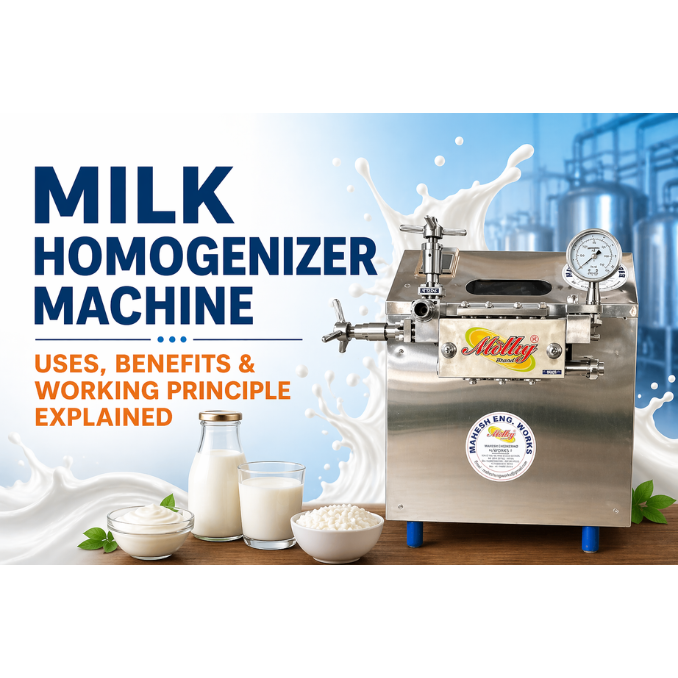
India’s dairy processing industry is evolving rapidly. As consumer demand shifts toward consistent, longer-lasting, value-added dairy products full-cream milk, flavored milk, UHT milk, yogurt, ice cream processors at every scale are investing in advanced equipment. At the center of this shift is the milk homogenizer machine, a critical piece of dairy processing technology that transforms raw, unstable milk into a uniform, shelf-stable product. This guide explains everything: how it works, what it costs, and how to choose the right one.
What Is a Milk Homogenizer Machine?
A milk homogenizer is a high-pressure mechanical device that breaks down fat globules in milk into uniformly tiny particles typically reducing them from 2–10 microns to 0.2–2 microns and distributes them evenly throughout the liquid so cream never separates again.
Key components:
- High-pressure pump — Forces milk through the system at 150–300 bar pressure
- Homogenizing valve — The core component where fat globule disruption occurs
- First-stage valve — Primary disruption of fat clusters
- Second-stage valve — Breaks up any reaggregated clusters for uniform distribution
- Pressure gauge & controls — Monitors and regulates operating pressure
Working Principle of a Milk Homogenizer (Detailed)
Homogenization works through three simultaneous physical forces applied as milk is forced at extreme pressure through a narrow valve gap:
1. Turbulence — High-velocity flow creates chaotic mixing that tears fat globules apart
2. Cavitation — Rapid pressure drop causes formation and collapse of microscopic bubbles, further breaking fat particles
3. Shear force — Fat globules are physically cut as they pass through the valve gap (as small as 0.1mm)
The two-stage process:
– Stage 1 (150–250 bar): Primary disruption — large fat globules broken into micro-particles
– Stage 2 (30–50 bar):Secondary dispersion — prevents re-clustering, ensures permanent uniform distribution
Result: Fat particles so small and uniformly distributed that gravity can no longer cause cream to rise ever.
Milk Homogenizer Machine Uses in Dairy Processing
Homogenizers are not single-purpose machines. They serve critical roles across multiple dairy and food processing applications:
- Full-cream & toned milk processing — Prevents cream separation during storage and retail
- UHT & pasteurized milk production— Homogenization before heat treatment extends shelf life significantly
- Yogurt & curd manufacturing — Uniform fat distribution improves texture, body, and mouthfeel
- Ice cream production — Creates smoother, creamier texture by preventing large fat crystal formation
- Flavored milk & dairy beverages — Keeps flavors and fats evenly suspended without settling
- Cheese & paneer production — Improves yield and consistency of curd formation
- Baby food & infant formula — Ensures precise, safe fat distribution in sensitive products
- Condensed & evaporated milk — Prevents separation during concentration process
Types of Milk Homogenizer Machines Available in India
| Type | Pressure Range | Capacity | Best For | Price |
|---|---|---|---|---|
| Single-Stage | 100–200 bar | 100–1,000 LPH | Small dairies, basic processing | Starting from ₹1 lakh (approx range) |
| Two-Stage | 150–300 bar | 500–10,000 LPH | Commercial dairy, UHT, yogurt | ₹4 lakh – ₹15 lakh (depends on capacity & automation) |
| High-Pressure Industrial | 250–400 bar | 5,000–30,000 LPH | Large plants, infant formula | Starting from ₹10 lakh (custom pricing based on setup) |
| Inline Homogenizer | 100–250 bar | 500–5,000 LPH | Continuous processing lines | ₹2 lakh – ₹12 lakh (approx range) |
| Lab / Mini Homogenizer | 50–150 bar | 10–100 LPH | R&D, testing | Starting from ₹1 lakh (depends on features) |
Milk Homogenizer Machine Price in India (2026)
| Capacity | Type | Price (Approx) | Best For |
|---|---|---|---|
| 100–500 LPH | Single-stage | Starting from ₹1 lakh (depends on basic configuration) | Small dairy, artisan processing |
| 500–2,000 LPH | Two-stage | ₹2.5 lakh – ₹6 lakh (approx range) | Medium dairy plants |
| 2,000–5,000 LPH | Two-stage | ₹6 lakh – ₹12 lakh (depends on capacity & automation) | Commercial processors |
| 5,000–10,000 LPH | Industrial | ₹12 lakh – ₹25 lakh (approx range) | Large dairy cooperatives |
| 10,000+ LPH | Industrial | Starting from ₹25 lakh (custom pricing based on automation & plant setup) | Large-scale UHT / infant formula |
Note: Prices are indicative and may vary based on capacity, material grade, automation level, and customization requirements.
What drives price variation:
- Number of homogenizing stages (1 vs 2)
- Operating pressure capacity
- Material grade (SS 304 vs SS 316)
- Automation level (manual vs PLC-controlled)
- Brand and after-sales service network
Subsidy note: Dairy processing equipment including homogenizers may qualify under NABARD’s Dairy Processing & Infrastructure Development Fund (DIDF) offering up to 50% interest subvention on loans.
Complete Buying Guide
- Daily processing volume — Choose a machine rated for 60–70% of your peak LPH requirement
- Single vs two-stage — Two-stage is essential for UHT milk, infant formula, and premium yogurt; single-stage suits basic fluid milk
- Operating pressure— Match pressure spec to your product type; higher pressure = finer particle size
- Integration— Confirm compatibility with your existing pasteurizer, separator, and filling line
- Automation level — PLC controls add cost but improve consistency and reduce operator dependency
- After-sales support — Critical in India; prioritize brands with local service engineers and spare parts
Buying Checklist:
✔ Daily LPH requirement confirmed
✔ Single or two-stage decided based on products
✔ Power supply (3-phase) availability verified
✔ Stainless steel grade specified (SS 316 for premium)
✔ Service center within reach
✔ NABARD/DIDF subsidy eligibility checked
Benefits of Using a Milk Homogenizer Machine
- Prevents cream separation — Uniform fat distribution eliminates floating cream layer permanently
- Extended shelf life — Homogenized milk resists spoilage and fat oxidation longer than non-homogenized
- Improved texture & mouthfeel— Smoother, creamier consistency across all dairy products
- Better flavor distribution — Flavors and nutrients stay evenly suspended throughout the product
- Higher product value — Homogenized dairy commands better retail and wholesale pricing
- Reduced returns & wastage— Consistent quality reduces batch rejections from dairy plants
- Enables premium product lines — Prerequisite for UHT milk, flavored milk, and infant formula production
Common Mistakes to Avoid
- Homogenizing cold milk — Always pre-heat milk to 55–70°C before homogenization; cold milk causes valve damage and poor fat disruption
- Skipping pasteurization sequence — Homogenization should occur after pre-heating but before final pasteurization in most setups
- Selecting wrong pressure— Too low = incomplete homogenization; too high = protein denaturation and off-flavors
- Undersizing capacity— Running at 100% rated capacity continuously causes premature valve and pump wear
- Ignoring valve wear — Homogenizing valves are wear parts; ignoring replacement intervals leads to inconsistent product quality
- Poor CIP discipline — Skipping Clean-In-Place cycles allows fat and protein buildup, causing contamination and blockages
Maintenance & Best Practices
After every production run:
Flush with clean warm water → run full CIP cycle with alkaline detergent → acid rinse to remove mineral deposits → final sanitization rinse.
Weekly:
Inspect homogenizing valve and seat for wear marks | Check pressure gauge calibration | Inspect all seals and gaskets | Lubricate pump as per manufacturer schedule.
Monthly:
Full disassembly and inspection of valve assembly | Check plunger seals and packing | Verify pressure relief valve function | Review CIP chemical concentrations.
Every 6 months:
Replace homogenizing valve seats if wear is evident | Full pump inspection by certified technician | Re-calibrate pressure controls.
FAQs
What is a milk homogenizer machine used for?
A milk homogenizer breaks fat globules into uniformly tiny particles using high pressure, preventing cream separation and creating smooth, consistent dairy products. It is used in producing full-cream milk, UHT milk, yogurt, ice cream, flavored milk, and infant formula.
What is the price of a milk homogenizer in India?
Prices range from ₹80,000 for small 100–500 LPH single-stage units to ₹60 lakh+ for large industrial two-stage systems. A 500–2,000 LPH two-stage homogenizer the most popular commercial range costs ₹2.5–6 lakh in India.
What is the working principle of a milk homogenizer?
Milk is forced at 150–300 bar pressure through a narrow valve gap. Three forces turbulence, cavitation, and shear simultaneously break fat globules from 2–10 microns down to 0.2–2 microns, distributing them permanently and uniformly throughout the milk.
What is the difference between single-stage and two-stage homogenization?
Single-stage breaks fat globules in one pass sufficient for basic fluid milk. Two-stage adds a second lower-pressure valve that breaks up re-clustered fat particles, producing finer, more stable emulsification essential for UHT milk, yogurt, and premium products.
Can small dairy farms use a homogenizer?
Yes. Compact 100–500 LPH single-stage homogenizers are available from ₹80,000 and are suitable for small dairy processors, artisan cheese makers, and farm-to-table operations producing value-added dairy products.
Conclusion
The milk homogenizer machine is no longer a luxury reserved for large industrial dairies. it is an essential investment for any dairy operation serious about product quality, shelf life, and profitability. From preventing cream separation in fluid milk to enabling premium UHT and yogurt lines, the right homogenizer pays for itself quickly through reduced wastage, better pricing, and expanded product capability. Choose your capacity based on peak daily volume, specify two-stage for premium products, and prioritize brands with strong Indian service networks.
Ready to upgrade your dairy processing line? Explore Mahesh Eng.Works full range of milk homogenizer machines, request a custom quote based on your capacity, or speak with our dairy processing experts for a free consultation.

Mahesh Eng. Works
Written by Mahesh Engineering Works, specializing in precision dairy machinery and hygienic stainless-steel dairy solutions for small and medium dairy plants in India.