

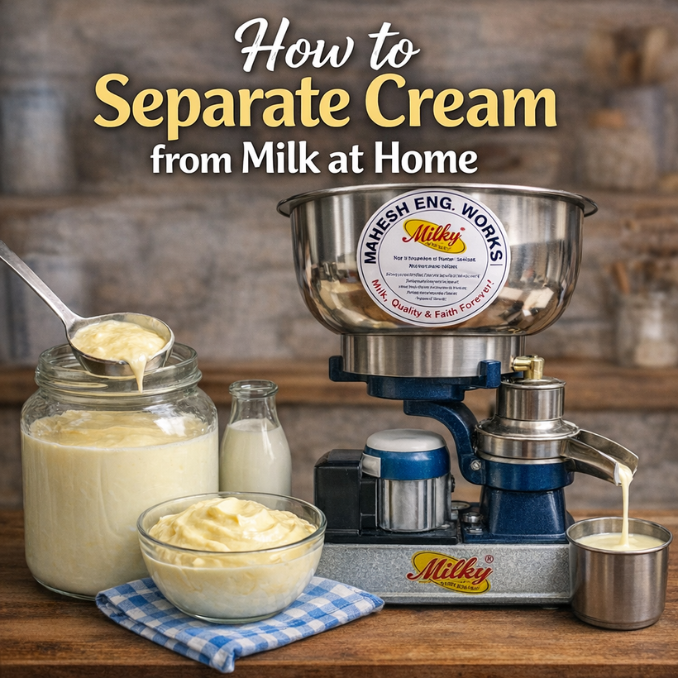
India is witnessing a rapid shift toward home-based dairy processing and self-sufficiency and searches for how to separate cream from milk at home are growing fast. Whether you’re making butter, ghee, or fresh cream, proper separation improves yield, hygiene, and cost savings. Today you have multiple options: from zero-cost traditional methods to efficient electric milk cream separator machine. This guide covers all of them clearly.
What is Cream Separation & How It Works?
Cream is the high-fat portion of milk. Since milk fat is lighter than water, it naturally rises to the top over time this is gravity separation. The faster, modern method uses centrifugal force to spin milk at high speed, pushing heavier skim milk outward and allowing cream to collect separately within seconds.
Key factors affecting separation quality:
Milk type — Buffalo milk (6–8% fat) yields significantly more cream than cow milk (3–4%)
Temperature — Warm milk (35–40°C) separates faster in machines; cold milk works better for natural settling
Storage time — Longer undisturbed rest = more cream rises naturally
4 Methods to Separate Cream from Milk at Home
1. Natural Gravity Method (Free, No Equipment)
The simplest traditional method — ideal for small households.
Steps:
- Pour fresh, full-fat milk into a wide shallow vessel
- Leave undisturbed at room temperature for 8–12 hours (or refrigerate overnight)
- A thick cream layer forms on top
- Skim gently with a flat spoon and collect in a separate container
Best for: Single-family households, 1–2 litres/day
- Zero cost
- No equipment needed
- Time-consuming
- Lower cream recovery (50–60%)
2. Boiling & Cooling Method (Most Popular Indian Method)
The malai method used in millions of Indian kitchens daily.
Steps:
- Boil full-fat milk on medium heat
- Pour into a wide vessel and cool to room temperature
- Refrigerate for 4–6 hours
- Collect the thick malai layer that forms on top
- Repeat daily store collected malai in the freezer to make butter or ghee
Tips: Use full-fat or raw milk for best yield. Avoid ultra-processed or toned milk.
Best for: Daily home use, malai/ghee making
- Thick, usable cream
- Easy and familiar
- Repeated boiling reduces some nutritional value
- Not suitable for large volumes
3. Manual Cream Separator (Hand-Operated Machine)
A step up for small dairy farmers or households processing 50–200 litres per day.
How it works: You pour warm milk (35–40°C) into the bowl and turn the hand crank. The spinning drum uses centrifugal force to separate cream from skim milk simultaneously cream exits from one spout, skim milk from another.
Best for: Small farms, village-level processing, no-electricity areas
- Much higher efficiency than manual methods
- No electricity required
- Affordable (₹3,000–₹12,000)
- Requires physical effort
- Slower than electric models
4. Electric Cream Separator (Best Efficiency)
The electric milk cream separator machine is the fastest, most hygienic, and most efficient way to separate cream from milk making it the top choice for regular use and small dairy businesses.
How it works: Motor-driven centrifugal separation at 6,000–8,000 RPM. Processes 100–500+ litres per hour with consistent cream quality and fat recovery of 90–95%.
Best for: Daily processing of 50L+, small dairy businesses, commercial home use
- High fat recovery
- Saves time
- Hygienic, food-grade construction
- Adjustable cream thickness
- Higher upfront cost (₹8,000–₹40,000+)
- Requires electricity
Comparison: Which Method is Right for You?
| Method | Cost | Time Required | Efficiency | Best For |
| Natural Gravity | Free | 8–24 hours | Low (50–60%) | 1–2L/day households |
| Boiling & Cooling | Very Low | 4–8 hours | Medium (65–75%) | Daily home malai/ghee |
| Manual Separator | ₹3,000–₹12,000 | 30–60 min | High (85–90%) | Small farms, 20–100L/day |
| Electric Separator | ₹8,000–₹40,000+ | 10–20 min | Very High (90–95%) | 50L+/day, commercial use |
Which Milk Works Best for Cream Separation?
Not all milk gives the same cream yield. The type of milk you use is the single biggest factor in how much cream you collect and how rich it will be.
| Milk Type | Fat Content | Cream Yield | Best Method |
| Raw Buffalo Milk | 6–8% | Very High | Any method |
| Raw Cow Milk | 3–4% | Good | Boiling or machine |
| Full-Fat Packet Milk | 3–6% | Moderate | Machine only |
| Toned Milk | 1.5–3% | Low | Not recommended |
| Homogenized Milk | 3–6% | Very Low | Avoid |
| Skimmed Milk | <0.5% | None | Not applicable |
Bottom line: Always use fresh, non-homogenized, full-fat milk for best results. If buying from a vendor, specifically ask for “full cream raw milk” — unprocessed and unhomogenized.
Common Mistakes to Avoid
- Using toned or processed milk — Low fat content means very little cream yield
- Skipping the warm-up step — Cold milk clogs manual and electric separators; always warm to 35–40°C first
- Not cleaning the machine immediately — Fat residue hardens quickly and becomes a contamination risk
- Choosing wrong capacity — A 100 LPH machine running at 200 LPH produces poor separation
- Repeated overboiling — Destroys cream structure and reduces ghee yield quality
Benefits of Separating Cream at Home
- Fresh homemade products — Make pure ghee, white butter, and cream without preservatives
- Significant cost savings — 1 litre of homemade ghee costs 40–50% less than packaged brands
- Zero wastage — Skim milk left after separation is fully usable for paneer, chaas, or cooking
- Quality control — You know exactly what goes in your dairy products
- Income opportunity — Small farms can sell fresh cream and butter locally at premium prices
Pro Tips to Increase Cream Yield (Simple & Practical)
- Use full-fat milk
- Let milk cool properly
- Keep milk undisturbed
- Use a wide bowl
- Give enough time
- Collect cream regularly
- Avoid homogenized milk
- Use a cream separator (optional)
FAQs
Can we separate cream from packet milk?
Yes, you can separate cream from packet milk, but the result is very low because most packaged milk is homogenized. Homogenization breaks fat into tiny particles, preventing it from rising to the top. For better cream separation, use fresh, non-homogenized full-fat milk.
How long does it take for cream to separate?
Cream typically takes 8 to 12 hours to separate from milk when refrigerated. During this time, the fat rises naturally to the top and forms a thick cream layer, especially in full-fat, non-homogenized milk.
Which milk gives more cream, cow or buffalo?
Buffalo milk gives significantly more cream than cow milk because it has a higher fat content. It forms a thicker and richer cream layer, making it ideal for making butter, ghee, and other dairy products.
Can I use a mixer to separate cream from milk?
Yes, a mixer can help separate cream from milk by agitating the fat particles. Blend full-fat milk for 1–2 minutes and let it rest; some cream will rise to the top. However, this method is less effective than natural separation or using a cream separator.
What is the fastest way to separate cream at home?
The fastest way to separate cream at home is by using a cream separator machine, which separates cream instantly using centrifugal force. Among manual methods, using a mixer is quicker than natural separation but gives lower efficiency.
Conclusion
Whether you’re a home cook collecting malai for ghee or a small dairy farmer maximizing fat utilization, the right cream separation method makes a measurable difference in yield, quality, and savings. Start with the boiling method if you’re a beginner, and upgrade to an electric cream separator as your volume grows.
Ready to upgrade your dairy setup? Explore Mahesh Eng.Works range of cream separator machines, compare models by capacity and price, or contact our experts for a free recommendation tailored to your daily milk volume.

Mahesh Eng. Works
Written by Mahesh Engineering Works, specializing in precision dairy machinery and hygienic stainless-steel dairy solutions for small and medium dairy plants in India.