

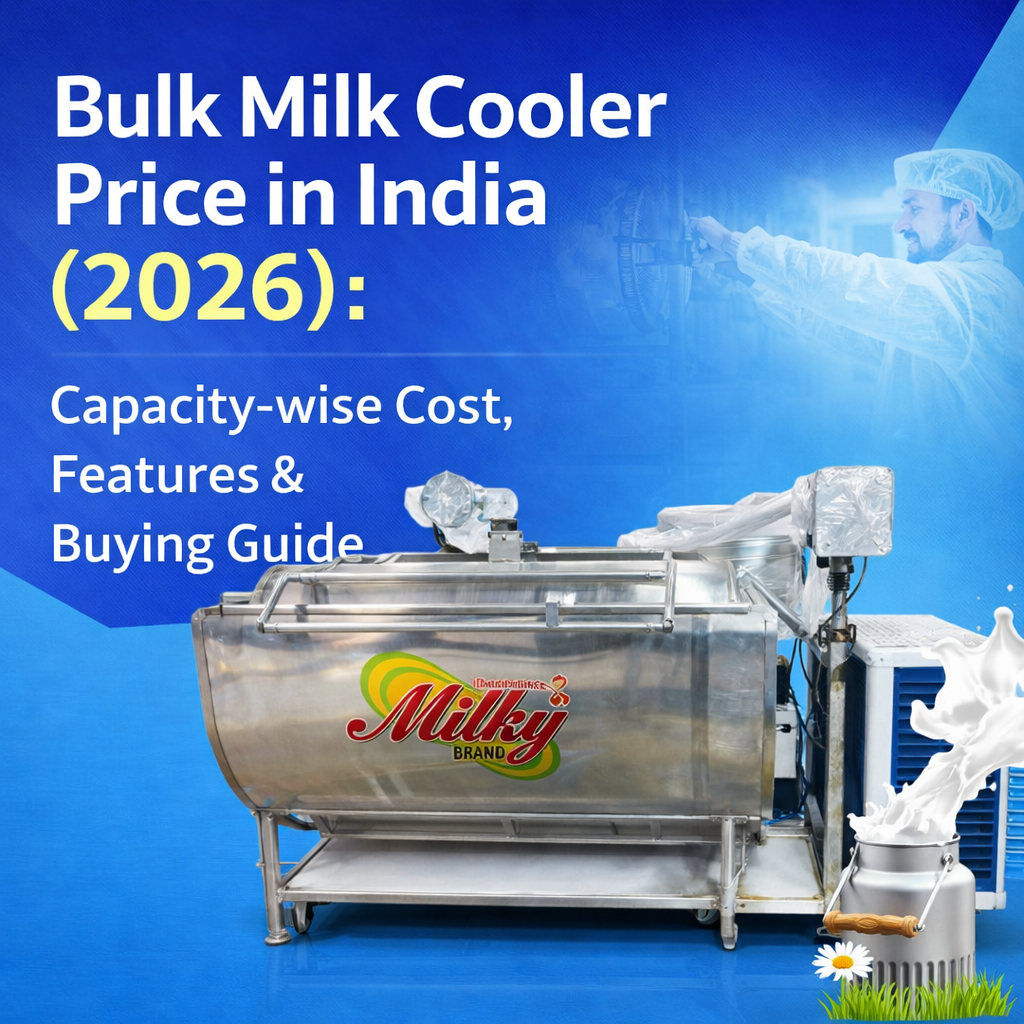
India’s dairy industry the world’s largest is growing faster than ever, yet spoilage remains one of the biggest profit killers for farmers. A Bulk Milk Cooler (BMC) solves this by rapidly chilling milk to 4°C, preserving quality, extending shelf life, and helping farmers earn premium prices from dairy plants. If you’re searching for the right bulk milk cooler price in India, this guide covers everything: capacity-wise costs, top models, and exactly what to look for before buying.
What is a Bulk Milk Cooler & How It Works?
A BMC is an insulated stainless steel tank that rapidly cools raw milk to 4°C within 2–3 hours of milking, halting bacterial growth and preserving quality. It’s now a standard fixture in modern dairy supply chains from village collection centers to large processing units.
Key components:
Compressor – Drives the refrigeration cycle
Condenser – Releases heat extracted from milk
Agitator – Continuously stirs milk for uniform cooling
Insulated Tank – SS 304/316 construction maintains temperature for 12–24 hours
Types of Bulk Milk Coolers Available in India
Direct Expansion (DX) BMC Refrigerant cools milk directly through the tank wall. Faster chilling, lower running cost. Best for continuous, high-volume daily collections. Slightly higher upfront cost.
Ice Bank Type (IBT) BMC Builds an ice bank overnight using off-peak electricity, then uses it to cool milk during peak collection. Ideal where power supply is inconsistent or costly during daytime.
Horizontal vs Vertical tanks — Horizontal suits large farms with space; vertical tanks work well for compact installations.
Small-scale (100–500L) vs Large-scale (1000L+) Small units serve village-level cooperatives; large units handle district-level milk collection centers.
Bulk Milk Cooler Price in India (2026) — Capacity-wise Breakdown
Bulk milk cooler prices in India range from ₹1.5 lakh for a 100-litre unit to ₹15 lakh+ for 2,000-litre industrial systems. A 500-litre BMC typically costs ₹4–8 lakh depending on brand, material (SS 304/316), and cooling technology. NABARD subsidies can reduce costs by 25–40%.
| Capacity | Price Range (INR) | Best For |
| 100–300 Litres | ₹1.5 lakh – ₹3 lakh | Small farms (5–15 cows) |
| 300–500 Litres | ₹2.5 lakh – ₹4.5 lakh | Village collection points |
| 500–1,000 Litres | ₹4 lakh – ₹8 lakh | Medium dairy cooperatives |
| 1,000–2,000 Litres | ₹7 lakh – ₹15 lakh | Large milk collection centers |
| 2,000+ Litres | ₹15 lakh+ | District-level / industrial units |
What drives price variation:
- SS 304 vs SS 316 construction
- DX vs IBT cooling technology
- Energy efficiency rating
- Brand reputation and service network
- Automation (digital controls, auto-cleaning)
Best Bulk Milk Coolers in India (2026) — Comparison
| Category | Capacity | Type | Cooling Time | Price Range | Best Use |
| Best for Small Farm | 100–300 L | DX | 2–3 hrs | ₹1.5–3 lakh | 5–15 cow farms |
| Best for Medium Farm | 500 L | DX | 2–3 hrs | ₹4–6 lakh | Village cooperatives |
| Best for Large Center | 1,000–2,000 L | DX / IBT | 2–4 hrs | ₹7–15 lakh | Milk collection hubs |
| Best Energy-Efficient | 500–1,000 L | IBT | 3–4 hrs | ₹5–9 lakh | Areas with frequent power cuts |
| Best Budget Option | 100–300 L | IBT | 3–4 hrs | ₹1.5–2.5 lakh | Entry-level dairy setup |
Prices may vary based on material grade (SS 304/316), automation level, heating system, and manufacturer specifications.
Top brands in India: Milkplan, DeLaval, Alfa Laval, BvL, Gopal Dairy Equipment, Mahindra Agri, Mahesh Eng.Works
Complete Buying Guide
Before purchasing, evaluate these factors:
- Daily milk volume – Choose a tank that holds 1–1.5x your daily collection
- Cooling time required – DX if power is reliable; IBT if outages are frequent
- Power availability – Confirm kW load your connection can handle
- Installation space – Horizontal tanks need more floor area
- Budget + subsidy eligibility – Factor in NABARD/state scheme benefits
- Future scalability – Buy 20–30% above current need
Quick Buying Checklist:
✔ Capacity requirement confirmed
✔ Electricity load assessed
✔ Space and drainage planned
✔ Service center within 100 km
✔ Subsidy application explored
✔ Warranty minimum 2 years
Key Features to Look for
- Fast cooling – Should reach 4°C within 2–3 hours of milking
- Energy efficiency – Look for star ratings or inverter-compatible compressors
- SS 304/316 tank – Non-corrosive, food-safe, easy to clean
- Digital temperature control – Auto-alerts for temperature deviation
- Insulation thickness – Minimum 60mm PUF insulation for 12–24 hr holding
- CIP (Clean-in-Place) system – Automated cleaning reduces contamination risk
Benefits of Using a Bulk Milk Cooler
- Stops bacterial growth – Rapid chilling to 4°C arrests bacterial multiplication within hours
- Extends shelf life – Properly chilled milk stays fresh 24–48 hours longer
- Reduces spoilage losses – Farmers report 15–25% reduction in rejected milk
- Earns premium pricing – Dairy plants pay 10–20% more for Grade A chilled milk
- Meets regulatory standards – FSSAI and state dairy board compliance requires controlled storage
Common Mistakes to Avoid
- Undersizing the tank – Overflow during peak flush season ruins the investment
- Ignoring power load – A 1,000L BMC draws 5–8 kW; confirm your connection supports it
- Choosing cheap materials – Non-food-grade SS corrodes and contaminates milk
- No service support plan – Compressor failure without local service means hours of spoilage
- Poor installation – Inadequate drainage, ventilation, or shade causes efficiency loss and equipment damage
Maintenance & Best Practices
Daily: Rinse tank with warm water after every collection | Check temperature log | Inspect agitator function
Weekly: Full CIP cycle with approved dairy detergent and sanitizer | Check refrigerant pressure | Clean condenser fins
Monthly: Inspect compressor belts and seals | Check insulation integrity | Service agitator motor | Calibrate temperature sensors
Every 6 months: Professional compressor service | Full system inspection by certified technician
FAQs
What is the price of a bulk milk cooler in India?
BMC prices range from ₹1.5 lakh (100L) to ₹15 lakh+ (2,000L+). A 500-litre unit the most popular size for village cooperatives — costs ₹4–8 lakh. NABARD subsidies can offset 25–40% of the cost for eligible farmers.
Which BMC is best for small dairy farms?
For farms with 5–15 cows, a 100–300 litre Direct Expansion BMC in the ₹1.5–3 lakh range is ideal compact, energy-efficient, and sufficient for daily collections.
How long does milk stay fresh in a BMC?
When chilled to 4°C within 2 hours of milking, milk stays fresh for 24–48 hours significantly longer than room-temperature storage, which spoils within 4–6 hours in Indian climatic conditions.
What capacity BMC do I need?
A simple rule: tank capacity = daily milk collection × 1.5. If you collect 300 litres/day, choose a 500-litre BMC to handle flush season peaks.
What is the difference between DX and IBT systems?
DX (Direct Expansion) cools milk immediately using refrigerant faster and lower running cost where power is stable. IBT (Ice Bank) builds ice overnight using cheap off-peak electricity, making it better for areas with unreliable daytime power supply.
Conclusion
Investing in the right Bulk Milk Cooler is one of the highest-return decisions a dairy farmer or cooperative can make reducing spoilage, meeting quality standards, and unlocking better prices. Match your capacity to daily collection volume, choose DX or IBT based on your power situation, and factor in subsidy availability before finalizing your budget.
Ready to invest? Explore Mahesh Eng.Works full BMC product range, request a custom quote, or speak with our dairy equipment experts for a free consultation tailored to your farm’s needs.

Mahesh Eng. Works
Written by Mahesh Engineering Works, specializing in precision dairy machinery and hygienic stainless-steel dairy solutions for small and medium dairy plants in India.