Have a question? Call us Now
+91-7574058811

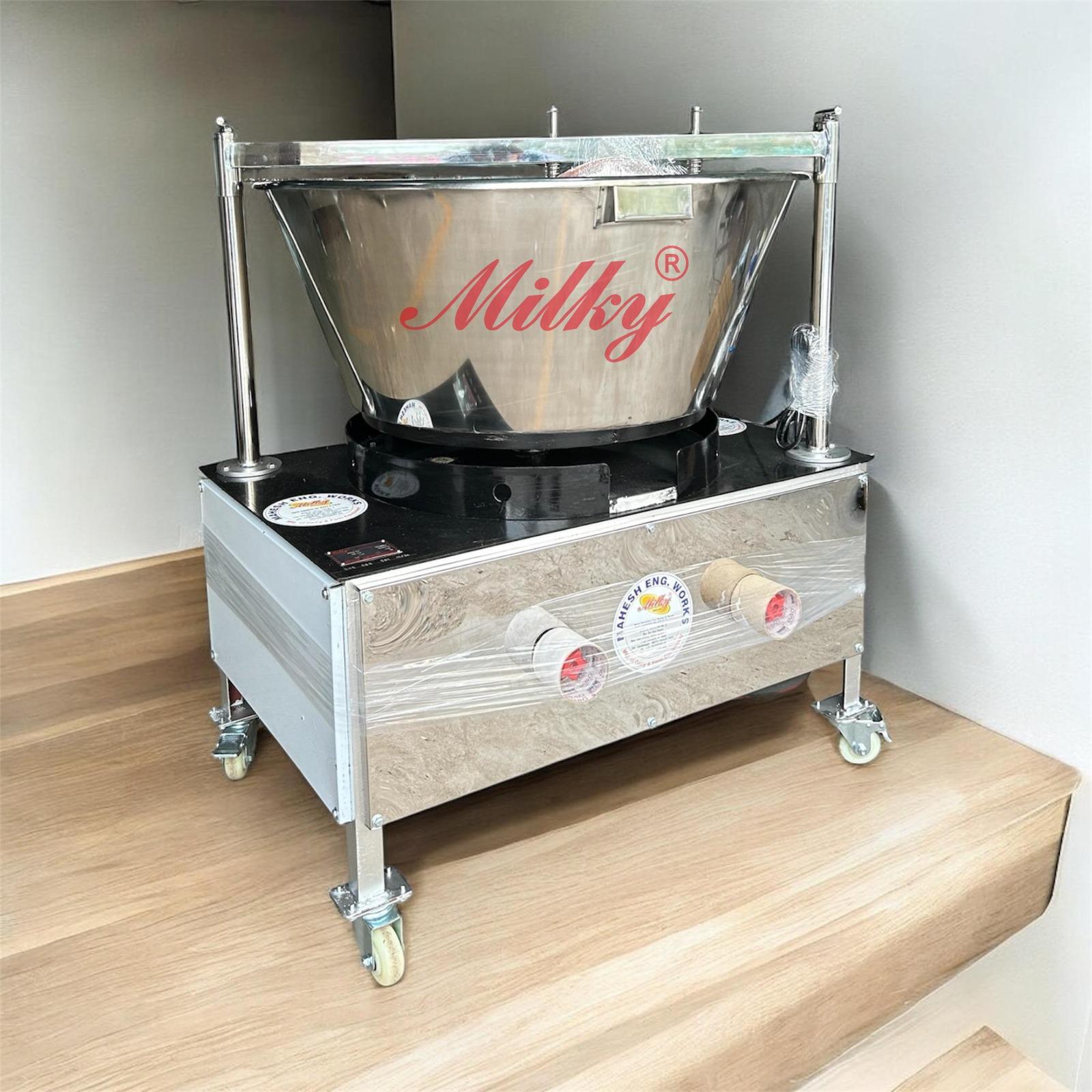
A khoya making machine heats and continuously stirs milk until the water evaporates and the milk thickens into khoya (also called khoa, khova or mava), the milk base used in Indian sweets.
Mahesh Eng. Works (MILKY®) is a khoya making machine manufacturer based in Rakanpur, Gandhinagar, Gujarat. Our khoa machine range covers 120, 200 and 300 litre barrel capacities. Whether you call it a khoa making machine or a mava making machine, each model has an electric gearbox stirrer and gas burners for even heating of milk. They suit sweet shops, halwais and dairy plants making barfi, peda and basundi. We are ISO 9001:2015 certified and export to 25+ countries. Tell us your daily milk volume and we will help you choose the right model.
| Specification | 120 LTR | 200 LTR | 300 LTR |
|---|---|---|---|
| Barrel capacity | 120 litres | 200 litres | 300 litres |
| Working milk capacity (at 90°C) | 80 litres | On request | 240 litres |
| Gas burner | 2T type, standard | 2T burner | 4 burner |
| Stirrer drive | Electric motor with gearbox | Electric motor with gearbox | Electric motor with gearbox |
| Motor (single phase) | 0.5 HP | 1 HP | 2 HP |
Need exact specifications for your production? [Get a quote].
A milk khoya making machine replaces hours of manual stirring over an open pan. It heats milk evenly and keeps it moving until the milk thickens into khoya. It is used for barfi, peda, dudhpak and basundi. The same machine also boils milk and fries cashew nuts. Small sweet shops and large dairy plants can both use it. The difference is the batch size they need.
| Use | Who uses it |
|---|---|
| Khoya (khoa, mava) for barfi, peda, dudhpak | Sweet shops, halwais, mithai makers |
| Basundi and milk thickening | Dairies, catering units |
| Milk boiling | Dairy plants, sweet units |
| Cashew frying | Sweet and snack makers |
Small shops use the 120 litre model to replace manual stirring. Larger sweet units and dairy plants use the 200 and 300 litre models for bigger batches.
| Feature | Details |
|---|---|
| Heating | Gas burners: 2T standard (120 L), 2T (200 L), 4 burner (300 L). |
| Stirring | Every model has an electric motor with a gearbox stirrer, so milk keeps moving during evaporation. |
| Material | High-quality stainless steel |
Mahesh Eng. Works provides installation and commissioning for its khoya machines. See our [khoya making machine installation guide] for site, utility and safety requirements. Our team is available for spare parts, service visits and operator guidance: confirm what is offered, and the service area.
We export dairy equipment, including khoa and mava making machines, to 25+ countries from our factory in Gandhinagar, Gujarat. For export enquiries, share your country, daily milk volume and available heating and power supply (voltage, gas).
Export contact: [salesmanager@maheshengworks.com].
A Khoya Making Machine (also called a Mava Making Machine) is used to convert liquid milk into khoya/khova/mava the concentrated milk solid used as a base for Indian sweets like barfi, peda, gulab jamun, and kalakand. The same machine can also be used for basundi, dudhpak, and cashewnut frying.
Khoya, khova, and mava are regional names for the same product milk that has been boiled and continuously stirred until the water evaporates and it thickens into a solid milk cake used in sweet-making.
A tilting model allows the flat pan to tip for easy discharge of the finished khoya, useful for faster batch turnaround. A stationary model keeps the pan fixed in place. Both are available across the 60–1000 litre capacity range in hygienic, GMP-compliant construction.
The machine can be configured for wood, LPG (gas), or diesel firing, depending on the client's preference and fuel availability.
On the 30-litre model, fuel consumption is approximately 1–2 litres of diesel/kerosene, or 500–600 grams of LPG, per 10 litres of milk processed.
The 30-litre model converts approximately 30 litres of milk to mava per hour. Larger machines in the range scale up to 1000 litres capacity.
The machine is designed to be operated by a single unskilled labourer, which reduces manning cost for small and mid-sized dairy units.
Standard construction is mild steel (MS), with stainless steel (SS) available as an optional upgrade for buyers who need food-grade, corrosion-resistant contact surfaces.
The standard configuration uses a 1 HP single-phase gear motor for stirring, plus a 0.5 HP single-phase blower motor on diesel-burner models.
Approximately 165 kg for the gas burner version and 210 kg for the diesel burner version (30-litre reference model).
Yes — the same equipment platform is used across ghee making, paneer making, kaju (cashew) processing, basundi making, kulfi layering, milk boiling, and batch milk condensing, in addition to khoya/mava production.
Machines are available from 60 litres up to 1000 litres, with commonly referenced batch sizes at 10, 20, and 30 litre milk-input levels for smaller operations.
Batch processing time depends on machine size for example, the smaller batch models range from roughly 12–35 minutes per batch depending on capacity (10L to 30L input range).
Khoya/Mava Making Machine pricing varies by capacity, construction material (MS vs SS), and design type (tilting vs stationary). Basic entry-level units typically start around ₹40,000–₹90,000, while larger, fully automatic, or higher-capacity machines (up to 1000 litres) can range up to roughly ₹5,00,000, depending on the manufacturer and specification.
For a detailed breakdown of Khoya / Mawa Making Machine Price in India – Full Guide, including machine types, capacities, features and pricing factors, read our complete guide.