

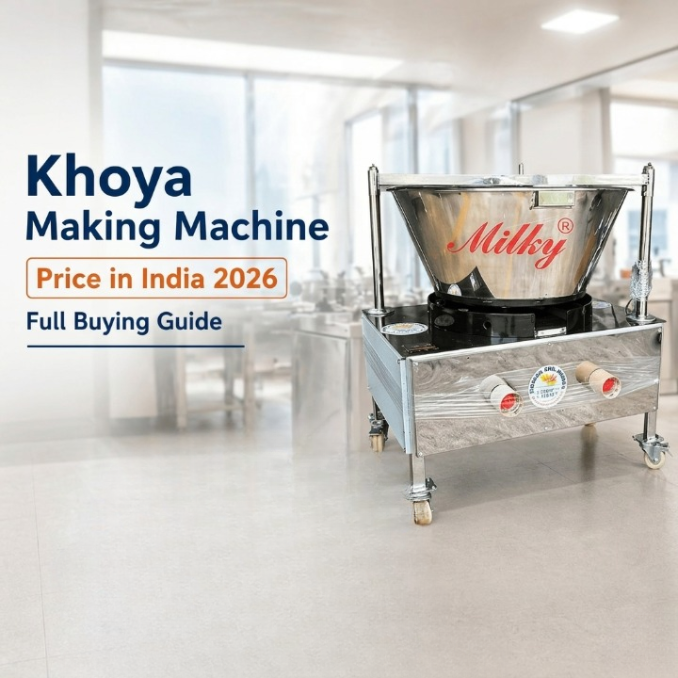
India runs on mithai. From Diwali barfi to daily peda, khoya (mawa) is the foundation of the country’s ₹50,000+ crore sweet industry and demand is growing every year. Yet most small and medium dairy businesses still make khoya the traditional way: hours of stirring milk over open flame, inconsistent output, high labor costs, and significant fuel waste.
The khoya making machine changes all of that. Modern automated mawa machines can process 50–500 litres of milk per batch with consistent quality, 60–70% less fuel consumption, and minimal labor. But with prices ranging from ₹80,000 to ₹15 lakh+, choosing the right machine for your scale and budget is critical.
This guide covers everything: how these machines work, capacity-wise pricing, ROI analysis, and exactly what to look for before you invest.
What Is a Khoya / Mawa Making Machine & How It Works?
A khoya making machine is a mechanized cooking vessel that continuously heats, agitates, and evaporates moisture from full-fat milk until it reduces to a solid or semi-solid mass khoya. It replaces the traditional karahi-and-ladle method with automated, controlled processing.
Core components:
Double-jacketed SS vessel — Steam or hot water jacket heats milk evenly from all sides, preventing scorching
Motorized agitator / scraper — Continuously stirs and scrapes the vessel walls, ensuring uniform cooking and preventing milk solids from burning
Heat source — Steam, LPG gas, or electric heating elements depending on model
Temperature controller — Monitors and maintains precise cooking temperature (85–95°C)
Tilting mechanism — Allows easy discharge of finished khoya without manual scooping
Drive unit — Motor and gearbox powering the agitator at controlled RPM
How the process works:
- Full-fat milk (cow or buffalo) is loaded into the vessel
- Jacket heating raises temperature gradually to 85–95°C
- Motorized agitator continuously stirs — preventing sticking and ensuring even evaporation
- Moisture evaporates steadily over 2–4 hours depending on batch size
- Milk solids concentrate until desired consistency (pindi, batti, or granular khoya) is reached
- Vessel tilts for clean, complete discharge
Types of Khoya Making Machines Available in India
Manual / Semi-Automatic (Entry Level) Basic motorized agitator with manual temperature monitoring. Operator controls heat and decides when khoya is ready.
- Capacity: 50–100 litres milk per batch
- Fuel: LPG or wood fire
- Price: ₹80,000–₹2 lakh
- Best for: Small halwai shops, village dairy units, startup mawa businesses
Semi-Automatic with Temperature Control Motorized agitation with digital thermostat — heat is auto-regulated but loading/unloading is manual.
- Capacity: 100–200 litres per batch
- Fuel: LPG or steam
- Price: ₹1.5 lakh–₹4 lakh
- Best for: Medium sweet shops, small dairy processors, cooperative societies
Fully Automatic (Commercial Grade) PLC-controlled operation — automated heating, agitation, temperature monitoring, and timed discharge. Minimal operator intervention.
- Capacity: 200–1,000 litres per batch
- Fuel: Steam (most efficient at scale)
- Price: ₹4 lakh–₹15 lakh+
- Best for: Large dairy plants, commercial mithai manufacturers, institutional sweet production
Khoya Making Machine Price in India (2026) — Capacity-wise Breakdown
Khoya making machine prices in India range from ₹80,000 for a basic 50-litre semi-automatic unit to ₹15 lakh+ for a fully automatic 500-litre commercial system. The most popular mid-range option a 100-litre semi-automatic machine — costs ₹1.5–₹2.5 lakh. Prices vary based on capacity, automation level, material grade, and fuel type.
| Capacity | Type | Fuel | Output (Khoya/batch) | Price Range (INR) | Best For |
| 50 Litres | Semi-auto | LPG/Gas | 6–7 kg | ₹80,000–₹1.2 lakh | Small halwai, startup |
| 100 Litres | Semi-auto | LPG/Steam | 12–14 kg | ₹1.5 lakh–₹2.5 lakh | Medium sweet shops |
| 200 Litres | Automatic | Steam/LPG | 24–28 kg | ₹3 lakh–₹5 lakh | Dairy processors |
| 300 Litres | Automatic | Steam | 36–42 kg | ₹5 lakh–₹8 lakh | Commercial units |
| 500 Litres+ | Fully automatic | Steam | 60–70 kg+ | ₹8 lakh–₹15 lakh+ | Large dairy plants |
Note: Approximately 7–8 litres of full-fat buffalo milk yields 1 kg of khoya.
Prices may vary based on material grade (SS 304/316), automation level, heating system, and manufacturer specifications.
Factors Affecting Khoya Machine Price
Understanding what drives the price helps you avoid overpaying or buying the wrong spec:
- Capacity — Biggest price driver. Every doubling of capacity roughly increases price by 60–80%
- Automation level — Manual < semi-auto < fully automatic (PLC). Each step up adds ₹50,000–₹2 lakh
- Material grade — SS 304 (standard) vs SS 316 (food-grade premium). SS 316 adds 15–25% to cost but is superior for hygiene
- Fuel type — Steam-heated units cost more upfront but deliver lower running costs at scale; LPG units are cheaper to buy but more expensive to operate
- Jacket design — Single jacket (basic) vs double jacket (better heat distribution, less scorching) — double jacket adds ₹20,000–₹80,000
- Brand & after-sales — Established brands with pan-India service networks command 20–30% premium over unbranded units usually worth it
- Tilting mechanism — Manual tilt vs motorized hydraulic tilt. Hydraulic adds ₹30,000–₹1 lakh but is essential for large capacity units
Complete Buying Guide — How to Choose the Right Machine
Step 1: Calculate your daily milk input How many litres of milk do you process daily for khoya? Divide by 2 (for 2 batches/day) to determine minimum vessel capacity needed.
Step 2: Decide fuel availability LPG is universally available but expensive at scale. Steam requires a boiler investment (₹2–8 lakh additional) but pays back quickly above 200L capacity. Electric is cleanest but highest running cost.
Step 3: Match automation to labor situation High labor cost or consistency issues → invest in semi or fully automatic. Tight budget with reliable workers → semi-auto gives best value.
Step 4: Verify material specifications Always insist on SS 304 minimum for all milk-contact surfaces. Request material test certificates from vendor.
Step 5: Check service network Confirm the brand has service engineers within 100–150 km. A broken machine during festival season is extremely costly.
Buying Checklist:
✔ Daily milk volume and batch requirement calculated
✔ Fuel type confirmed and infrastructure assessed
✔ SS grade specified in purchase order
✔ Automation level matched to labor and budget
✔ Service center location verified
✔ Warranty minimum 1 year on motor and vessel
✔ Government subsidy eligibility checked
Benefits of Using a Khoya Making Machine
- 60–70% labor reduction — One operator manages what previously required 2–3 workers
Consistent quality — Automated temperature and agitation eliminates batch-to-batch variation critical for branded sweet production - Higher output — Machine processes 2–3 batches per day vs 1 batch manually, increasing daily khoya production by 100–200%
- Fuel efficiency — Double-jacketed steam heating is 40–50% more fuel-efficient than open karahi method
Hygiene compliance — Closed system with SS surfaces meets FSSAI standards essential for selling to institutions and retailers - Reduced wastage — Motorized scraper prevents milk solids from burning and sticking reducing waste by 8–12%
- Scalability — Machine-based production scales easily; manual production hits a hard ceiling quickly
ROI & Profit Analysis
| Parameter | Manual Method | 100L Machine | 200L Machine |
| Daily milk processed | 100L | 200L | 400L |
| Khoya output/day | 12–14 kg | 25–28 kg | 50–56 kg |
| Khoya selling price | ₹350–400/kg | ₹350–400/kg | ₹350–400/kg |
| Daily revenue | ₹4,900 | ₹9,625 | ₹19,250 |
| Labor cost/day | ₹800–1,200 | ₹300–400 | ₹400–600 |
| Fuel cost/day | ₹600–900 | ₹400–600 | ₹700–1,000 |
| Machine payback period | — | 8–14 months | 10–16 months |
Figures are indicative based on average market rates. Actual ROI depends on milk procurement cost, local khoya prices, and operational efficiency.
Common Problems & Mistakes to Avoid
- Buying undersized capacity — Festival season demand spikes 3–4x; a machine that barely meets daily needs becomes a bottleneck when it matters most
- Ignoring fuel infrastructure cost — Steam machines need a boiler; many buyers discover this after purchase. Always calculate total installed cost including fuel infrastructure
- Choosing single jacket over double jacket to save money — False economy. Single jacket causes hot spots, scorching, and inconsistent product quality
- Skipping the tilting mechanism on large units — Manually scooping 40–60 kg of hot khoya from a fixed vessel is unsafe and slow
- No AMC (Annual Maintenance Contract) plan — Gearbox and agitator failures during peak production are catastrophic. Always budget for AMC from day one
- Using low-fat milk — Khoya machines are optimized for full-fat milk (buffalo preferred). Low-fat milk gives poor yield and watery khoya
Maintenance Tips & Best Practices
After every batch: Scrape all residual khoya immediately while vessel is warm → rinse with hot water → wipe dry. Never let milk solids harden inside the vessel.
Daily: Inspect agitator blades and scraper edges for wear | Check motor temperature | Verify thermostat accuracy with probe thermometer | Clean exterior SS surfaces.
Weekly: Inspect all gaskets and seals | Check gearbox oil level | Lubricate tilting mechanism | Clean steam jacket inlet and condensate drain (steam models).
Monthly: Full motor and gearbox inspection | Check all electrical connections | Inspect vessel interior for pitting or corrosion | Calibrate temperature controller.
Every 6 months: Professional service by certified technician | Replace worn scraper blades | Full steam system check (pressure relief valve, steam trap) for steam-heated units.
FAQs
What is the price of a khoya making machine in India?
Khoya making machine prices in India range from ₹80,000 for a basic 50-litre semi-automatic unit to ₹15 lakh+ for a 500-litre fully automatic commercial system. The most popular 100-litre semi-automatic model costs ₹1.5–₹2.5 lakh and suits medium-scale sweet production well.
How much milk is needed to make 1 kg of khoya?
Approximately 7–8 litres of full-fat buffalo milk produces 1 kg of khoya. Cow milk requires 9–10 litres per kg due to lower fat content. Machine efficiency reduces wastage by 8–12% compared to manual methods.
Which fuel is best for a khoya making machine?
For small units (50–100L), LPG is most practical. For medium to large units (200L+), steam heating is more efficient — 40–50% lower fuel cost per kg of khoya though it requires a boiler investment.
Can a khoya machine make different types of khoya?
Yes. By adjusting cooking time and temperature, the same machine produces pindi khoya (firm), batti khoya (very firm), and granular/dhap khoya all from the same vessel.
Is government subsidy available on khoya making machines?
Yes. Under NABARD’s Dairy Entrepreneurship Development Scheme (DEDS) and state dairy development board schemes, eligible dairy entrepreneurs can avail 25–33% capital subsidy on dairy processing equipment including khoya machines.
What capacity machine is right for a small halwai shop?
A 50–100 litre semi-automatic LPG-heated machine (₹80,000–₹2 lakh) is ideal for small halwai operations producing 10–25 kg of khoya per day. It provides automation benefits without requiring large capital investment or steam infrastructure.
Conclusion
The shift from manual khoya-making to mechanized production is no longer optional for dairy businesses serious about scale, quality, and profitability. With machines available across every budget from ₹80,000 entry-level units for small sweet shops to ₹15 lakh industrial systems for large dairy plants there is a right solution for every operation size.
Match your machine to your daily milk volume, choose the right fuel system for your infrastructure, and always prioritize SS quality and after-sales service over upfront cost savings. A well-chosen khoya making machine typically pays for itself within 8–16 months and then generates consistent profit for 10–15 years with proper maintenance.
Ready to upgrade your khoya production? Explore Mahesh Eng.works full range of mawa making machines, compare models by capacity and automation level, or contact our dairy equipment experts for a free consultation and custom quote tailored to your business.