

Introduction
Cream separators have become indispensable equipment across India’s dairy landscape from small cooperative farms in Gujarat and Punjab to large-scale commercial processing units supplying national brands. As demand for fresh cream, butter, and ghee continues to climb, operators are running their machines harder and longer than ever before. Yet for every dairy business achieving peak output, there are many more struggling with the same trio of frustrations: low cream output, excessive vibration during operation, and poor separation quality that wastes milk and drains profits. In the vast majority of cases, these problems share a single root cause inadequate maintenance.
A well-maintained cream separator delivers consistent cream fat percentages, reduces energy consumption by up to 20%, extends equipment lifespan significantly, and critically keeps your product compliant with hygiene standards set by authorities such as the Food Safety and Standards Authority of India (FSSAI) and the National Dairy Development Board (NDDB).
This comprehensive cream separator maintenance checklist breaks down exactly what to do daily, weekly, and monthly giving you a practical, no-guesswork system to protect your machine, your product quality, and your profitability in 2026.
1. What Is a Cream Separator and How Does Maintenance Impact Performance?
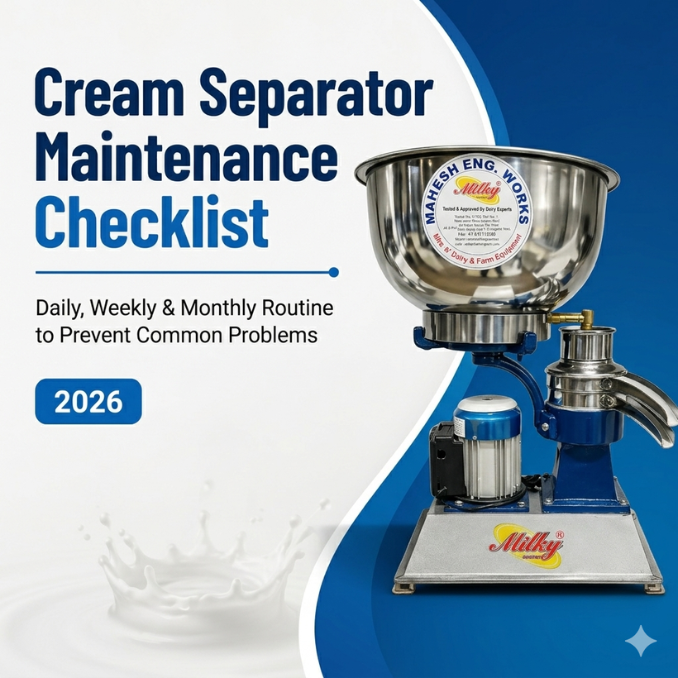
A cream separator is a centrifugal device that spins raw whole milk at high speed typically 6,000–8,000 RPM – using centrifugal force to separate lighter cream (fat) from heavier skim milk. The efficiency of this process depends entirely on the mechanical precision of the machine’s components: the disc stack alignment, bowl balance, bearing condition, seal integrity, and feed rate control. When any of these elements degrades through fouling, wear, or neglect the separation efficiency drops.
Practically speaking, this means:
• Every 1% drop in separation efficiency can mean litres of cream lost per batch
• Dirty discs reduce throughput and increase bacterial load in the final product
• Worn bearings cause vibration, which further misaligns discs and compounds the problem
• Failed seals allow cream and skim milk to re-mix, undoing the separation entirely
Proper maintenance of your cream separator machine is not just about keeping equipment running it directly determines how much cream you extract per litre of milk processed and whether that cream is safe for sale or consumption.
2. Daily Maintenance Checklist for Cream Separators
Daily maintenance is your first line of defense. Milk residue left on components overnight becomes a breeding ground for bacteria and accelerates corrosion. These quick checks take less than 20 minutes and prevent the majority of separator troubleshooting calls.
Daily Maintenance Checklist Table
| Task | How to Perform | Why It Matters |
| Rinse all parts with warm water | Disassemble discs, bowl, and spout; rinse under 40–50°C water | Removes milk residue before bacteria multiply |
| Inspect disc stack alignment | Check that discs seat evenly with no visible tilt or gaps | Misaligned discs cause poor cream-skimmed milk separation |
| Wipe exterior body & motor housing | Use a damp cloth; never spray water directly on motor | Prevents corrosion and keeps electrical parts safe |
| Check oil level (manual separators) | Open oil plug; oil should be visible at mid-mark | Low oil increases friction and accelerates wear |
| Listen for abnormal vibration/noise | Run for 60 seconds; note any grinding or wobble | Early detection prevents bearing failure |
| Verify cream and skim outlets are clear | Pass water through both nozzles before use | Blocked outlets reduce output and strain the motor |
| Check feed rate (milk input speed) | Adjust float valve to manufacturer-specified flow | Incorrect feed rate reduces separation efficiency |
Pro Tip: Record daily checks in a logbook. A log of ‘normal’ readings makes it far easier to spot the gradual drift that precedes a failure and gives you evidence of due diligence if a hygiene inspection occurs.
3. Weekly Maintenance Checklist: Inspection & Adjustment
Weekly inspections go beyond surface cleaning to assess the mechanical health of your separator. These checks are designed to catch problems before they cause downtime or product contamination common pain points for both small dairy operations and commercial processors.
Weekly Maintenance Checklist Table
| Component | Inspection Action | Signs of Trouble |
| Disc stack | Remove and inspect for scale, discolouration, or cracks | Calcium deposits, pitting, or bent edges |
| Bearings | Rotate spindle by hand; feel for roughness or play | Grinding sensation, unusual heat after run |
| Drive belt / gears | Inspect belt tension and teeth; check gear mesh | Fraying, slipping, or clicking sounds |
| Seals & gaskets | Run a visual check for cracks, hardening, or deformation | Milk leaks around bowl joint or outlet |
| Bowl & body bolts | Torque check all fasteners to specification | Loose bolts cause vibration and misalignment |
| Motor ventilation slots | Brush clean with soft brush; no compressed air | Clogged vents cause overheating |
| Cleaning chemical residue | Rinse all parts in plain water after alkaline/acid wash | Chemical residue taints cream and corrodes metal |
4. Monthly Maintenance Checklist: Deep Cleaning & Part Replacement
Monthly maintenance is where preventive care shifts from inspection to intervention. This is the time to perform deep Cleaning-In-Place (CIP) protocols, replace consumable parts on schedule (rather than waiting for failure), and conduct the kind of detailed mechanical assessment that daily and weekly checks cannot achieve.
Monthly Maintenance Checklist Table
| Task | Method | Products Needed | Frequency |
| Deep alkaline cleaning | Circulate 1.5% NaOH solution at 75°C for 20 min | Food-grade caustic soda | Monthly |
| Acid descaling | Follow alkaline wash with 0.5% nitric/phosphoric acid rinse | Food-safe acid cleaner | Monthly |
| Bearing lubrication | Apply 2–3 ml of food-grade grease per bearing point | NLGI Grade 2 food-grade grease | Monthly |
| Oil change (gearbox) | Drain old oil, flush with clean oil, refill to mark | Food-grade ISO 68 gear oil | Monthly |
| Replace worn seals/O-rings | Swap all rubber seals regardless of visible wear | OEM seal kit | Monthly |
| Full disc stack inspection | Measure disc spacing with feeler gauge; replace if out of spec | Feeler gauge, spare discs | Monthly |
| Motor insulation check | Use a multimeter to test winding resistance | Digital multimeter | Monthly |
5. Preventive Maintenance vs. Common Problems: Cause–Solution Mapping
Understanding the relationship between deferred maintenance and specific failures is key to eliminating recurring separator problems. The table below maps the most common cream separator problems to their maintenance causes and solutions making it a practical separator troubleshooting reference
| Problem | Likely Cause | Maintenance Solution | Prevention |
| Low cream output | Blocked discs or incorrect disc spacing | Deep clean disc stack; reset spacing to spec | Weekly disc inspection |
| Excessive vibration | Unbalanced bowl or loose spindle bearing | Re-balance bowl; replace bearing | Monthly bearing check |
| Poor separation quality | Worn seals allowing re-mixing | Replace all O-rings and gaskets | Monthly seal replacement |
| Overheating motor | Clogged vents or low lubrication | Clean vents; check oil/grease levels | Weekly vent cleaning |
| Milk leaks | Cracked bowl or failed gasket | Replace gasket; inspect bowl for cracks | Monthly seal inspection |
| Noisy operation | Dry bearings or worn gear teeth | Lubricate bearings; replace worn gears | Monthly lubrication |
| Cream/milk contamination | Chemical residue from improper rinsing | Triple-rinse after every chemical clean | Follow standard CIP protocol |
6. Step-by-Step Cream Separator Cleaning Process (Best Practices)
Cleaning is the single most impactful maintenance task you can perform. Incorrect cleaning causes more damage than no cleaning harsh chemicals applied incorrectly etch disc surfaces, while insufficient rinsing leaves milk stone deposits that reduce separation efficiency over time. Follow this sequence every day after the final run:
Step 1 — Immediate Post-Operation Rinse (0–15 minutes after shutdown)
• Disassemble bowl, disc stack, and cream/skim outlets while parts are still warm
• Flush all components with clean water at 40–50°C to remove bulk milk residue
• Never use cold water immediately thermal shock can warp precision disc stacks
Step 2 — Alkaline Detergent Wash
• Prepare a 1–2% solution of food-grade caustic-based dairy detergent
• Soak disc stack and bowl for 15–20 minutes, or circulate through CIP system
• Use a soft-bristle brush on disc surfaces never metal brushes or abrasive pads
Step 3 — Clean Water Rinse
• Rinse all components thoroughly with clean water at 50°C until no detergent odour remains
• Test pH of rinse water: it should read 7.0–7.5 before proceeding
Step 4 — Acid Rinse (Descaling — Weekly or as Needed)
• Use a 0.5% food-safe phosphoric or nitric acid solution to remove mineral deposits
• Apply for 10–15 minutes, then rinse again thoroughly with clean water
Step 5 — Sanitization Before Next Use
• Apply an approved dairy sanitizer (hot water at 85°C, or approved chemical sanitizer)
• Allow components to air dry — never use cloth towels, which can recontamination surfaces
7. Common Cream Separator Maintenance Mistakes to Avoid
Even experienced dairy operators make maintenance errors that silently erode machine performance. The following are the most frequently observed mistakes and their consequences:
• Reassembling discs in random order: Discs must always be reassembled in their original numbered sequence. Reversed or shuffled discs reduce separation efficiency immediately.
• Using high-pressure water jets on the motor: Water ingress into motor windings causes insulation failure and creates an electrocution hazard.
• Skipping the acid rinse: Alkaline-only cleaning removes fat and protein but leaves mineral scale. Over weeks, this scale reduces the gap between discs and chokes cream output a common cause of ‘low cream output problem’ complaints.
• Over-tightening bowl lock rings: Excessive torque distorts the bowl body and misaligns the disc stack, causing vibration.
• Using non-food-grade lubricants: Any oil or grease that contacts milk-wetted surfaces must be certified food-grade. Petroleum-based lubricants contaminate cream and violate FSSAI standards.
• Ignoring early vibration signs: Operators often dismiss minor vibration as normal machine behavior. Unaddressed vibration progressively damages bearings, then the spindle, then the bowl a repair bill that escalates at each stage.
• Storing without drying: Moisture left inside a stored separator promotes rust and bacterial biofilm formation. Always dry completely and store with end caps on outlets.
8. Benefits of Proper Cream Separator Maintenance
A structured cream separator maintenance routine delivers measurable returns across four dimensions of dairy business performance:
Performance & Output
• Maintains peak separation efficiency — typically 99%+ cream extraction from properly maintained machines
• Reduces energy consumption by 15–25% compared to a fouled, poorly maintained separator
• Consistent cream fat percentage per batch — critical for standardized product formulations
Profitability
• Extends machine lifespan from 5–7 years to 10–15 years with disciplined maintenance
• Reduces unplanned downtime costs — a single day’s downtime in a mid-scale dairy can cost ₹15,000–₹50,000 in lost output
• Reduces spare parts expenditure by replacing items on schedule rather than in emergency conditions
Hygiene & Compliance
• Keeps Total Plate Count (TPC) in cream within FSSAI-permissible limits
• Prevents biofilm formation inside the bowl — a major source of product spoilage
• Supports audit readiness for FSSAI, ISO 22000, and export market certifications
Operator Safety
• Reduces risk of bowl ejection events caused by unbalanced or corroded components
• Eliminates electrical hazards from moisture-compromised motors
9. Essential Spare Parts Checklist
Waiting for spare parts to arrive is one of the most preventable causes of dairy production downtime. Stocking these critical components ensures that your monthly maintenance is never delayed by supply chain gaps.
| Part | Purpose | Replacement Cycle | Priority |
| O-rings / Seals kit | Prevents leaks; maintains pressure | Monthly | Critical |
| Disc stack set | Core separation element | Every 6–12 months | Critical |
| Drive belt | Transfers motor power to bowl | Every 3–6 months | High |
| Food-grade bearing | Supports high-speed spindle rotation | Every 6 months | High |
| Gear oil (ISO 68) | Lubricates gearbox | Monthly change | High |
| NLGI 2 grease | Lubricates bearings and spindle | Monthly application | High |
| Cream outlet nozzle | Controls cream flow rate | Every 6 months | Medium |
| Float valve assembly | Regulates milk feed rate | Annually or on failure | Medium |
10. Buying Tips
The easiest maintenance task is the one you never have to do because your machine was designed to minimize it. Here is what to look for when selecting a cream separator that will serve your dairy operation well for years:
• Stainless steel construction (SS 304 minimum, SS 316 preferred): Resists corrosion, withstands CIP chemicals, and meets FSSAI material standards
• Numbered disc stack with tool-free disassembly: Reduces reassembly errors and cuts cleaning time by 40%
• Accessible oil/grease points: Lubrication points should be reachable without full disassembly
• Availability of OEM spare parts: Confirm that the manufacturer stocks full spare parts kits locally this is the single most important factor for long-term maintenance cost
• CIP compatibility: Machines with integrated CIP ports allow automated chemical cleaning, dramatically reducing labor and improving hygiene consistency
• Variable speed control: Allows operators to optimize RPM for different milk fat contents older fixed-speed machines are less efficient across varying milk quality
• After-sales service network: Choose a brand with service engineers accessible within your district or state
11. Frequently Asked Questions
Q: How often should a cream separator be cleaned?
A: After every use. Do a full clean weekly (or daily for heavy use) and deep cleaning monthly.
Q: Why is my cream separator producing low cream output?
A: Usually due to dirty discs, blocked outlet, wrong milk flow, or improper disc spacing.
Q: What causes excessive vibration in a cream separator?
A: Unbalanced bowl, worn bearings, or loose parts.
Q: How do I maintain a cream separator machine at home?
A: Clean after every use, dry properly, lubricate regularly, and deep clean monthly.
Q: What oil is used in a cream separator?
A: Food-grade gear oil (ISO VG 68) and food-safe grease (NLGI Grade 2), as per Food Safety and Standards Authority of India guidelines.
Q: How long does a cream separator last?
A: Around 10–15 years with proper maintenance; less with poor care.
Conclusion
The difference between a cream separator that consistently delivers maximum cream yield and one that underperforms, breaks down, and contaminates product is not the brand or the price it is maintenance discipline. The daily, weekly, and monthly routines outlined in this cream separator maintenance checklist require a modest investment of time and consumables, and they return that investment many times over in extended machine life, reduced repair costs, better cream yield, and the peace of mind that comes from FSSAI-compliant hygiene standards.
Whether you run a small household dairy or manage a commercial cream processing unit, building these routines into your standard operating procedures is the single most impactful step you can take in 2026 to protect both your equipment and your profits.
Ready to optimize your dairy operation? Explore Mahesh Eng.Works full range of cream separators or contact our dairy equipment specialists for personalized maintenance guidance and service support.

Mahesh Eng. Works
Written by Mahesh Engineering Works, specializing in precision dairy machinery and hygienic stainless-steel dairy solutions for small and medium dairy plants in India.