

Introduction
India is the world’s largest producer and consumer of milk, producing over 230 million metric tonnes annually. Within this thriving ecosystem, yogurt popularly known as curd or dahi holds a central place in every Indian household and food business. From roadside dhabas to large-scale dairy cooperatives, the demand for fresh, consistent, and hygienic curd has never been higher.
Traditionally, curd was set by hand boiling milk, cooling it to the right temperature, adding a starter culture, and waiting. While this method still exists, it is no longer viable for businesses aiming to scale. Inconsistency in texture, temperature deviations, hygiene risks, and labour dependency are real challenges that affect quality and profitability.
This is precisely why the shift to automated yogurt making machines is accelerating across India. Whether you run a small dairy farm in Gujarat, a city-based curd processing unit, or an export-focused food manufacturing plant, a yogurt making machine offers consistency, hygiene, speed, and profit in every batch.
But with dozens of machine types, brands, and price points available in 2026, choosing the right yogurt making machine is a decision that requires research. This comprehensive guide covers everything you need to know from machine types and capacity to pricing and buying criteria so you can invest with confidence.
1. What Is a Yogurt Making Machine and How Does It Work?
A yogurt making machine (also called a curd making machine or dahi setting machine) is a temperature-controlled device designed to automate the process of fermenting milk into curd or yogurt at consistent, precise conditions. It eliminates human error, speeds up production, and maintains hygiene throughout the process.
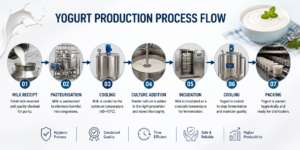
How the process works — step by step:
• Milk is received, filtered, and pre-heated to pasteurization temperature (72°C for 15 seconds in HTST method).
• The milk is cooled rapidly to the optimal incubation temperature typically 40°C to 45°C for curd.
• A measured starter culture (lactic acid bacteria) is injected or mixed in at the correct ratio.
• The inoculated milk is transferred to incubation tanks or trays within the machine.
• Temperature is maintained consistently for 4–8 hours, allowing fermentation and setting.
• Once the curd achieves the desired pH and consistency, it is cooled for storage or packaging.
• In automatic models, CIP (Clean-in-Place) systems rinse and sanitize the machine after each batch.
2. Types of Yogurt Making Machines Available in India
Yogurt making machines are not one-size-fits-all. India’s market in 2026 offers a wide spectrum of machines suited to every production level and budget. Understanding the types helps you narrow down exactly what your business needs.
A. Manual / Traditional Curd Setting Units
• Basic insulated containers with no electronic temperature control.
• Rely on ambient temperature or manually added warm water for fermentation.
• Best for: Home use, micro-dairy startups, or rural cooperatives with very low volumes.
• Limitation: Inconsistent results, no automation, high labour demand.
B. Semi-Automatic Yogurt Making Machines
• Feature basic heating elements and timers for temperature control.
• Operator must manually load milk, add culture, and monitor the process.
• Best for: Small dairy businesses, canteens, sweet shops, and mid-scale farms.
• Available in stainless steel (SS 304/316) construction for food safety compliance.
C. Fully Automatic Yogurt Making Machines
• PLC/HMI-controlled systems for end-to-end automation.
• Include pasteurization, culture dosing, incubation, and CIP cycles.
• Consistent output with minimal operator intervention.
• Best for: Commercial dairy units, branded curd manufacturers, food processors.
• Often include data logging for FSSAI/ISO compliance documentation.
D. Industrial Yogurt Processing Lines
• Integrated systems that handle milk reception to finished product packing.
• Capacities from 500 litres/hour to 2,000+ litres/hour.
• Include homogenizers, UHT pasteurizers, fermentation tanks, and aseptic fillers.
• Best for: Large dairy cooperatives, milk federations, and export-oriented manufacturers.
• Custom-engineered as per plant layout and product specifications.
3. Yogurt Making Machine Capacity Guide — Small to Industrial Scale
Selecting the right capacity is as important as selecting the right machine type. Underbuying leads to production bottlenecks; overbuying ties up capital unnecessarily. Use this guide to match your daily production target to the right machine size.
| Scale | Capacity | Machine Type | Output/Day |
| Home / Micro | 5–20 L | Manual / Semi-Auto | Up to 40 kg curd |
| Small Business | 20–100 L | Semi-Automatic | 40–200 kg curd |
| Commercial | 100–500 L | Automatic (SS) | 200–1,000 kg curd |
| Industrial | 500 L+ | Fully Automatic | 1,000+ kg curd |
Key capacity calculation tip: If you sell 200 kg of curd per day, and your machine runs 2 batches of 4–5 hours each, you need a minimum 100-litre batch machine with a reliable incubation system that can run back-to-back cycles without temperature drift.
4. Yogurt Making Machine Price in India (2026)
The yogurt making machine price in India varies significantly based on capacity, automation level, material quality, and brand. Below is a comprehensive price table to help you budget accurately for 2026.
| Machine Type | Capacity | Price Range (INR) | Best For |
| Manual/Semi-Auto | 1–5 litres litres/batch | ₹500 – ₹5,000 | Household use |
| Semi-Automatic | 5–100 litres | ₹20,000 – ₹75,000 | Small dairy businesses |
| Automatic (SS) | 100–500 litres | ₹1,00,000 – ₹3,00,000 | Commercial dairy units |
| Industrial Auto | 500–2000+ LPH | ₹2,50,000 – ₹15,00,000+ | Large dairy plants |
| Custom / Export | As per requirement | On Request | Exporters, cooperatives |
Prices may vary based on capacity, material quality, automation level, and brand, as well as location and customization requirements.
What affects the final price?
• SS 304 is standard; SS 316 (food-grade/export quality) adds 15–25% to cost.: Material grade
• PLC-controlled systems cost more upfront but save 60–70% on labour over time.: Automation level
• Price scales roughly 1.5x–2x for every doubling of capacity.: Capacity
• Established manufacturers with service networks command a premium.: Brand and after-sales support
• Special voltage, custom tank dimensions, or multi-product functionality adds cost.: Customization
• 18% GST applies on most dairy equipment; factor in freight for outstation delivery.: GST and logistics
Pro Tip: Always request a per-liter production cost breakdown from the supplier. The cheapest machine is rarely the most economical one over a 3-year horizon.
5. Best Yogurt Making Machines in India — How to Compare
With multiple manufacturers offering curd and yogurt making machines in India, comparison must go beyond price. Use these criteria to evaluate and shortlist the best machine for your operation.
| Feature | Manual | Semi-Auto | Fully Automatic |
| Hygiene Control | Low | Medium | High |
| Labour Required | High | Medium | Low |
| Consistent Output | Variable | Moderate | Excellent |
| Energy Usage | Minimal | Moderate | Moderate–High |
| Initial Cost | Low | Medium | High |
| ROI Speed | Slow | Medium | Fast |
| Best For | Home/Micro | Small Units | Commercial/Industrial |
Key differentiators to look for in top machines:
• Food-grade SS 304 or 316 inner contact surfaces (mandatory for FSSAI compliance).
• Accurate temperature controllers with ±0.5°C precision or better.
• Energy-efficient insulation to maintain incubation temperature without continuous heating.
• Ease of CIP (Clean-in-Place) machines with smooth, crevice-free inner surfaces.
• Proven after-sales support with spare part availability in your state.
• Compliance with BIS standards and ISO certification of the manufacturer
Complete Buying Guide — Factors to Consider Before You Purchase
A yogurt making machine is a long-term business investment. The following buying checklist ensures you cover every critical factor before placing an order.
Step 1 — Define Your Production Requirements
• Daily output target in kilograms or liters of curd.
• Number of batches per day and shift schedule (single/double shift).
• Product variety — plain curd, flavored yogurt, set curd, Greek-style, etc.
Step 2 — Assess Your Infrastructure
• Available floor space and utility connections (3-phase power, water, steam/gas).
• Cold storage capacity for finished product.
• Proximity to milk source and distribution channel.
Step 3 — Evaluate Compliance Requirements
• FSSAI licence category and related equipment hygiene standards.
• State-specific dairy regulations for your production scale.
• Export requirements if supplying to international buyers.
Step 4 — Compare Supplier Credentials
• ISO certification of the manufacturer.
• Years of experience and client references in your industry segment.
• Service network presence in your region for post-purchase support.
Step 5 — Calculate Total Cost of Ownership (TCO)
• Machine purchase price + installation + commissioning.
• Annual energy consumption and utility costs.
• Expected maintenance cost and spare parts pricing.
• Operator training requirements and associated labour cost.
7. Key Benefits of Using a Yogurt Making Machine
- Every batch meets the same texture, taste, and pH standard — critical for branded retail products.: Consistent quality
- Closed systems eliminate open-air contamination risks that lead to batch failures and customer returns.: Improved hygiene
- Automated machines can process 3–5x more volume per shift compared to manual methods.: Higher throughput
- Reduces skilled labour dependency — one operator can manage a 500L automatic machine.: Labour savings
- Insulated fermentation chambers consume 30–40% less energy than equivalent traditional methods.: Energy efficiency
- SS 304/316 contact surfaces and CIP systems support regulatory audit requirements.: FSSAI compliance ready
- Modular designs allow capacity expansion as business grows without replacing the entire system.: Scalability
- Precise temperature control eliminates over-fermentation losses that commonly affect manual batches.: Reduced wastage
Common Mistakes to Avoid When Buying a Yogurt Making Machine
- The lowest-priced machine often lacks the temperature precision needed for consistent quality. Always compare specifications, not just cost.: Buying based on price alone
- Non-food-grade steel corrodes rapidly and fails FSSAI inspections. Insist on SS 304 or 316 for all milk-contact surfaces.: Ignoring material grade
- Buying a 100L machine when your business plan targets 300L within 2 years means costly replacement. Size up by at least 20–30%.: Underestimating future growth
- A machine without a local service network can sit idle for weeks awaiting parts. Verify service availability before purchase.: Skipping after-sales evaluation
- Buffalo milk, cow milk, and toned milk have different fat content and fermentation profiles. Test the machine with your actual raw material.: Not testing with your milk type
- Some automatic machines require 3-phase power or steam connections your facility may not have. Confirm infrastructure compatibility upfront.: Overlooking utility requirements
Maintenance and Best Practices for Yogurt Making Machines
A well-maintained yogurt making machine delivers consistent performance for 10–15 years. Follow these best practices to protect your investment.
Daily maintenance:
- Run CIP (Clean-in-Place) cycle after every production run with approved dairy-grade sanitizer.
- Inspect seals, gaskets, and valves for wear or leaks before each batch.
- Check temperature sensor accuracy against a calibrated reference thermometer.
- Drain and rinse all milk-contact surfaces thoroughly after shutdown.
Monthly maintenance:
- Lubricate agitator bearings and moving parts as per manufacturer specifications.
- Inspect electrical connections, control panel, and heating elements for signs of wear.
- Calibrate temperature controllers and flow meters to ensure batch accuracy.
Annual maintenance:
- Full mechanical inspection and replacement of seals, O-rings, and gaskets.
- Motor and pump service including alignment check.
- Review and update SOPs with the service engineer to incorporate any process improvements.
Best Practice: Keep a maintenance logbook it is required for ISO and FSSAI compliance audits, and it protects your warranty claims with the manufacturer.
FAQs
Q1. What is the price of a yogurt making machine in India in 2026?
Yogurt making machine prices in India range from ₹8,000 for basic small-scale units to ₹10,00,000+ for industrial automated systems. The most popular commercial-grade automatic machines for 100–500 litre batches fall in the ₹80,000 – ₹2,50,000 price range.
Q2. What is the difference between a curd making machine and a yogurt making machine?
In the Indian context, curd (dahi) and yogurt refer to essentially the same fermented product. The machines are functionally identical — the term ‘yogurt making machine’ is more commonly used in export and food processing contexts, while ‘curd making machine’ is the preferred term in domestic dairy operations.
Q3. Which yogurt making machine is best for small dairy businesses?
For small dairy businesses processing 20–100 litres per batch, a semi-automatic stainless steel curd setting machine with a temperature controller and insulated body is the most practical choice. It balances cost, hygiene, and ease of operation for this scale.
Q4. How long does a yogurt making machine last?
A high-quality SS 304 or SS 316 yogurt making machine from a reputable manufacturer, with regular maintenance, typically lasts 10–15 years. Gaskets, seals, and heating elements may need replacement every 2–3 years depending on production load.
Q5. Does a yogurt making machine require a 3-phase power connection?
Small and semi-automatic machines (up to 100 litres) generally operate on single-phase 220V power. Larger automatic machines above 200 litres typically require 3-phase 415V industrial power. Always confirm power specifications with the supplier before installation.
Q6. Is GST applicable on yogurt making machines in India?
Yes. Most dairy processing machinery, including yogurt making machines, attracts 18% GST in India. However, some specific agricultural and dairy equipment categories may qualify for reduced GST rates — consult your CA or the supplier for the exact HSN code applicable to your machine.
Conclusion
The yogurt making machine market in India offers options for every scale of operation from a 5-litre home unit to a 2,000-litre-per-hour industrial processing line. But the right machine is not simply the cheapest one or the most feature-rich one. It is the one that matches your production volume, compliance requirements, infrastructure, and growth ambitions.
As you’ve seen through this guide, pricing is just one dimension of the decision. Material quality, automation level, energy efficiency, and after-sales support collectively determine the real return on your investment over the machine’s operational lifetime.
Mahesh Eng. Works operating under the trusted Milky Brand has over two decades of experience manufacturing and exporting precision-engineered dairy equipment from Gujarat, India. Our curd and yogurt making machines are built to food-grade SS 304 and SS 316 standards, designed for FSSAI compliance, and backed by a dedicated service network.

Mahesh Eng. Works
Written by Mahesh Engineering Works, specializing in precision dairy machinery and hygienic stainless-steel dairy solutions for small and medium dairy plants in India.