

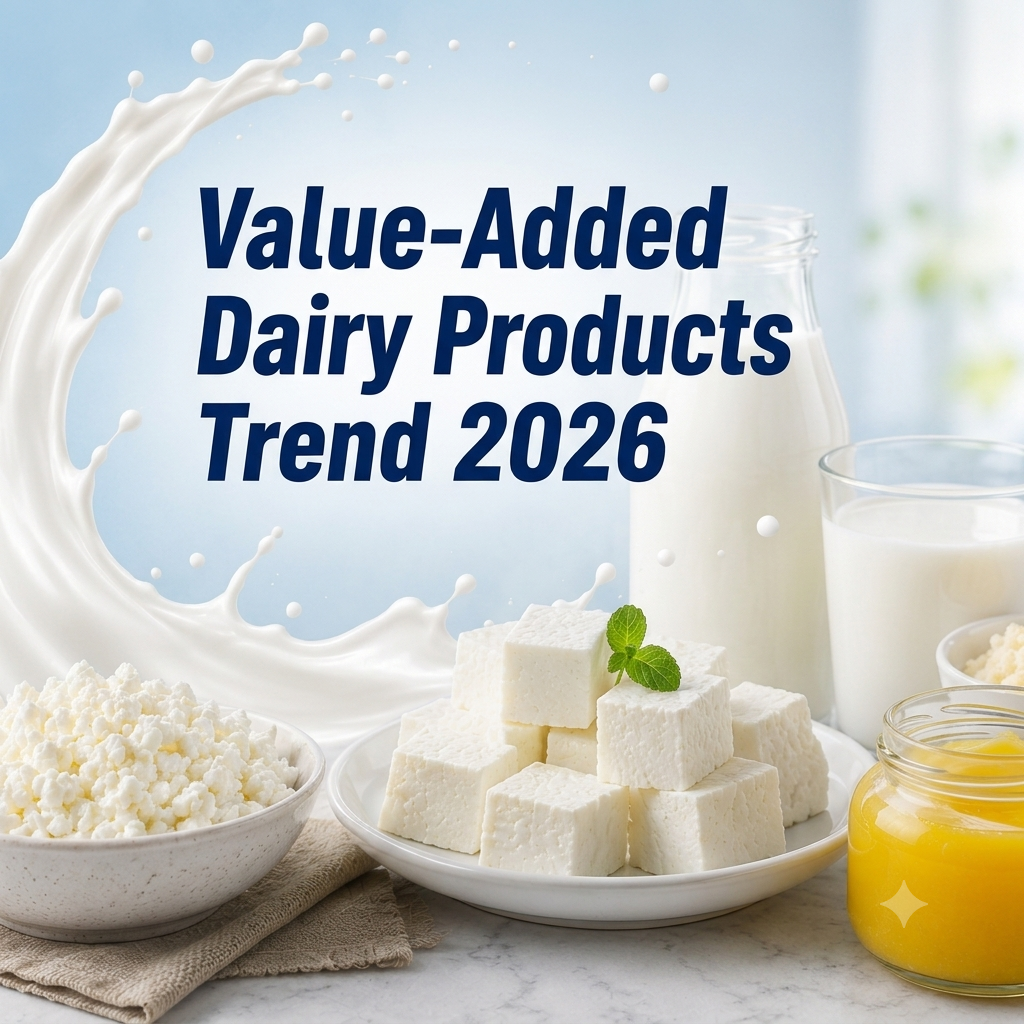
Selling raw milk alone rarely builds a sustainable dairy business margins are thin and prices swing with the season. Converting even a portion of your milk into paneer, ghee, or khoya can multiply your realized value per litre, extend shelf life, and open new customer segments. For most small dairies, this is the single biggest profitability lever available in 2026.
Introduction
If you run a small dairy or collect milk from local farmers, you already know the problem: raw milk prices don’t move much, but your costs fuel, labour, transport, feed keep climbing. On top of that, milk output is seasonal. During flush season, you often have more milk than buyers, and prices drop just when your volume is highest.
This is exactly why more small and mid-sized dairies are shifting toward value-added products paneer, ghee, and khoya instead of selling milk as-is. These three products are not new, but 2026 is seeing renewed demand from urban retail, hotels, sweet shops, and export buyers, making this a practical time to add processing capability.
In this article, you’ll learn what value-added dairy products are, why they matter for small dairies specifically, how paneer, ghee, and khoya compare in terms of demand and profitability, what equipment each product needs, and how to decide which one to start with based on your milk supply and budget.
What Are Value-Added Dairy Products?
Value-added dairy products are items made by processing raw milk into a more concentrated, longer-lasting, or higher-demand form such as paneer, ghee, khoya, cheese, or flavoured milk. Processing increases the price per litre of milk used and reduces dependency on daily fresh milk sales.
Raw milk has a fixed, market-driven price. Once you convert it into paneer, ghee, or khoya, you’re selling a finished food product with its own separate market, pricing, and customer base one that isn’t tied directly to the daily milk rate.
Common categories of value-added dairy products include:
- Fresh products: paneer, curd, flavoured milk
- Fat-based products: ghee, butter
- Concentrated milk solids: khoya, milk powder
- Fermented products: cheese, shrikhand
For small dairies, paneer, ghee, and khoya are the most practical starting points because the equipment is affordable, the process is well understood, and local demand already exists.
Why Small Dairies Should Focus on Value Addition in 2026
Small dairies should prioritize value addition in 2026 because raw milk margins remain thin and unpredictable, while paneer, ghee, and khoya have stable, growing demand from retail, hospitality, and sweets manufacturing sectors. Processing also helps absorb surplus milk during flush season instead of selling it at a loss.
A few practical realities are pushing this shift:
- Raw milk margins are capped. You’re paid on fat and SNF content, with little room to differentiate your product.
- Flush season creates oversupply. Many dairies are forced to sell excess milk at low rates during peak production months. Converting that surplus into ghee or khoya (both of which store well) protects you from distress sales.
- Urban and semi-urban demand for packaged paneer is rising, driven by home cooking, restaurants, and quick-commerce grocery delivery.
- Ghee has strong festival and year-round demand, and commands a premium when sold under a clean, trusted brand.
- Khoya demand spikes seasonally around festivals, making it a high-return opportunity for dairies that can plan production around demand cycles.
The common thread: these products let you convert perishable, low-margin milk into shelf-stable or premium-priced goods.
Market Demand for Paneer, Ghee & Khoya
Paneer, ghee, and khoya each serve different market segments, which is actually an advantage a dairy producing more than one product can diversify its customer base and reduce dependence on any single buyer type.
- Paneer sells daily to households, restaurants, hostels, and caterers.
- Ghee sells to households, sweet shops, and increasingly to health-conscious urban buyers seeking traditional, additive-free ghee.
- Khoya sells heavily to sweet shops and confectioners, especially before festivals like Diwali, Holi, and regional celebrations.
Paneer: High-Demand Product with Strong Daily Sales
Quick Answer: Paneer is one of the most consistently profitable value-added dairy products because it has daily, non-seasonal demand from households, restaurants, and caterers, and can be produced with a relatively small initial equipment investment.
Paneer works well as a first product for small dairies because:
- It has year-round, not just seasonal, demand
- Production cycle is short (a few hours from milk to finished paneer)
- Local and hyperlocal markets (restaurants, sweet shops, households) can absorb daily output
- Quality-focused paneer (soft texture, good binding, consistent taste) commands a price premium over generic paneer
The core equipment required is a paneer making machine, along with a milk pasteurizer or boiler and a cream separator if you want to standardize fat content before processing.
Ghee: Premium Product with Excellent Profit Margins
Quick Answer: Ghee offers strong profit margins because it is shelf-stable for months, commands a premium price when made with clean processing, and has consistent demand across households, sweet shops, and export markets. It requires more equipment investment than paneer but delivers a higher-value finished product per litre of milk.
Ghee is attractive for a few specific reasons:
- Long shelf life means no urgency to sell immediately you can hold stock and sell when prices are favourable
- Higher price per kg compared to most other dairy products
- Trust-driven category dairies that can demonstrate clean, traditional processing (using a proper ghee clarifier) build strong repeat demand
- Export potential for dairies that scale up and meet quality certifications
The main equipment needed is a cream separator (to extract cream from milk) and a ghee clarifier (to convert cream or butter into ghee through controlled heating).
Khoya: Seasonal Opportunity with High Returns
Quick Answer: Khoya is a concentrated milk solid used mainly by sweet shops and confectioners, with demand spiking around festivals. It offers high returns during peak season but requires production planning since demand is not steady through the year.
Khoya makes sense for dairies that:
- Have access to sweet shop or confectionery buyers in their region
- Can plan higher production ahead of festival seasons
- Want a product that uses surplus milk during flush season, since khoya production absorbs large milk volumes efficiently
The key equipment is a khoya making machine, which reduces processing time significantly compared to traditional open-pan methods and gives more consistent texture and quality.
Comparison Table: Paneer vs Ghee vs Khoya
| Factor | Paneer | Ghee | Khoya |
|---|---|---|---|
| Demand pattern | Daily, year-round | Year-round, festival peaks | Seasonal, festival-driven |
| Shelf life | Short (needs refrigeration) | Long (months) | Short to medium |
| Main buyers | Households, restaurants, caterers | Households, sweet shops, exporters | Sweet shops, confectioners |
| Core equipment | Paneer making machine | Cream separator + ghee clarifier | Khoya making machine |
| Best suited for | Daily-supply dairies | Dairies wanting stock flexibility | Dairies near sweet shop clusters |
Equipment Required for Each Product
| Product | Essential Equipment | Optional Add-ons |
|---|---|---|
| Paneer | Paneer making machine, milk boiler/pasteurizer | Cream separator (for standardization) |
| Ghee | Cream separator, ghee clarifier | Butter churner (if starting from cream) |
| Khoya | Khoya making machine | Milk pasteurizer |
A milk pasteurizer and a bulk milk cooler are useful shared infrastructure if you plan to produce more than one of these products, since consistent milk quality benefits all three processes.
Profit & ROI Overview
Exact profit depends on local milk cost, product pricing, production volume, and equipment efficiency these vary by region and should be checked against your local market before investing. As a general pattern, ghee typically offers the highest margin per litre of milk due to its long shelf life and premium pricing, paneer offers the fastest, most consistent daily cash flow, and khoya offers high seasonal returns concentrated around festival periods.
Factors that affect actual profitability include:
- Local raw milk cost and fat/SNF content
- Selling price achievable in your specific market
- Production efficiency and wastage during processing
- Packaging, branding, and whether you sell direct-to-consumer or through distributors
- Consistency of quality, which affects repeat buying and pricing power
Rather than relying on generic profit figures, it’s worth checking current wholesale and retail prices for paneer, ghee, and khoya in your own region, and calculating margins against your specific milk procurement cost.
Tips Before Investing in Dairy Processing
- Start with one product that matches your existing buyer relationships, rather than trying paneer, ghee, and khoya all at once.
- Match equipment capacity to your actual daily milk volume oversized machines increase cost without adding value if you don’t have the milk supply to run them fully.
- Prioritize food safety compliance. FSSAI registration and basic hygiene standards are non-negotiable for any dairy product sold commercially in India.
- Secure buyers before scaling production, especially for khoya, where demand is concentrated around specific seasons.
- Invest in quality-consistent equipment. Inconsistent texture or taste is one of the most common reasons new dairy processors lose repeat customers.
- Plan for cold storage if you’re producing paneer or curd, since these products depend heavily on the cold chain for shelf life and safety.
Conclusion
Raw milk alone puts a ceiling on what a small dairy can earn. Paneer, ghee, and khoya each open a different path to higher, more stable returns paneer for daily cash flow, ghee for shelf-stable premium value, and khoya for seasonal festival demand. The right starting point depends on your milk volume, local buyer base, and budget, but for most small dairies in 2026, adding at least one of these three products is one of the most direct ways to improve profitability without needing to increase milk procurement.
Frequently Asked Questions
What are value-added dairy products?
Value-added dairy products are items made by processing raw milk into products like paneer, ghee, or khoya, which have their own separate market pricing rather than being tied to the daily milk rate. This processing increases the value realized per litre of milk.
Why should small dairies process milk instead of selling it raw?
Raw milk prices are largely fixed by market rates, leaving little room for margin improvement. Processing milk into paneer, ghee, or khoya creates a differentiated product with its own pricing, shelf life, and buyer base, which can significantly increase overall profitability.
Which dairy product gives the highest profit?
It depends on your market and production efficiency, but ghee generally offers strong margins due to its long shelf life and premium pricing, while paneer offers the most consistent daily income. It’s best to compare actual local prices for each product against your milk cost.
Is paneer manufacturing profitable?
Yes, paneer manufacturing can be profitable due to its consistent daily demand from households, restaurants, and caterers. Profitability depends on production quality, local selling price, and how efficiently the paneer making process converts milk to finished product.
Is ghee manufacturing a good business?
Ghee manufacturing can be a strong business because ghee has a long shelf life, commands premium pricing, and has both domestic and export demand. It requires investment in a cream separator and ghee clarifier, but offers flexibility to hold and sell stock when prices are favourable.
What equipment is required to start value-added dairy processing?
The equipment needed depends on the product: paneer requires a paneer making machine and milk boiler, ghee requires a cream separator and ghee clarifier, and khoya requires a khoya making machine. Many dairies also invest in a shared milk pasteurizer for quality consistency across products.
Which product should beginners start with?
Paneer is often the easiest starting point for beginners due to its daily demand, shorter production cycle, and relatively lower equipment investment. Dairies with strong sweet shop relationships may consider ghee or khoya instead, depending on local demand.
How much milk is needed to start a small dairy processing unit?
This depends on the product and equipment capacity chosen. Small-scale paneer, ghee, and khoya making machines are available in a range of capacities, so it’s best to match machine capacity to your actual daily milk supply rather than starting with excess capacity.

Mahesh Eng. Works
Written and reviewed by Mahesh Eng. Works, a dairy machinery manufacturer specializing in milk cream separator machines and hygienic stainless steel dairy equipment. Since 1980, we have been designing and manufacturing cream separators, butter churners, milk pasteurizers, bulk milk coolers, and complete dairy processing solutions for dairy farms, milk collection centers, and processing plants.