

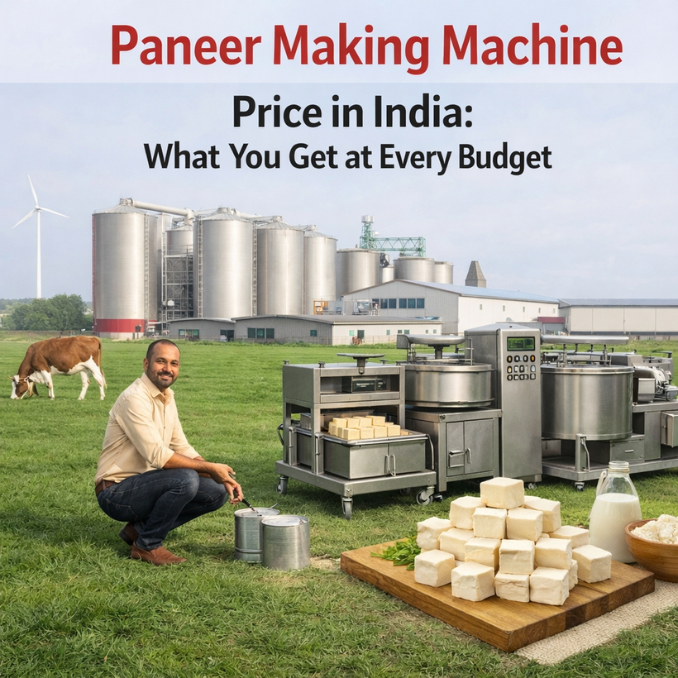
If you are running a dairy, a sweet shop, a hotel kitchen, or even a small paneer-making operation from home — at some point you face the same question: should I buy a machine for this, and if yes, which one?
The problem is not a shortage of options. It is the opposite. Search for a paneer making machine in India and you will find everything from a Rs. 8,000 manual press to a Rs. 7 lakh automated plant. No clear explanation of what the price difference actually means. No honest breakdown of what each level gets you in practice.
That is what this guide is for. Real price ranges, real differences in what you get at each level, and a clear way to figure out where your operation fits.
What a Paneer Making Machine Actually Does
Before getting into prices, it helps to understand what the process involves — because the machine complexity, and therefore the cost, tracks directly with how much of this process it automates.
Paneer is made through acid coagulation of milk at around 85°C, followed by removal of whey. Good paneer has less than 70% moisture and milk fat equal to or more than 50% of the dry substance.
In practice that means: heat the milk, add an acid (usually citric acid or lemon juice), let it curdle, drain the whey, press the curd under controlled pressure, and cool it. A basic paneer press machine handles only the pressing step. A mid-range setup handles pressing and moulding. A full paneer making machine or plant automates the heating, coagulation, pressing, and cutting in one connected system.
The price you pay reflects how many of those steps the machine handles — and how much daily labour you need to fill the gaps it does not.
Paneer Making Machine Price in India: Budget-by-Budget Breakdown
Entry Level — Rs. 8,000 to Rs. 35,000
This is the manual and semi-manual range. What you typically get at this level is a stainless steel paneer press machine — essentially a mould with a pressing mechanism. You pour cooked, curdled milk into it, apply pressure manually or via a simple screw mechanism, and the whey drains out.
Entry-level automatic paneer making machines start from around Rs. 25,000, while basic manual press machines are available from Rs. 9,500.
Who this works for: small home-based operations, caterers who make paneer two or three times a week, or anyone testing the market before committing to a larger investment. The machine does not heat or coagulate milk — that happens separately on a stove or in a vat. It only handles pressing.
What it does not do: consistent pressure, uniform block shape, any level of automation. Output quality varies depending on how carefully the operator works. Yield per batch is limited by hand capacity.
Mid Range — Rs. 35,000 to Rs. 1,60,000
This is where most small commercial dairy operations and paneer producers sit. A paneer making machine with a cream separator, two paneer moulds, and a multipurpose vat is priced between Rs. 1,26,000 and Rs. 1,54,000.
At this price range, you get a proper coagulation vat, multiple pressing moulds, and in better models a basic heating element. The pressing is either pneumatic or mechanical — meaning consistent pressure applied uniformly across the block, not dependent on how hard an operator pushes. Block shape is consistent. Yield per batch goes up because pressure is controlled.
A pneumatic paneer press machine with an integrated air compressor — capable of pressing 50 kg to 200 kg of paneer per hour — is available from around Rs. 1,70,000.
The automatic paneer press machine at this level is a genuine step up from manual. You still need someone to manage the coagulation and milk heating separately in most cases, but the pressing and draining is mechanised. For a dairy producing 50 to 150 kg of paneer per day, this range covers the operation well.
Commercial and Industrial — Rs. 1,60,000 to Rs. 7,70,000+
At this level you are moving into complete paneer making machines or mini paneer plants — where milk goes in one end and pressed, shaped paneer blocks come out the other.
A paneer making machine with 1,000 to 2,000 litres of milk capacity, 200 to 300 kg paneer output, an online pasteurizer, and 300 litres per hour heating capacity is priced between Rs. 6,30,000 and Rs. 7,70,000. A full wood-fired boiler paneer plant with indirect water heating, cream separator, paneer moulds, and multipurpose vat runs Rs. 5,44,500 to Rs. 6,65,500.
These are automatic paneer making machines in the fullest sense — PLC-controlled, food-grade SS 304 construction, integrated heating and coagulation, CIP (clean-in-place) cleaning systems, and the ability to run continuously across production shifts without stopping. Industrial grade machines handle 100 to 1,000 litres of milk capacity and are built for large-scale production facilities.
Who this is for: dedicated paneer manufacturers, dairy cooperatives, hotel chains with central kitchen operations, or any business producing more than 200 kg of paneer per day and needing consistent block quality, hygiene compliance, and minimal per-unit labour cost.
What the Price Actually Buys You — The Real Differences
A lot of buyers focus on the headline price and miss what actually changes at each level. Here is the honest breakdown:
Pressing mechanism — Manual screw presses at the entry level, pneumatic presses in mid-range, hydraulic or automated pressing at industrial scale. The difference shows up in block consistency and how much operator attention each batch needs.
Material grade — Entry models often mix SS 202 and mild steel. Mid-range and above should be full SS 304. If you are selling paneer commercially, food-grade SS 304 is not optional — it is what FSSAI hygiene compliance requires.
Capacity and throughput — A manual press handles 5 to 10 kg per batch. A mid-range pneumatic machine handles 50 to 200 kg per hour. An industrial automatic paneer making machine runs 200 to 300 kg of output per hour continuously.
Integration — Entry-level machines do one step: pressing. Mid-range adds moulds and sometimes basic heating. Industrial plants integrate pasteurisation, coagulation, pressing, and cutting in one connected line. More integration means less labour cost per kg of output — which is what drives ROI on the larger investment.
Cleaning — Manual cleaning at the entry level. CIP systems at industrial scale. This matters because cleaning time is production downtime, and hygiene failures at commercial scale have consequences manual operations do not face.
How to Choose the Right Paneer Making Machine for Your Operation
Daily output is your starting point. Less than 20 kg per day — a good manual paneer press machine handles it. 20 to 100 kg per day — mid-range semi-automatic or pneumatic press. Above 100 kg per day — a proper automatic paneer making machine or integrated plant is the only option that makes economic sense long-term.
Think about labour cost, not just machine cost. A Rs. 30,000 manual press looks cheap until you calculate how many hours of skilled labour it takes to produce 80 kg of consistent paneer per day versus what a Rs. 1.5 lakh pneumatic machine does in the same time with one operator. The payback on the higher machine often happens within months if your volume justifies it.
Check material certification before anything else. Food-grade SS 304, FSSAI-compliant design, and a proper warranty from the manufacturer. These are not negotiable if you are selling paneer commercially. The cheapest machines cut corners here first.
Ask about after-sales service specifically. A cheese making machine or paneer plant that breaks down during peak production hours is an expensive problem. Manufacturer support — not just a number that rings — matters more than it seems when you are comparing options.
Frequently Asked Questions
What is the price of a paneer making machine in India?
It depends entirely on scale and automation level. Basic manual paneer press machines start from Rs. 8,000 to Rs. 25,000. Mid-range semi-automatic and pneumatic machines run Rs. 35,000 to Rs. 1,70,000. Full automatic paneer making machines and complete paneer plants range from Rs. 1,60,000 to over Rs. 7 lakh, depending on milk capacity and output.
What is the difference between a paneer press machine and a paneer making machine?
A paneer press machine handles only the pressing and whey drainage step — you do the milk heating and coagulation separately. A paneer making machine or plant is a more complete system that integrates heating, coagulation, pressing, and sometimes cutting. The more steps it handles, the higher the price and the lower the per-kg labour cost.
Which material should a paneer making machine be made from?
Food-grade SS 304 stainless steel throughout — especially all surfaces that contact milk or curd. Avoid machines that mix mild steel components in food-contact areas. If you are selling commercially, FSSAI standards require food-safe construction, and SS 304 is the minimum standard.
How much paneer can a commercial machine produce per hour?
Mid-range pneumatic machines produce 50 to 150 kg of paneer per hour. Industrial automatic paneer making machines handle 200 to 300 kg per hour at continuous operation. Entry-level manual presses typically manage 5 to 10 kg per batch, with batch time depending on operator speed.
Is an automatic paneer press machine worth the extra cost?
For operations producing more than 50 kg per day — yes, clearly. Consistent block shape, controlled pressing pressure, lower labour requirement per kg, and better hygiene compliance all improve with automation. For smaller operations under 20 kg per day, a good manual press is sufficient and the ROI on a more expensive machine does not work out.
Can the same machine make both paneer and cheese?
Some mid-range and industrial machines are designed as paneer and cheese making machines — meaning the moulds, pressing parameters, and temperature controls can be adjusted for both. If your operation produces both products, this is worth asking about specifically before buying. Not all paneer press machines support the cheese-making process without modification.
What should I check before buying a paneer making machine?
Material grade (SS 304 minimum for food contact surfaces), pressing mechanism type, capacity versus your daily output needs, cleaning method (manual versus CIP), warranty terms, and the manufacturer’s after-sales service availability. Price is the last thing to compare — after everything else lines up.
At Mahesh Eng.Works, we manufacture the Paneer / Cheese Making Machine for dairy operations across India — from small setups to full commercial lines. Every machine is built in food-grade SS 304, tested before dispatch, and backed by installation support and after-sales service.

Mahesh Eng. Works
Written by Mahesh Engineering Works, specializing in precision dairy machinery and hygienic stainless-steel dairy solutions for small and medium dairy plants in India.