

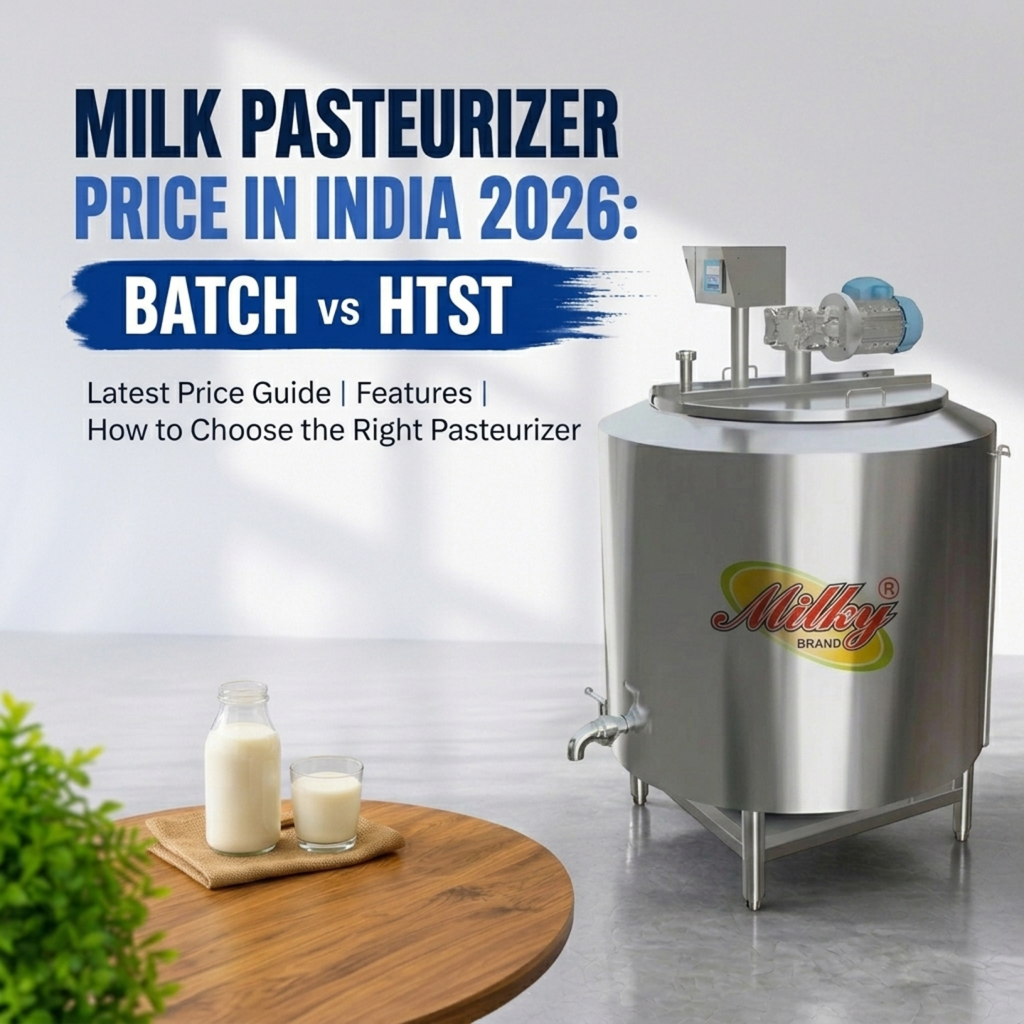
A batch milk pasteurizer in India typically costs ₹95,000 to ₹4,00,000, depending on capacity (100L to 1000L), automation level, and material grade (SS304 vs SS316). An HTST (continuous flow) pasteurizer starts around ₹2,40,000 for a 100–300 LPH skid-mounted unit and can run ₹6,00,000 to ₹28,00,000+ for 1000–5000 LPH systems with heat recovery, PLC automation, and an in-built balance tank (IBT).
The exact price for your dairy depends on five factors:
- Capacity — the single biggest price driver
- Batch vs HTST — HTST costs more upfront but far less per litre at volume
- Automation — manual, semi-automatic (PLC + touchscreen), or fully automatic
- Material grade — SS304 (standard, FSSAI-compliant) vs SS316 (export/corrosive environments)
- Heating system and utilities — electric heaters vs steam/hot-water jacket, plus your existing boiler/steam infrastructure
Batch Milk Pasteurizer — Price by Capacity
| Capacity | Estimated Price Range (₹) | Recommended For |
|---|---|---|
| 100 L | ₹95,000 – ₹1,65,000 | Home dairies, small startups, curd/paneer units |
| 200 L | ₹1,40,000 – ₹2,00,000 | Small dairy farms, milk collection centres |
| 300 L | ₹1,35,000 – ₹2,50,000 | Growing cooperatives, sweet/mithai manufacturers |
| 500 L | ₹1,70,000 – ₹2,65,000 | Mid-sized dairy plants, branded milk units |
| 1000 L | ₹1,99,000 – ₹4,00,000 | Large batch operations before HTST becomes viable |
HTST (Continuous) Pasteurizer — Price by Throughput
| Capacity | Estimated Price Range (₹) | Recommended For |
|---|---|---|
| 100–300 LPH | ₹2,40,000 – ₹2,95,000 | Entry-level continuous processors, small commercial dairies |
| 500 LPH | ₹2,95,000 – ₹8,00,000 | Mid-size plants; range depends heavily on automation and IBT |
| 1000 LPH | ₹4,00,000 – ₹8,50,000 | Established dairy plants scaling production |
| 2000 LPH | ₹6,50,000 – ₹9,00,000+ | Large cooperatives, high-volume processing units |
| 5000 LPH | ₹9,00,000 – ₹28,00,000+ | Industrial dairy plants; wide range reflects heat-recovery %, SS316 build, full PLC/SCADA |
Note: These are indicative market ranges compiled from current supplier listings, not fixed quotes. Actual pricing depends on automation grade, heat-recovery efficiency, material grade, IBT inclusion, installation, and freight. Always request itemized quotations.
Batch Milk Pasteurizer — Full Explainer
Working principle: A batch pasteurizer heats a fixed volume of milk to a set temperature (typically 63°C) and holds it there for 30 minutes the Low Temperature Long Time (LTLT) method before cooling it down. The milk sits in a jacketed, insulated stainless steel tank; hot water or an electric/gas heating element circulates in the outer jacket while an agitator (gearbox + motor) keeps the milk moving so heat distributes evenly. Mahesh Eng. Works’ own BMP line, for example, uses an SS304 insulated and jacketed tank with electric or gas heating and a 3-phase gearbox agitator a fairly standard configuration across Indian manufacturers.
Advantages
- Low upfront cost compared to HTST systems
- Simple to operate — minimal training needed
- Flexible: same tank can process milk, curd base, flavoured milk, or paneer/khoa feedstock in different batches
- Easy to clean manually or with a basic CIP setup
- No continuous-flow plumbing or large utility load required
Limitations
- Slower throughput — a full batch cycle (heat, hold, cool) can take 60–90+ minutes depending on volume and heating method
- Higher labour involvement per litre processed than HTST
- Less energy-efficient at scale — no heat recovery between incoming raw milk and outgoing pasteurized milk
- Becomes impractical beyond roughly 1000–2000 L/day of throughput, where continuous systems start winning on cost-per-litre
Ideal users: Small dairy farms, milk collection centres, dairy startups, sweet and mithai manufacturers, curd/paneer units, and cooperatives processing under ~1,500–2,000 litres a day.
Typical price range: ₹95,000 – ₹4,00,000, scaling with capacity (100 L to 1000 L). Automation (manual vs semi-automatic touch controls) and heating method (electric vs gas/steam) are the two biggest swing factors within a given capacity band.
Operating cost: Running cost is driven mainly by heating fuel/electricity and labour time per batch, since every batch needs to be heated from scratch there’s no heat recovery. Electric-heated units draw more grid power per cycle; gas or steam-jacketed units can be cheaper to run where a boiler or LPG line is already in place. Per-litre energy cost on a batch system typically runs noticeably higher than on an HTST system of comparable output, because HTST reclaims heat from outgoing pasteurized milk to preheat incoming raw milk.
Maintenance: Straightforward periodic gasket/seal checks on the agitator shaft, descaling of the heating jacket (especially with hard water), and routine cleaning of the tank interior. No plate packs or complex control valves to service, keeping annual maintenance costs low relative to HTST.
Best applications: Small to mid-scale dairy processing (100–1000 L/batch); multi-product units switching between milk, curd, paneer, and khoa; operations without existing continuous-process utility infrastructure; businesses prioritizing low capital investment over maximum throughput.
Also Read: How Small Dairies Improve Milk Quality Using a Batch Pasteurizer
HTST (Continuous) Pasteurizer — Full Explainer
Working principle: An HTST (High Temperature Short Time) pasteurizer runs milk continuously through a plate heat exchanger (PHE) rather than heating it in a static tank. Milk flows between thin stainless steel plates, gets rapidly heated to ~72°C, is held at that temperature for 15–16 seconds in a holding tube, then flows into a regeneration section where it pre-heats incoming raw milk recovering a large share of the heat energy before final cooling. Complete HTST systems are almost always specified with a balance tank, milk pump, inline filter, holding tube, hot and chilled water circuits, and a control panel not just the plate pack alone.
Advantages
- Processes large volumes continuously — no batch downtime between cycles
- Heat recovery (regeneration) cuts energy cost per litre significantly versus batch heating
- Gentler, more consistent thermal treatment — better milk quality retention at scale
- Scales cleanly from 100 LPH skid units to 5,000+ LPH industrial lines
- Lower labour cost per litre once running
Limitations
- Higher upfront capital cost than a batch system of similar daily output
- Requires more technical know-how to operate, monitor, and clean (CIP)
- Plate packs and gaskets need periodic replacement — a real spare-parts line item
- Not economical for very small or irregular production volumes
Heat recovery: Regeneration efficiency how much heat is recovered from outgoing pasteurized milk to preheat incoming raw milk is one of the biggest differentiators between HTST systems at the same LPH rating. Higher regeneration efficiency (commonly quoted in the 85–95% range) means lower ongoing hot-water/steam and chilling costs, which is why two systems rated at “1000 LPH” can carry very different price tags and running costs.
Automation: HTST systems range from semi-automatic (manual valve operation, panel-mounted temperature indicators) to fully automatic with PLC/SCADA control, automatic flow-diversion valves (rerouting under-pasteurized milk for reprocessing), and touchscreen HMI. Automation level is one of the largest swing factors in price within a given LPH bracket.
Production capacity: Entry HTST skids start around 100–300 LPH; mid-range plants run 500–2000 LPH; industrial lines run 5000 LPH and above, often built from AISI 316 stainless steel for higher regeneration efficiency and durability.
ROI: Because HTST reduces both labour-hours and energy cost per litre versus batch processing, payback shortens as daily volume rises. A plant processing under ~1,000 L/day rarely recovers the extra capital cost quickly; a plant running several thousand litres a day typically does, often within 1–3 years though the exact payback depends on your energy tariff, labour cost, and existing system’s condition.
Operating cost: Lower per-litre than batch at volume, thanks to regeneration, but HTST carries a higher fixed operating-cost baseline CIP chemicals, plate pack gasket wear, pump maintenance, and a trained operator. Below a certain daily volume, this fixed cost outweighs the per-litre savings.
Best applications: Dairy plants processing 500+ litres per hour on a regular schedule; cooperatives and branded milk businesses needing consistent, high-volume throughput; operations planning to scale over the next few years; export-oriented processors needing tighter, more consistent pasteurization control.
Batch vs HTST — Comparison Table
| Factor | Batch Pasteurizer | HTST Pasteurizer |
|---|---|---|
| Capacity | 100–1000 L per batch | 100–5000+ LPH continuous |
| Investment | ₹95,000 – ₹4,00,000 | ₹2,40,000 – ₹28,00,000+ |
| Operating Cost | Higher per litre (no heat recovery) | Lower per litre at volume (regeneration) |
| Automation | Manual to semi-automatic | Semi-automatic to full PLC/SCADA |
| Production Speed | Slower — 60–90+ min per batch cycle | Continuous — thousands of litres/hour |
| Energy Efficiency | Lower — full reheat every batch | Higher — regenerative preheating |
| Heat Recovery | None | Typically 85–95% regeneration |
| Cleaning | Manual or basic CIP | CIP standard, plate pack cleaning needed |
| Maintenance | Low — simple mechanical parts | Higher — plate packs, gaskets, valves |
| Labour | More labour-hours per litre | Fewer labour-hours per litre |
| Scalability | Limited beyond ~1,500–2,000 L/day | Scales smoothly with LPH-rated units |
| Milk Quality Consistency | Good, batch-to-batch variation possible | Very consistent, tighter thermal control |
| Shelf Life Impact | Standard pasteurized shelf life | Comparable, sometimes marginally better |
| Best Use | Small/mid dairies, multi-product units | Volume dairies, cooperatives, exporters |
| ROI Timeline | Fast payback, low investment | Longer payback, better economics at scale |
Factors Affecting Milk Pasteurizer Price
| Factor | How It Affects Price |
|---|---|
| Capacity | Largest driver — price scales with tank volume (batch) or LPH rating (HTST) |
| Material Grade | SS316 costs more than SS304; needed for corrosion resistance or certain export markets |
| Automation | Manual < semi-automatic (PLC) < fully automatic (PLC + SCADA + touchscreen) |
| Heating Method | Electric heaters are cheaper to install but costlier to run than steam/gas-jacketed systems where boiler infrastructure exists |
| PLC | Adds cost but reduces labour dependency and improves consistency |
| Touchscreen HMI | Incremental cost over basic panel indicators; better control and data logging |
| Heat Exchanger Quality | Higher regeneration-efficiency plate packs cost more upfront but cut running costs (HTST only) |
| Insulation | Better insulation reduces heat loss and long-term energy cost |
| CIP System | Automated CIP adds cost but reduces cleaning labour and downtime |
| Utilities | Steam boiler, chilled water plant, and electrical capacity may need upgrading — often the biggest hidden cost |
| Installation | Site prep, piping, electrical work, and commissioning add to the quoted machine price |
| Warranty | Longer/more comprehensive warranties are typically reflected in list price |
| After-Sales Service | Manufacturers with dedicated service networks may price slightly higher but reduce downtime risk |
Buying Guide
- Is the quoted price ex-factory or does it include installation, commissioning, and freight?
- What’s the exact material grade (SS304 vs SS316) for product-contact parts?
- What’s the regeneration efficiency (HTST only), and is it tested or estimated?
- What utilities (electrical load, steam/boiler capacity, water) does the machine require?
- What’s covered under warranty, and for how long?
- What’s the typical lead time from order to installation?
- Where are spare parts (gaskets, plates, heaters) sourced, and how fast can they be replaced?
Hidden costs to watch for: Installation, piping, and electrical work not included in the machine price; utility upgrades (boiler capacity, chiller sizing, electrical panel); CIP chemicals and consumables; freight and insurance for larger HTST systems; operator training.
Expansion planning: Buy for your production volume 2–3 years out, not just today’s output — undersizing is one of the most expensive mistakes to correct later, since it usually means a full replacement rather than an upgrade.
Utility requirements: Confirm electrical supply (single vs 3-phase), water availability and quality (hard water accelerates jacket scaling), and for HTST steam or hot water generation capacity before finalizing.
Mistakes to avoid: Comparing quotes without confirming material grade and automation level are identical; ignoring installation and utility costs; buying capacity based only on today’s volume.
Quotation comparison tips: Normalize every quote to the same basis capacity, material grade, automation level, and what’s included (installation, warranty, spares) before comparing headline prices.
ROI Example
(Illustrative only — actual figures depend on local energy tariffs, labour costs, and production schedule.)
- Small Dairy (200 L batch/day): A ₹1.5–2 lakh batch pasteurizer suits this volume well. The labour and energy savings from an HTST system rarely justify the extra ₹1–5 lakh+ investment at this scale batch stays the more economical choice.
- Medium Dairy (1000 LPH, scaling toward continuous processing): A mid-range HTST system (₹4–8 lakh) starts paying back through reduced labour-hours per litre and regenerative energy savings, typically within 2–3 years of consistent operation.
- Large Dairy (5000+ LPH): At this volume, per-litre energy and labour savings compound significantly. Even a higher-spec system (₹9–28 lakh+) can show favorable payback within 1–2 years of full-capacity operation.
Common Buying Mistakes
- Buying based on today’s volume instead of 2–3 year growth projections
- Comparing quotes without matching material grade (SS304 vs SS316)
- Ignoring installation, piping, and electrical costs in the headline price
- Not confirming utility requirements (steam, water, electrical load) before ordering
- Choosing the cheapest quote without checking automation level included
- Overlooking after-sales service and spare-parts availability
- Skipping FSSAI compliance verification for product-contact materials
- Underestimating CIP and cleaning labour requirements
- Not asking about warranty terms and what’s actually covered
- Choosing HTST for very low, irregular volumes where batch is more economical
- Failing to plan for boiler/utility upgrades a new pasteurizer may require
Frequently Asked Questions
How much does a milk pasteurizer cost in India?
Batch pasteurizers range from ₹95,000 to ₹4,00,000 depending on capacity (100–1000 L). HTST systems start around ₹2,40,000 for small skids and go up to ₹28,00,000+ for large 5000 LPH industrial lines. Exact pricing depends on automation, material grade, and utilities.
What’s the difference between batch and HTST pasteurizers?
Batch pasteurizers heat a fixed volume of milk in a tank and hold it for 30 minutes at 63°C. HTST pasteurizers continuously flow milk through a plate heat exchanger, heating it to ~72°C for 15–16 seconds. HTST is faster and more energy-efficient at volume; batch is cheaper and simpler.
Which milk pasteurizer is best for a small dairy?
A batch pasteurizer is usually best for small dairies processing under 1,000–1,500 litres a day. It has lower upfront cost, simpler operation, and flexibility to also process paneer, curd, or khoa feedstock in the same tank.
What is the price of a 200-litre batch pasteurizer?
A 200-litre batch pasteurizer typically costs between ₹1,40,000 and ₹2,00,000 in India, depending on heating method (electric vs gas), automation level, and material grade.
How much does an HTST pasteurizer cost?
Entry-level HTST systems (100–300 LPH) start around ₹2,40,000. Mid-range 1000 LPH systems run ₹4,00,000–₹8,50,000, and large 5000 LPH industrial systems can cost ₹9,00,000 to ₹28,00,000+ depending on automation and heat-recovery efficiency.
Is HTST better than batch pasteurization?
Neither is universally “better” it depends on volume. HTST is more energy- and labour-efficient at high volumes (500+ LPH sustained), while batch is more cost-effective and flexible for smaller, irregular production.
What material should a milk pasteurizer be made of?
Most Indian-market pasteurizers use SS304 stainless steel, which meets FSSAI food-grade requirements. SS316 is used where higher corrosion resistance is needed, such as certain export markets or aggressive cleaning regimes.
How long does a batch pasteurization cycle take?
A full batch cycle heating, holding, and cooling typically takes 60–90 minutes or more, depending on batch volume and heating method. This is significantly slower than HTST’s continuous processing.
What is the maintenance cost of a milk pasteurizer?
Batch pasteurizers have low maintenance costs mainly gasket checks and jacket descaling. HTST systems cost more to maintain due to plate pack gaskets, valves, and pumps, but the added cost is usually offset by labour and energy savings at volume.
How much electricity does a milk pasteurizer consume?
Electricity consumption depends on capacity, heating method, and insulation quality. Electric-heated batch systems draw more power per cycle since there’s no heat recovery, while HTST systems consume less electricity per litre due to regenerative preheating.
Can one pasteurizer process both cow and buffalo milk?
Yes, both batch and HTST pasteurizers can process cow, buffalo, or mixed milk without modification the pasteurization principle (time and temperature) is the same regardless of milk source.
What capacity pasteurizer do I need for my dairy?
Capacity should be based on your daily milk volume plus 2–3 years of projected growth, not just current output. As a rough guide, batch systems suit up to ~1,500–2,000 L/day; beyond that, HTST becomes more economical.
Can a batch pasteurizer be upgraded to HTST later?
Not directly — they use fundamentally different equipment (tank vs plate heat exchanger). Most dairies scaling up purchase a separate HTST system rather than converting, though the batch unit can often continue serving smaller or secondary production needs.
How long do milk pasteurizers typically last?
With proper maintenance, stainless steel pasteurizers both batch and HTST commonly run for 10–15+ years, though plate pack gaskets and heating elements are wear items that need periodic replacement well before that.
Should I buy from a local supplier or a specialized dairy equipment manufacturer?
A specialized dairy equipment manufacturer typically offers better after-sales support, spare-parts availability, and application knowledge specific to milk processing important given how much price and performance vary with automation, material grade, and utility requirements.
Conclusion
If you’re processing under roughly 1,500–2,000 litres a day, or you need flexibility to switch between milk, curd, paneer, and khoa production in the same equipment, a batch pasteurizer is the more sensible investment — lower capital cost, simpler operation, and easier maintenance. Once your volume climbs past that threshold on a consistent basis, an HTST system starts earning its higher upfront cost back through lower energy and labour cost per litre, tighter process consistency, and room to scale without adding more tanks.
Neither choice is universally “better” it comes down to your current volume, your growth plan over the next few years, and the utility infrastructure you already have or are willing to build. With three decades of manufacturing dairy processing equipment for operations across India and 25+ export markets, Mahesh Eng. Works has helped dairies at both ends of that spectrum size their pasteurization setup correctly the first time worth a conversation before you commit to a capacity you may outgrow, or overpay for one you won’t use.

Mahesh Eng. Works
Written and reviewed by Mahesh Eng. Works, a dairy machinery manufacturer specializing in milk cream separator machines and hygienic stainless steel dairy equipment. Since 1980, we have been designing and manufacturing cream separators, butter churners, milk pasteurizers, bulk milk coolers, and complete dairy processing solutions for dairy farms, milk collection centers, and processing plants.