

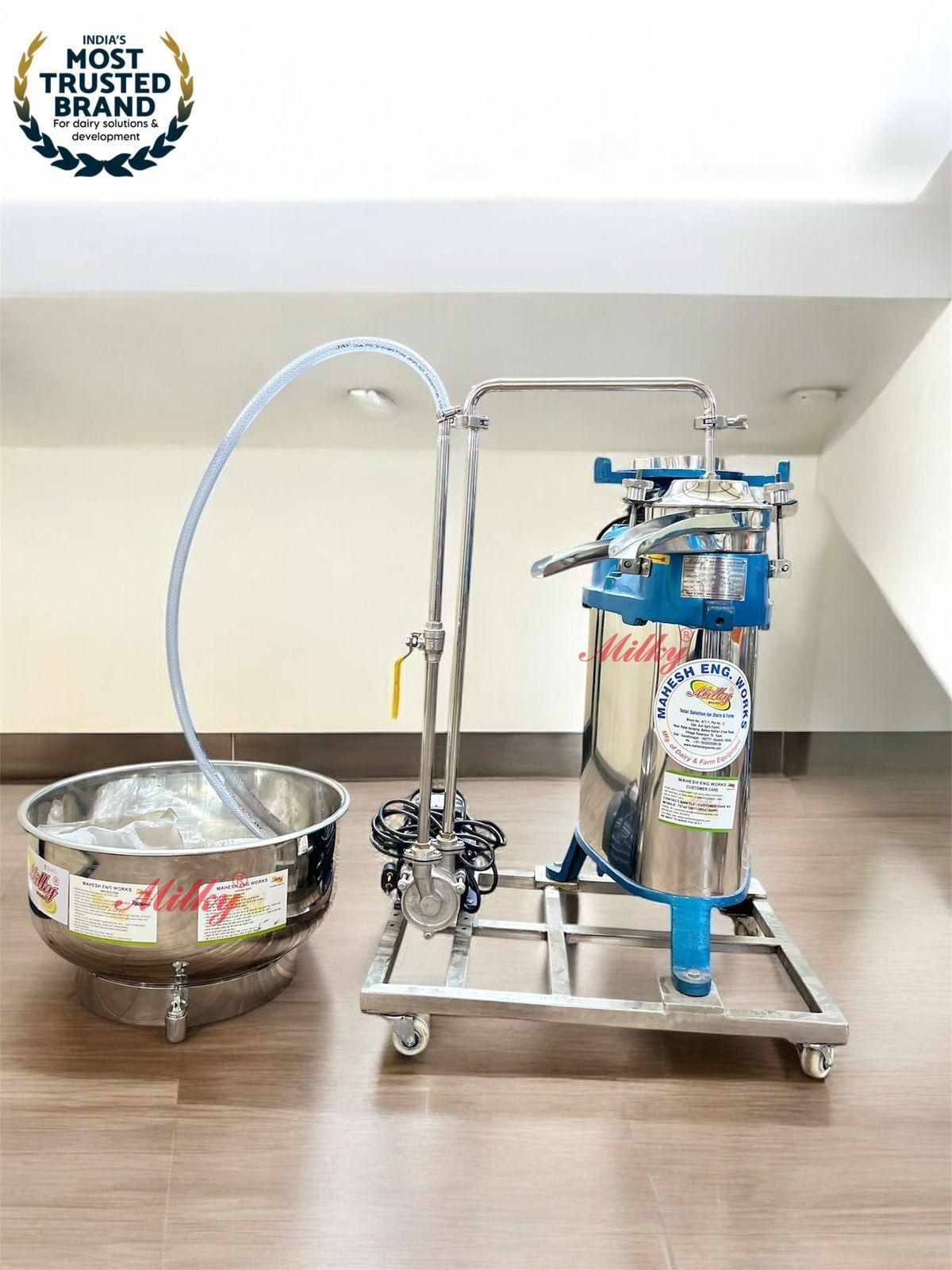
Leading Cream Separator Manufacturers for Dairy Farms & Processing Plants
Mahesh Eng. Works is one of the trusted Milk Cream Separator Manufacturers in India, designing and manufacturing high-performance cream separator machines for dairy farms, milk collection centres, cooperative dairies, ghee plants, butter manufacturers, and commercial dairy processing units. With over 45 years of experience in dairy equipment manufacturing, we deliver reliable cream separation solutions that help dairy businesses improve cream recovery, standardize milk fat, and increase production efficiency.
Why Choose Mahesh Eng. Works as a Cream Separator Manufacturer?
Mahesh Eng. Works has been manufacturing dairy processing equipment under the Milky Brand since 1994. Apart from cream separators, we manufacture a complete range of dairy processing equipment including Milk Pasteurizer Machines, Bulk Milk Coolers, Milk Homogenizer Machines, Butter Churner Machines, and Ghee Clarifier Machines, enabling customers to establish complete dairy processing lines from milk reception to finished products.
Three decades of manufacturing experience provide practical knowledge of dairy operations and help customers select compatible equipment based on processing capacity and production requirements.
- Food-grade stainless steel construction: All product-contact components are fabricated from SS304, meeting FSSAI requirements for dairy equipment used in India and food safety standards applicable in our export markets.
- Capacity customization: We manufacture cream separators from 50 LPH to 5,000 LPH. Non-standard capacities can be discussed our engineering team will review feasibility and cost implications honestly.
- Quality testing before dispatch: Each machine undergoes a run-test at rated RPM. Bowl balance is verified during assembly. We do not dispatch machines that show excessive vibration or fail the skim milk residual fat check.
- Technical support: Our team provides installation guidance, operating instructions in English and Gujarati/Hindi, and direct access to our technical team for commissioning support.
- Export capability: Mahesh Eng. Works exports to 25+ countries across Africa, Southeast Asia, and the Middle East. Our packaging, documentation, and compliance team supports export orders.
- Experience in dairy machinery manufacturing: Three decades of producing dairy equipment including milk homogenizers, bulk milk coolers, and pasteurizers gives our team practical knowledge of how dairy operations work in Indian conditions.
Applications of Cream Separator Machines
Cream separator machines are used across the dairy value chain from individual farms to large-scale industrial processing facilities. Any operation that needs to separate fat from whole milk, standardize fat content, or recover cream for value-added products requires a cream separator.
- Dairy farms: Separating cream from farm-fresh milk for direct sale or further processing. Skim milk is fed back to calves or sold separately.
- Milk collection centers: Processing collected milk before chilling, enabling fat standardization to FSSAI-prescribed levels for different milk grades. Milk is commonly stored in a Bulk Milk Cooler before further processing.
- Sweet manufacturers (mithai units): Recovering cream for use in khoa (mawa), rabri, and milk-based confectionery. Sweet manufacturers often use Paneer Making Machines and khoya processing equipment alongside cream separators.
- Ghee plants: Cream separation is the first step in ghee production. High cream recovery directly affects ghee yield and profitability.
- Ice cream plants: Producing high-fat cream (38–45% fat) required for premium ice cream formulations.
Dairy processing plants: Fat standardization for toned milk, double-toned milk, and skimmed milk manufacturing per FSSAI standards.
What Is a Milk Cream Separator?
A milk cream separator is a centrifugal machine that spins milk at high speed to separate fat (cream) from skim milk. Inside a rotating bowl assembly, heavier skim milk moves outward while lighter fat globules concentrate toward the center, exiting through separate outlets. Cream separators are used in dairy farms, collection centers, ghee plants, ice cream factories, and paneer production units.
Our Cream Separator Manufacturing Capabilities
Cream separator manufacturers produce machines ranging from small farm-scale units to large industrial separators. The quality of a manufacturer depends on the grade of stainless steel used, the precision of bowl assembly, dynamic balancing during production, and the range of capacities available.
Food Grade SS304 Construction
All product-contact surfaces the bowl, disc stack, cream outlet, and skim milk outlet are fabricated from AISI 304 stainless steel (SS304). This grade meets food-contact safety requirements under FSSAI guidelines and international food-grade standards. SS304 resists corrosion from milk acids and lactic acid generated during processing, and it tolerates standard CIP (clean-in-place) chemicals without surface degradation.
Outer frames and non-contact components are typically constructed from mild steel with appropriate surface treatment, or SS304 when hygienic design is a priority for the buyer.
Precision Bowl Assembly
The bowl assembly is the heart of a cream separator. It houses the disc stack a series of conical discs spaced 0.3–0.5 mm apart that dramatically increase the effective separation surface area. Bowl components are machined to tight tolerances to prevent vibration at high RPM (typically 6,000–9,000 RPM for electric models). Disc stacks are pressed from SS304 sheet and deburred to avoid surface contamination.
Gaskets and seals between bowl sections use food-grade rubber or silicone compounds that resist milk fats and cleaning agents. Bowl assembly quality directly determines both separation efficiency and machine lifespan.
Dynamic Balancing and Quality Testing
A poorly balanced bowl creates vibration that damages bearings and reduces separation accuracy. At Mahesh Eng. Works, bowl assemblies undergo dynamic balancing before installation. Each machine is test-run at rated RPM to verify that vibration levels, cream outlet flow, and skim milk purity meet specification before dispatch.
Quality testing includes checking bowl seating, verifying outlet pressures, and confirming that residual fat content in skim milk falls within acceptable limits (typically below 0.05% fat by weight at rated capacity).
Custom Capacity Options
Standard cream separator machines are produced in fixed capacity tiers. However, dairy processing requirements vary considerably a small farmer needs 50 LPH while a cooperative may require 500 LPH or more. Manufacturers like Mahesh Eng. Works offer capacity customization by modifying bowl dimensions, motor size, and disc stack count to match the buyer’s throughput and cream recovery targets.
How Does a Cream Separator Machine Work?
A cream separator uses centrifugal force generated by a high-speed rotating bowl to push heavier skim milk outward and allow lighter cream to collect at the center. Milk enters from the top, passes through a disc stack, and exits from two separate outlets one for cream and one for skim milk.
1. Milk enters the bowl assembly. Pre-warmed milk (ideally 35–40°C) is fed into the center of the rotating bowl through the inlet. Proper temperature reduces fat globule clustering and improves flow through the disc stack.
2. Centrifugal force separates fat globules. As the bowl spins at 6,000–9,000 RPM, centrifugal acceleration pushes denser skim milk outward and allows lighter fat globules to move inward toward the central axis.
3. Cream moves inward and concentrates. Fat globules accumulate near the bowl axis, where they form a cream layer. The disc stack ensures this separation happens across a large surface area in a short time.
4. Skim milk moves outward. Denser skim milk is forced to the outer edge of the bowl, where it flows upward through peripheral channels.
5. Separate outlets discharge cream and skim milk. Cream exits through the cream outlet (inner channel) and skim milk exits through the skim milk outlet (outer channel) simultaneously, allowing continuous processing.
Stage What Happens Key Parameter
Cream Separation Process at a Glance
| Stage | What Happens | Key Parameter |
| 1. Milk Feed | Milk enters bowl center via inlet | Temperature: 35–40°C ideal |
| 2. Rotation | Bowl spins at high RPM | RPM: 6,000–9,000 |
| 3. Separation | Fat moves inward; skim milk moves outward | G-force: 3,000–6,000× gravity |
| 4. Disc Stack | Increases effective separation surface | Disc spacing: 0.3–0.5 mm |
| 5. Discharge | Cream and skim milk exit separately | Cream fat: 30–45% typical |
Types of Milk Cream Separator Machines
Cream separator machines fall into three main categories based on drive mechanism and capacity: manual (hand-cranked), electric (motor-driven), and industrial (high-volume, continuous). Choosing the right type depends on processing volume, power availability, and whether operation is continuous or batch.
Manual Cream Separator
Manual cream separators are hand-cranked machines designed for small-scale farm use. The operator turns a handle to bring the bowl up to separation speed. Typical capacity ranges from 30 to 100 LPH. These machines require no electricity, making them suitable for remote dairy farms without reliable power supply.
Suitable applications: Small dairy farms (5–20 cattle), household ghee production, remote locations without power infrastructure.
Electric Cream Separator
Electric cream separators use an induction motor (typically 0.25 HP to 1 HP) to drive the bowl at consistent RPM. This eliminates operator fatigue and delivers more uniform separation because bowl speed does not fluctuate. Capacities typically range from 100 LPH to 1,000 LPH.
Suitable applications: Medium-sized dairy farms, milk collection centers, small cooperative dairies, paneer and ghee production units.
Industrial Cream Separator
Industrial cream separators are continuous-flow machines built for high-volume dairy processing. They incorporate automatic desludging (periodic discharge of solids), high-capacity disc stacks, and robust motor drives. These machines can process 2,000 LPH to 10,000 LPH or more and are designed for integration into CIP systems.
Suitable applications: Dairy processing plants, large cooperatives, butter and cheese factories, ice cream manufacturing units.
Cream Separator Capacity Guide
| Capacity (LPH) | Suitable Application | Typical Power (HP) | Drive Type |
| 50 | Small farm, 5–10 cattle, household ghee production | Manual / 0.25 HP | Manual or electric |
| 100 | Medium farm, 10–25 cattle, small dairy entrepreneur | 0.25–0.5 HP | Electric |
| 300 | Milk collection center, cooperative (small), paneer unit | 0.5–1 HP | Electric |
| 500 | District-level cooperative, ghee manufacturing unit | 1–1.5 HP | Electric |
| 1,000 | Small dairy processing plant, butter production unit | 1.5–3 HP | Electric |
| 5,000 | Large dairy plant, industrial butter/cream processing | 5–10 HP | Industrial electric |
How to Choose the Right Capacity: Divide your total daily milk volume (litres) by the number of operating hours per day. For example, if you collect 1,200 litres per day and operate the separator for 4 hours, you need a minimum 300 LPH machine. Add a 20–25% buffer to avoid running the machine at continuous maximum load, which extends machine life.
Key Features:
We have 300 ltr., 550 ltr., 750 ltr., 1000 ltr., and 1500 ltr. cream separators on a skid/cart that can be easily moved anywhere. It runs on 220v., 60 Hz., and includes a stainless steel pump.
- Cream separation is done quickly.
- Increased service life
- Sturdy construction
Factors to Consider When Choosing Cream Separator Manufacturers
Selecting a cream separator manufacturer goes beyond comparing cream separator machine Price. Key criteria include manufacturing experience, material grade, the range of capacities offered, testing procedures before dispatch, and the availability of after-sales service and spare parts.
Manufacturing Experience
Dairy equipment manufacturing requires process knowledge that accumulates over years of production and field feedback. Manufacturers with long track records have typically refined their bowl geometry, disc stack tolerances, and seal materials through real-world use. Ask for references from existing customers, especially those with similar capacity requirements.
Material Grade
Confirm that all product-contact surfaces are SS304 or higher. Some lower-cost machines use SS202 or even food-grade plastic for disc stacks and bowls. SS202 contains manganese instead of nickel and offers lower corrosion resistance, which shortens machine life in a dairy environment. Request a material test certificate or at minimum a written specification.
Capacity Availability
A manufacturer that stocks or produces multiple capacity tiers can supply replacement or upgrade equipment as your dairy operation grows. Single-capacity manufacturers offer less flexibility when business needs change.
Testing Procedures
Ask whether the manufacturer runs each machine at rated RPM and rated flow before dispatch, and whether residual fat in skim milk is measured during testing. Manufacturers who test performance rather than just checking assembly deliver machines that perform to specification from the first day of operation.
After-Sales Service
Cream separator failure during peak milk flush (October–March in India) causes immediate revenue loss. Evaluate whether the manufacturer offers a service helpline, field service capability, and a clear warranty period (typical: 12 months on manufacturing defects).
Spare Parts Support
Wearing parts seals, gaskets, bearings, and drive belts need periodic replacement. A manufacturer who stocks these parts and can dispatch them within 24–48 hours prevents extended downtime. Ask specifically about disc stack replacement availability, since this is the most commonly worn component in high-use machines.
Frequently Asked Questions
What do cream separator manufacturers do?
Cream separator manufacturers design, manufacture, test, and supply centrifugal machines that separate cream from milk. They also provide installation support, spare parts, customization, and after-sales service for dairy farms and milk processing plants.
Which capacity cream separator should I choose?
Choose a cream separator based on your daily milk volume and operating hours. Divide the total milk processed per day by the number of processing hours, then add a 20–25% capacity margin for future growth.
For example, processing 1,200 litres of milk in 4 hours requires approximately a 300 LPH cream separator.
What material is used in cream separator machines?
Food-grade AISI 304 stainless steel (SS304) is the preferred material for cream separator machines because it is corrosion-resistant, hygienic, and suitable for dairy processing.The bowl assembly, disc stack, cream outlet, and skim milk outlet should all be manufactured from SS304 for long-term durability.
What is cream recovery efficiency?
Cream recovery efficiency is the percentage of milk fat successfully separated from whole milk. A properly operated cream separator typically recovers 95–98% of available cream while leaving very little fat in skim milk.
Milk temperature, bowl speed, and machine cleanliness all affect recovery efficiency.
Can cream separators process buffalo milk?
Yes. Cream separator machines are suitable for both buffalo milk and cow milk. Buffalo milk generally produces more cream because it contains a higher fat percentage.For best results, process buffalo milk at 35–40°C.
How much electricity does a cream separator consume?
Electricity consumption depends on machine capacity and motor size. Most commercial cream separator machines use motors ranging from 0.25 HP to 3 HP. For example, a 500 LPH cream separator typically consumes around 3–4.5 kWh during four hours of operation.
What is the RPM of a cream separator machine?
Most electric cream separator machines operate between 6,000 and 9,000 RPM to achieve efficient cream separation. Manual models generally operate at lower speeds.Maintaining the recommended operating RPM is essential for consistent cream recovery.
What is the difference between manual and electric cream separators?
Manual cream separators are hand-operated and ideal for small dairy farms without reliable electricity. Electric cream separators use a motor to provide consistent speed, higher productivity, and better cream recovery.
Commercial dairy businesses generally prefer electric models because they reduce labour and improve efficiency.
Which industries use cream separator machines?
Cream separator machines are used in dairy farms, milk collection centres, cooperative dairies, ghee plants, butter factories, ice cream plants, paneer units, cheese plants, and commercial dairy processing facilities.
They are suitable for any dairy business that separates cream or standardizes milk fat.
How long does a cream separator machine last?
A high-quality SS304 cream separator typically lasts 10–15 years with proper cleaning, regular maintenance, and timely replacement of wear parts.Routine servicing helps maintain efficient cream separation and extends machine life.
What is the ideal milk temperature for cream separation?
The ideal milk temperature for cream separation is between 35°C and 40°C. This temperature reduces milk viscosity and improves cream recovery efficiency.Milk processed at lower temperatures may produce lower separation efficiency.
What is the fat content of cream produced by a separator?
Most cream separator machines produce cream containing approximately 30–45% milk fat. The final fat content can be adjusted by changing the cream screw setting. Higher fat cream is commonly used for butter, ghee, and premium ice cream production.
How often should a cream separator be cleaned?
A cream separator should be cleaned after every production shift or daily after use. Regular cleaning prevents milk residue buildup, maintains separation efficiency, and improves food safety.Use approved dairy cleaning chemicals and follow the manufacturer’s maintenance guidelines.
Do cream separators require FSSAI compliance in India?
Yes. Cream separator machines manufactured with food-grade SS304 stainless steel are suitable for use in dairy processing facilities operating under FSSAI hygiene requirements.Always verify the material specification before purchasing.
What spare parts should I keep in stock?
The most important spare parts include bowl gaskets, seals, bearings, drive belts, and cream outlet components. Keeping these parts available helps minimize production downtime. Regular inspection also improves machine reliability.
Can Mahesh Eng. Works supply cream separators for export?
Yes. Mahesh Eng. Works manufactures and exports milk cream separator machines to more than 25 countries, supplying complete documentation, export packaging, and technical support for international customers.

Mahesh Eng. Works
Written and reviewed by Mahesh Eng. Works, a dairy machinery manufacturer specializing in milk cream separator machines and hygienic stainless steel dairy equipment. Since 1994, we have been designing and manufacturing cream separators, butter churners, milk pasteurizers, bulk milk coolers, and complete dairy processing solutions for dairy farms, milk collection centers, and processing plants.