

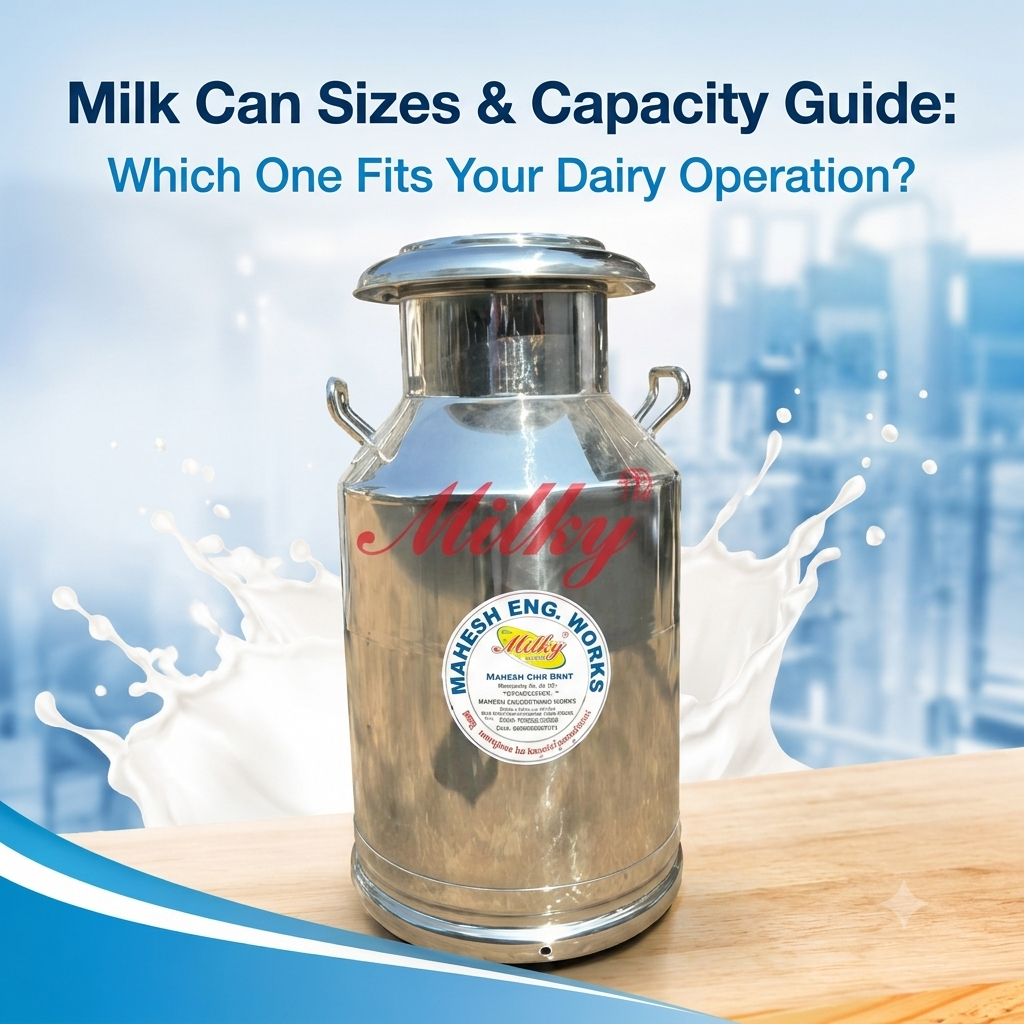
What Is a Milk Can?
A milk can is a food-grade metal container designed for collecting, storing, and transporting raw milk between the point of milking and the point of processing.
- Purpose: Safely holds milk during milking, farm storage, and transit to a collection center or plant
- Role in the supply chain: Bridges the gap between individual farmers/small dairies and centralized collection or processing points
- Traditional aluminum cans: Lightweight, long an industry standard under BIS specification IS 1825:1983, still common for farm-to-collection-center transport
- Stainless steel cans (SS304/SS316): More corrosion-resistant, easier to sanitize, and increasingly preferred at collection centers and processing plants where cans are cleaned and reused at high frequency
Standard Milk Can Sizes in India
Milk cans are commonly available in 5L, 10L, 20L, 30L, 40L, and 50L capacities, with custom sizes made to order. Under IS 1825:1983, 20L, 30L, 40L, and 50L are the standard transport capacities 40 litres is the most widely used size in India, having become the de facto standard during the Operation Flood era.
| Capacity | Typical Use | Best Suited For |
|---|---|---|
| 5–10L | Individual household/small farm collection | 2–5 animals |
| 20L | Small farm storage, short-distance transport | 5–15 animals |
| 30L | Mid-size farm-to-center transport | 15–30 animals |
| 40L | Industry-standard collection & bulk transport | 30+ animals, collection centers |
| 50L | High-volume collection, cooperative routes | Collection centers, cooperatives |
| Custom | Plant-specific handling needs | Processing plants, institutional buyers |
Exact dimensions and weights vary by manufacturer and wall thickness ask us for size-specific specs before ordering.
40-Litre Milk Can: Full Specifications
Since 40L is the industry-standard size, here’s a direct comparison of MILKY®’s two 40-litre options — stainless steel and aluminum so you can see exactly what you’re choosing between.
| Specification | 40 LTR SS Can | Milk Can 40 LTR (Aluminum) |
|---|---|---|
| Material | Stainless steel, food-grade | Aluminum alloy |
| Finish | Mirror polish | — |
| Weight | 8 kg | 6.5 kg (with lid) |
| Height | — | 591 ± 4 mm |
| Depth | — | 575 ± 3 mm |
| Inside diameter | — | 340 ± 3 mm |
| Mouth diameter | — | 200 ± 5 mm |
| Bottom bend diameter | — | 352 ± 3 mm |
| Wall thickness | — | 2 mm |
| Bottom thickness | — | 3 mm |
| Hardness | — | 85 BHN |
| Price | On request — get a quote | On request — get a quote |
The stainless steel can is roughly 1.5 kg heavier than the aluminum version but offers better corrosion resistance and easier sanitization the trade-off covered in the material comparison below.
How Many Milk Cans Does Your Dairy Need?
The right number of cans depends on your daily production volume, how often you collect, and how much buffer you want for peak-season output. Using 40L as the standard reference size:
| Daily Volume (LPD) | 40L Cans Needed (single collection) | Recommended Setup |
|---|---|---|
| 50 LPD | ~2 cans | 1–2 x 40L, or a single 50L can for small farms |
| 100 LPD | ~3 cans | 3 x 40L, with one spare for rotation while cleaning |
| 300 LPD | ~8 cans | 7–8 x 40L, split across morning/evening collection |
| 500 LPD | ~13 cans | 12–13 x 40L, or transition to a bulk milk cooler at this volume |
| 1000 LPD | ~25 cans | Can-based handling becomes labor-intensive; bulk milk cooler recommended |
| 2000 LPD | ~50 cans | Cans typically used only for backup/short transfers; bulk cooling standard |
As a rule of thumb, add 15–20% extra cans beyond the daily minimum so a set is always available for cleaning or in transit and factor in seasonal flush-season volume increases when deciding your buffer.
Which Size Fits Your Operation?
- Small dairy farms (2–10 animals): 10–20L cans are easier to lift and clean daily; low milk volume doesn’t justify larger cans
- Medium dairy farms (10–40 animals): 20–30L balances handling ease with fewer trips
- Large/commercial dairies: 40L is the practical ceiling for manual lifting when full
- Milk collection centers & cooperatives: Standardize on 40L for compatibility with weighing/testing equipment and transport vehicles
- Milk transportation businesses: 40L cans stack and load most efficiently in standard transport crates
- Institutional dairy plants: Often use a mix — 40–50L for bulk intake, smaller cans for internal sample handling
Stainless Steel vs Aluminum Milk Cans
| Factor | Stainless Steel (SS304) | Aluminum |
|---|---|---|
| Durability | Higher — resists dents, corrosion | Lighter but more prone to denting |
| Food safety | Non-reactive, easier to validate for FSSAI compliance | Safe when BIS-certified (IS 1825:1983), but oxide layer needs maintenance |
| Weight | Heavier | Significantly lighter easier for manual lifting |
| Cleaning/hygiene | Easier to sanitize at scale, resists staining | Requires more careful cleaning to avoid pitting |
| Lifespan | Longer with proper care | Shorter under heavy daily handling |
| Upfront cost | Higher | Lower |
| Long-term ROI | Better for high-frequency, collection-center use | Better for budget-conscious individual farmers |
Factors to Consider Before Buying
- Capacity vs. your actual daily volume — don’t oversize “for future growth” at the cost of daily handling ease
- Material grade — SS304 for food-contact reliability; avoid unverified “SS202” claims
- Wall thickness and seamless construction — thinner walls dent and leak sooner
- Lid quality — should seal without gaps; loose lids are a leading cause of spillage and contamination
- Handle strength — matters most at 30L+ when full cans are heavy
- Manufacturer reputation and after-sales support — spare lids/handles should be available without replacing the whole can
Common Buying Mistakes
- Buying oversized cans “to be safe,” then struggling to lift them full
- Choosing on price alone, without checking steel grade or thickness
- Ignoring lid fit, which causes spillage during transport
- Skipping daily cleaning routines, which shortens can lifespan regardless of material
Milk Can Buying Checklist
- Capacity matches your daily milk volume, not just herd size
- Material grade confirmed (SS304 for food-grade reliability)
- Lid seals tightly and locks securely
- Handles rated for the can’s full weight
- Manufacturer offers BIS/FSSAI-relevant documentation
- Spare parts (lids, handles, gaskets) available separately
Frequently Asked Questions
Which milk can size is best for dairy farms?
For farms with under 15 animals, 20L cans are typically easiest to handle daily. Larger farms and collection points generally standardize on 40L.
Is a 40-litre can better than a 30-litre can?
Not universally — 40L suits collection centers and cooperatives moving higher volumes; 30L is often more manageable for mid-size farms with fewer daily trips.
Are stainless steel milk cans better than aluminum?
Stainless steel offers better corrosion resistance and easier sanitization for high-frequency use; aluminum remains lighter and more budget-friendly for individual farmers.
How long do stainless steel milk cans last?
With proper cleaning and storage, SS304 cans typically outlast aluminum cans under similar daily use, though exact lifespan depends on handling and maintenance.
What’s the best milk can size for a dairy cooperative?
Most Indian cooperatives standardize on 40L for compatibility with existing collection and transport infrastructure.
Conclusion
Getting milk can capacity right isn’t just about litres it’s about matching your daily volume, handling capacity, and transport setup to reduce spillage, protect milk quality, and keep labor costs down as your operation grows. Whether you’re outfitting a small farm or standardizing cans across a cooperative’s collection routes, the right size pays for itself in fewer trips and less waste.
Explore MILKY®’s stainless steel milk can range, or get in touch with Mahesh Eng.Works for a size recommendation based on your daily milk production.