

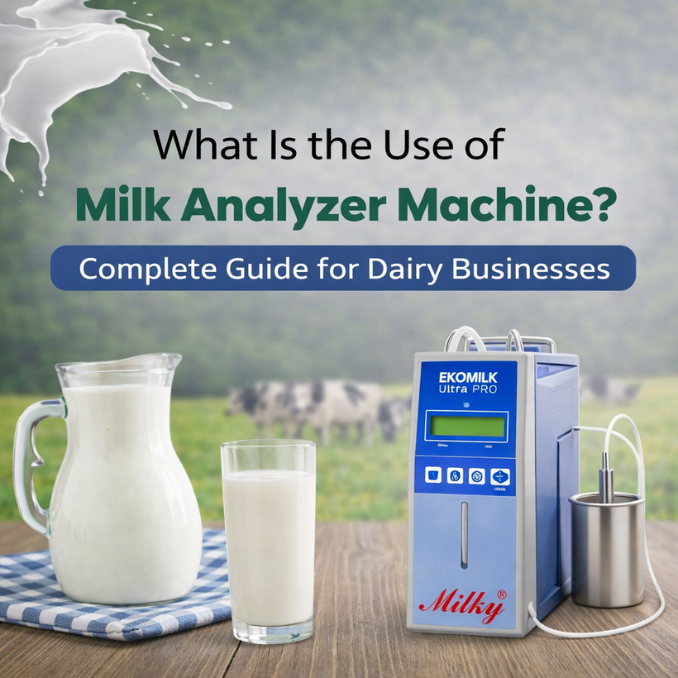
Someone probably told you to get a milk analyzer. Maybe a supplier mentioned it. Maybe you saw one at another dairy and wondered what it actually does.
Here is the straight answer: if you collect milk from farmers, process raw milk, or sell dairy products commercially — a milk analyzer machine is not optional. It is the tool that decides whether farmers get paid fairly, whether adulterated milk enters your line, and whether your quality records hold up when it matters.
Let us go through it simply.
What Is a Milk Analyzer Machine?
A milk analyzer machine tests the exact composition of raw milk — on the spot, in under 40 seconds.
No lab. No waiting. You pour the sample in and within seconds you have accurate readings on fat, protein, water content, and more. It works right at the collection point or processing intake — exactly where the information is most useful.
Most models use ultrasonic technology. Sound waves pass through the milk sample and the machine reads composition from how those waves travel. More advanced milk fat analyzer machines use NIR (near-infrared) technology — faster, and capable of measuring more parameters at once.
Either way, in under a minute you know exactly what is in that milk.
What Does a Milk Analyzer Actually Measure?
Most guides just list parameters. Here is what each one actually tells you in practice:
Fat % — The most commercially important reading. Fat content sets the price paid to farmers and directly affects the quality of butter, ghee, cream, and paneer. Without an accurate fat reading, you are guessing at both cost and quality.
SNF (Solids-Not-Fat) — Everything in milk that is not fat and not water — protein, lactose, minerals. Low SNF almost always means water has been added. Fat testing alone misses this. SNF catches it.
Added Water — The most common adulteration in India. Impossible to detect by sight or smell. The milk fat testing machine flags it immediately through density and SNF readings. One reading. Problem identified.
Density — A cross-check on fat and SNF. When density does not match those readings, something is off. It is an early warning before you investigate further.
Protein — Critical for any processing operation. Paneer yield, cheese texture, and protein-enriched products all depend on protein content at intake. Knowing it upfront means no surprises mid-production.
Lactose — Important for fermented products like curd and yogurt, and for lactose-sensitive product ranges. Helps track whether milk quality is consistent across different supply sources.
Temperature — Milk arriving too warm has been poorly handled in transit. Temperature logged alongside composition data gives you a complete intake picture — not just what was in the milk, but the condition it arrived in.
Where Is a Milk Analyzer Used?
At the Milk Collection Centre
This is where automatic milk fat testing equipment makes the most visible difference every single day.
Every farmer who brings milk gets a reading in seconds. Payment is based on actual fat and SNF content — not a flat rate that treats diluted milk and full-quality milk the same. Honest farmers get paid fairly. Farmers who add water get flagged at the first sample. The incentive to adulterate simply disappears.
More than 75% of India’s 250,000 village-level collection centres now use some form of milk analyzer for fat and SNF testing. It has become the standard — not the exception.
At the Processing Plant
Every incoming batch of raw milk needs to meet minimum quality standards before it enters your production line. A milk fat analyzer at the intake point stops anything below specification — adulterated, diluted, or simply poor quality — before it touches a full day’s production.
For plants making standardised packaged milk, the fat reading at intake feeds directly into the standardisation calculation. How much cream to remove. How much to blend back. Without an accurate reading at the start, standardisation is guesswork — and guesswork shows up in the final product.
For FSSAI Compliance
FSSAI requires dairy businesses to maintain milk quality records. A cloud-connected milk analyzer handles this automatically — timestamped readings, batch records, shift summaries, all stored without manual effort.
No logbooks. No scramble before an audit. The record builds itself from the first sample tested each morning.
Types of Milk Analyzer Machines
Ultrasonic Milk Analyzer — The most widely used type across India. Measures fat, SNF, added water, and density. Around 90 samples per hour at 40 seconds each. Reliable, easy to operate, and the right fit for most collection centres and small to mid-size dairy operations.
NIR Milk Analyzer — Faster and more capable. Covers fat, SNF, protein, lactose, density, and added water in under 29 seconds. Better suited to high-volume processing plants where protein and lactose data matter operationally every day.
Portable Milk Tester Machine — Compact, battery-operated, runs on a 12V adapter. Works on collection vehicles and remote farm visits, not just a fixed centre. The right choice for routes where testing happens at multiple points before milk reaches the main facility.
Automatic Milk Fat Testing Machine with DPU — The most complete setup. Combines milk fat testing equipment with a Data Processing Unit that calculates farmer payments, generates shift summaries, and exports records. Standard at large cooperative centres handling hundreds of farmers per shift.
What Actually Changes When You Have One
Payment disputes drop to near zero. When the machine shows the reading and both the operator and the farmer can see it clearly, there is nothing to argue about. The number is the number.
Adulteration stops at the source. Added water is caught at the first collection. Once a farmer knows the machine will flag it every time, the problem stops happening.
Processing becomes more predictable. Knowing the exact fat and SNF of every incoming batch means standardisation is accurate, production planning is reliable, and product quality stays consistent batch after batch.
Compliance takes care of itself. Cloud-connected milk analyzer machines store every reading automatically. Your quality documentation exists without anyone maintaining it manually.
Collection runs faster. A centre that manually tested 20 farmers per hour can now handle 90 with one machine. Farmers wait less. Morning collection finishes on time.
What to Check Before You Buy
Accuracy above everything else. Around 28% of low-cost portable milk analyzers showed fat detection errors above ±0.5% in field audits across India. At scale, that creates real payment disputes. Always ask for an accuracy specification and request a live demonstration with your own milk samples before committing.
Testing speed. At a busy collection centre, a slow machine creates a queue that frustrates everyone. Look for 40 seconds or under for standard operations. For high-volume sites, 29 seconds or under.
Parameters covered. A basic milk tester machine covers fat, SNF, and added water. If your operation also needs protein, lactose, pH, or conductivity — confirm those are included before purchase. Adding sensors later costs more than buying right the first time.
Data connectivity. Cloud sync, WiFi, Bluetooth, and mobile app access are standard on most mid-range and above models. If you run multiple collection points, centralised data access saves hours of admin every week.
Calibration and servicing. Most precision milk analyzers need monthly calibration. Ask exactly what that involves — can it be done in-house or does it need a service visit? What do spare parts cost annually? Know this before you buy, not after.
After-sales support. A milk analyzer that breaks down during peak morning collection with no local service available for a week is an expensive, disruptive problem. Buy from a supplier who can tell you specifically how they handle service calls — not just hand you a warranty card.
Looking for the Right Milk Analyzer for Your Dairy? At Mahesh Eng.Works, we supply the Ekomilk Ultra Pro Double Sensor Milk Analyzer — accurate, fast, and built for the demands of Indian dairy operations. Whether you are setting up a new collection centre or replacing an unreliable older machine, we will help you find the right fit for your volume and budget.
Frequently Asked Questions
What is the main use of a milk analyzer machine? It tests raw milk composition — fat, SNF, protein, added water — accurately and immediately. At a collection centre it determines fair farmer payment and catches adulteration. At a processing plant it controls input quality and feeds standardisation calculations.
What is the difference between a milk fat testing machine and a full milk analyzer? A milk fat testing machine measures fat only. A full milk analyzer covers fat, SNF, protein, lactose, density, added water, and temperature from the same sample simultaneously. For any commercial dairy operation, the full analyzer gives significantly more decision-useful data for the same testing time.
Does a milk analyzer detect adulteration? Yes — for the most common forms. Added water appears immediately in density and SNF readings. Unusual fat-to-SNF ratios flag potential synthetic additives. For specific chemical adulterants like urea, formalin, or detergent, a dedicated adulteration test kit is needed alongside the analyzer.
How much does a milk analyzer machine cost in India? Basic models start around Rs. 8,500. Standard ultrasonic milk analyzer machines run Rs. 20,000 to Rs. 40,000. Full-featured automatic milk fat testing machines with cloud connectivity and DPU integration range from Rs. 38,000 to Rs. 75,000 and above.
How often does it need calibration? Monthly for most models. High-volume operations typically need bi-annual sensor replacement as well. Regular calibration prevents the reading drift that causes payment disputes over time.

Mahesh Eng. Works
Written by Mahesh Engineering Works, specializing in precision dairy machinery and hygienic stainless-steel dairy solutions for small and medium dairy plants in India.