
A khoya making machine that's installed incorrectly rarely fails outright it just produces inconsistent results. Scorched or stuck milk solids, uneven texture, slow moisture evaporation, or a discharge valve that leaks can usually be traced back to the installation stage, not the equipment itself. For sweet manufacturers, dairy plants, and commercial khoya producers, getting the setup right from day one protects both product consistency and equipment life.
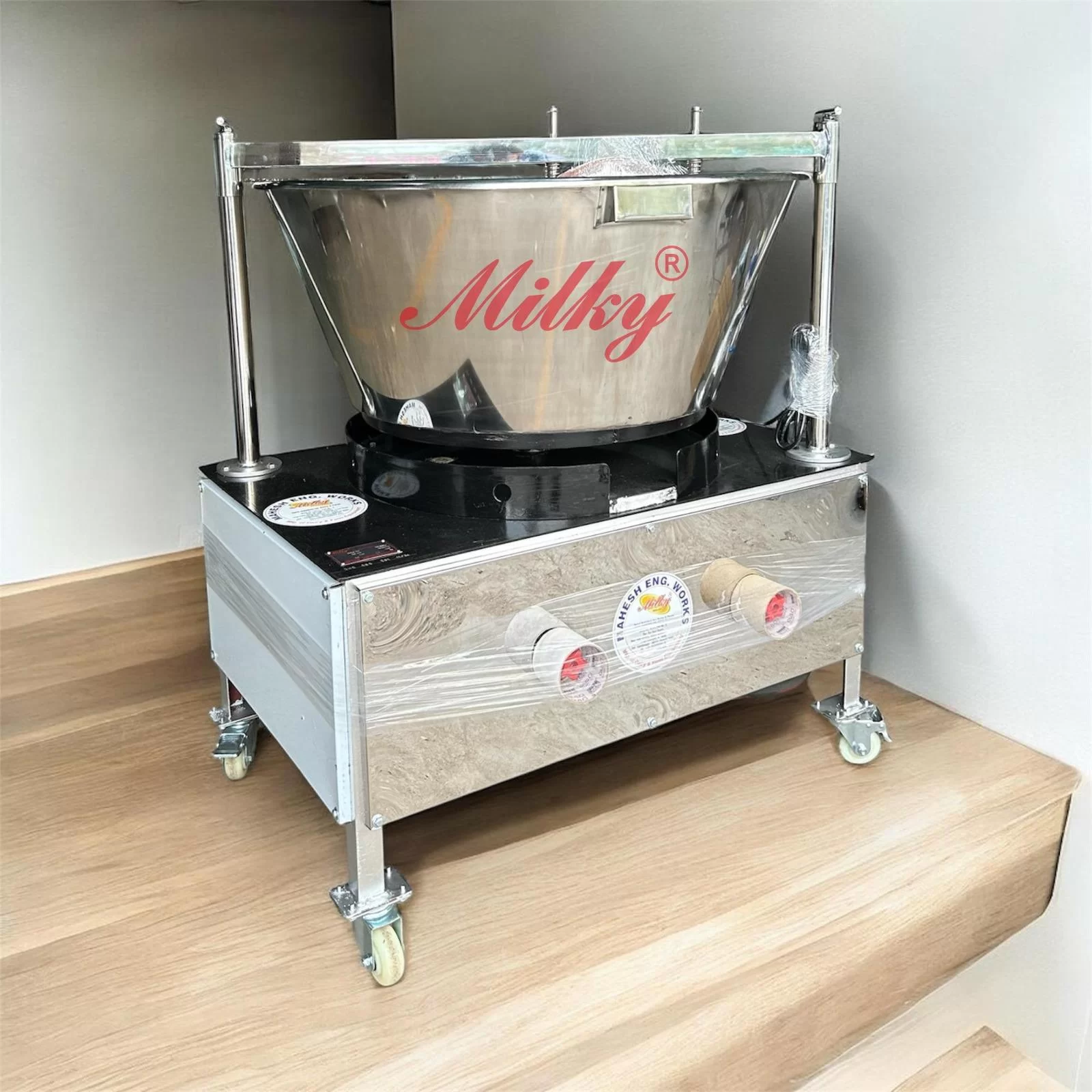
This guide walks through how to install a MILKY® khoya (mawa) making machine from site preparation through commissioning so operators know what to check at each stage. MILKY® khoya making machines are manufactured by Mahesh Eng. Works, and installation guidance is available for every model and configuration supplied.
 Installation Support
 Mahesh Eng. Works is an ISO 9001:2015 certified manufacturer based in Gandhinagar, Gujarat, with experience since 1980 across dairy equipment including khoya making machines, paneer making machines, and milk cream separators. MILKY® khoya making machines are available in tilting and stationary types, with barrel capacities including 120L, 200L, and 300L, built in mild steel with a stainless steel option. The company exports to 25+ countries and provides installation guidance and after-sales support to help businesses set up their equipment correctly.
Before installing a Khoya Making Machine, confirm the machine capacity, type, installation surface, electrical supply, earthing, fuel/heating connection, vessel and stirrer assembly, and discharge valve setup. Ensure the machine is level and stable, all connections are secure, and the machine completes an initial trial batch before regular production.
Choosing the right capacity and heating type depends on your daily production target and fuel availability on site. Businesses planning to scale often choose a model slightly above their current need to avoid early equipment upgrades.
| No. | Technical Data | What to Do |
|---|---|---|
| Step 1 | Inspect the machine. | Check the vessel, stirrer, gearbox/motor, burner assembly (if gas or diesel fired), and discharge valve against the delivery documentation for transit damage or missing parts. |
| Step 2 | Prepare the installation location. | Choose a clean, well-ventilated area with a stable floor, suitable drainage, and clearance for operator access and cleaning. Ventilation matters especially for gas or diesel-fired models. |
| Step 3 | Position and level the machine. | Place the vessel on a level surface. For tilting models, ensure there is enough clearance for the vessel to tilt fully for discharge without obstruction. |
| Step 4 | Check electrical supply and earthing | Have a qualified electrician confirm the supply matches the stirrer motor/gearbox's rated requirement and that proper earthing is in place before wiring. |
| Step 5 | Connect the fuel or heating source. | Connect gas, diesel, or electric heating as specified for your model. Steam-jacketed models additionally require a connection to a boiler — confirm which heating type applies to your machine before proceeding. |
| Step 6 | Check the stirrer and gearbox assembly. | Confirm the stirrer blades are correctly fitted and rotate freely, since continuous, even stirring is what prevents milk from scorching during heating. |
| Step 7 | Check the discharge valve and outlet. | Confirm the bottom-mounted discharge valve is correctly fitted and seals properly to prevent leakage once the vessel is loaded. |
| Step 8 | Check connections before startup | Recheck electrical, fuel/heating, and mechanical connections together before switching the machine on. |
| Step 9 | Perform an initial trial batch. | Run a small batch to confirm even heating, consistent stirring, and proper moisture evaporation over the cooking cycle. |
| Step 10 | Complete commissioning checks. | Confirm consistent khoya texture, no scorching, proper discharge, and stable operation before regular production begins. |
Download Full Brochure
Get drawings, full specifications, layout requirements and pricing on email.
Khoya Making Machines are engineered for efficient, hygienic, and consistent khoya production, helping sweet manufacturers and dairy processing units achieve reliable output with reduced manual effort.

Stable, level, and well-drained

Adequate for gas or diesel-fired heating models

Matches the stirrer motor/gearbox rating

Properly provided before connection

Gas, diesel, electric, or steam (boiler required only for steam-jacketed models)

Clearance for tilting arc (tilting models) and operator access

Clean, food-grade processing environment

Clean the vessel, stirrer blades, and discharge valve before use to prevent residue buildup and scorching.

Fit the stirrer blades correctly so they rotate freely and reach every part of the vessel base.

A properly assembled vessel and stirrer help heat spread evenly, preventing hot spots that scorch milk solids.

Ensure the bottom-mounted discharge valve is correctly seated and seals properly before loading the vessel.

On tilting models, confirm the tilt action moves smoothly through its full range without obstruction.

Vessel capacity, stirrer design, and heating type can vary according to machine model and configuration.
Continuous, even stirring supports uniform moisture evaporation and consistent khoya texture.
Never operate the machine until the vessel, stirrer, and discharge valve are completely secured according to the supplied instructions.

Have a qualified electrician connect the wiring to the stirrer motor/gearbox's rated supply. Ensure proper earthing and electrical protection before powering on, and never work on live equipment.

Connect the gas, diesel, or electric heating source as specified for your model. Steam-jacketed models additionally require a secure connection to a boiler. Ensure all fuel lines and fittings are leak-free before operation.

Confirm all mechanical, electrical, and fuel/heating connections are complete and secure.

Run the heating system and stirrer together and confirm even, consistent operation with no unusual noise.
Check for even heating, consistent stirring, and steady moisture evaporation through the cooking cycle.
Stirrer rotation and heating consistency
Heating source connection and settings
Vacuum level and claw/liner assembly
Stirrer assembly and even heat distribution
Valve seal and fitting
Fuel line connection and ventilation
Electrical supply and motor connection
Mahesh Eng. Works provides installation guidance and after-sales support for MILKY® khoya making machines supplied across India and to export markets. Whether you’re setting up a new machine or troubleshooting an existing installation, the team can help you get it running correctly.
Once installed, khoya making machines require daily cleaning of the vessel, stirrer, and discharge valve to maintain product hygiene and equipment performance, along with regular inspection of the stirrer assembly, fuel/heating components, and periodic servicing. Establishing this cleaning routine from the first day of use protects both khoya quality and the working life of the machine.
Request Technical AssistanceA khoya making machine is generally installed by preparing a stable, ventilated location, positioning the vessel, checking electrical and fuel/heating connections, checking the stirrer and discharge valve, and commissioning the machine with a trial batch.
You'll need a stable, level, ventilated floor space, a matching electrical supply with proper earthing, and the correct fuel or heating connection for your model (gas, diesel, electric, or steam). Confirming the exact model and heating type beforehand avoids mismatched requirements.
Electrical and fuel connections should always be handled by qualified technicians, and stirrer/vessel setup should follow model-specific instructions. Working with the manufacturer's guidance reduces the risk of connection or assembly errors.
The claw and teat cup liners are cleaned and seated correctly, and the pulsator is connected to cycle at its rated ratio (60/40 on standard MILKY® models). Damaged or worn liners should be replaced before use.
The vessel and stirrer blades are cleaned thoroughly, then checked for free rotation and correct fitting, with the discharge valve checked for a secure seal. The exact assembly depends on the model.
Typically 2 to 3 hours per batch through controlled heating and continuous stirring, though exact duration and temperature settings vary by machine model and capacity.
Uneven texture is usually caused by inconsistent stirring or uneven heat distribution across the vessel. Both should be checked during installation.
Only steam-jacketed khoya making machines require a boiler. Gas, diesel, and electric-heated models do not.
Yes. Mahesh Eng. Works provides installation guidance and after-sales support for MILKY® khoya making machines supplied across India and to export markets.
Confirm all electrical, fuel/heating, and mechanical connections are secure, then run a trial batch to check even heating, consistent stirring, and proper discharge before regular production.
Talk to Mahesh Eng. Works today for the latest price, technical guidance, capacity recommendation, and machine configuration.