

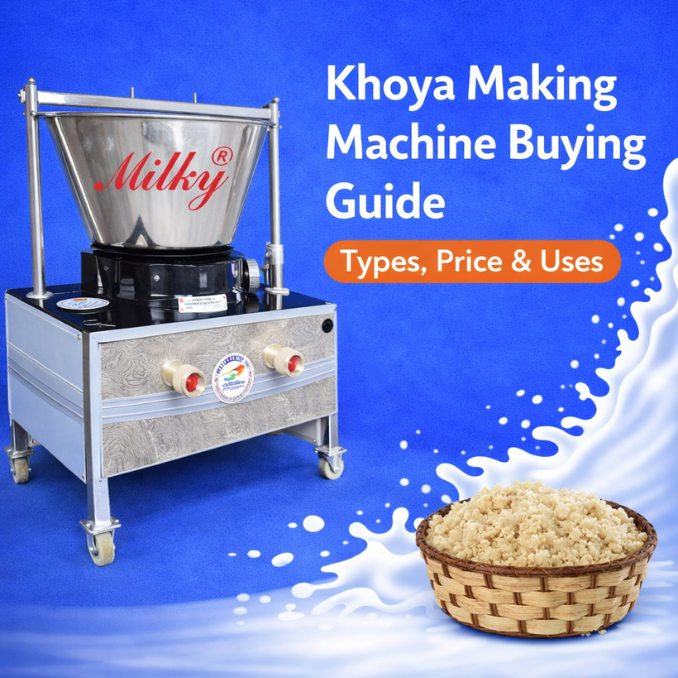
In the heart of the Indian dairy industry, khoya (also known as mawa or khoa) remains an indispensable staple. This thick, creamy paste—created by evaporating milk—is the foundation of beloved traditional sweets like gulab jamun, barfi, and peda. However, as the demand for high-quality khoya surges, traditional manual production methods are increasingly becoming a bottleneck for scaling businesses.
For dairy entrepreneurs, the transition from manual labor to mechanization is no longer just an option; it is a necessity for survival and growth. Businesses adopting automated khoya machines report up to 40% higher profit margins due to reduced labor costs and minimal wastage. This guide explores everything you need to know about choosing, pricing, and profiting from a khoya making machine.
Why Traditional Methods Are Holding Your Business Back
Manual khoya production is notoriously labor-intensive and time-consuming. It requires skilled workers to constantly monitor and stir the milk to prevent burning, leading to high human error and inconsistent product quality.
The Hidden Costs of Manual Production:
- Inconsistency: Variations in texture and quality can damage customer loyalty.
- Scaling Limitations: You are limited by the physical capacity of your labor force.
- Higher Overheads: The time and wages spent on manual stirring drain resources that could be used for marketing or sales.
By modernizing, businesses can significantly reduce production time and costs, allowing them to compete effectively in a growing market.
Types of Khoya Making Machines
Understanding the different models available is crucial for matching the right technology to your specific business scale.
- Electric Khoya Making Machines
Ideal for medium to large-scale operations, these machines offer consistent quality and precise temperature settings. They are preferred by businesses with a stable power supply.
- Pros: Reliable, efficient, and easy to operate.
- Gas-Operated Machines (LPG)
In many Indian cities, gas is more cost-effective than electricity. These machines are highly effective during power cuts and are a favorite for small to medium shops.
- Steam-Heated Machines
For large-scale industrial production (above 100 kg per hour), steam-heated models provide the most uniform heating and integrate seamlessly into existing large dairy plant infrastructures.
- Mini and Home-Use Models
Compact and energy-efficient, these are designed for small startups or personal use, catering to the rising demand for homemade dairy products.
Key Features to Look For
When selecting a premium machine, specific features separate high-end models from basic, less durable ones.
- Material Quality: Always prioritize SS 304 grade stainless steel. Look for a sheet thickness of 3-4mm to ensure the machine maintains heat better and lasts longer.
- Advanced Heating & Insulation: Good insulation can reduce heat loss by 30-40%, significantly lowering fuel costs.
- Automation Features: An automatic stirrer is essential to prevent milk from burning. Other vital features include digital temperature displays, programmable cooking cycles, and auto shut-off timers.
- Maintenance Design: Look for a tilting mechanism for easy discharge, removable stirring blades, and smooth internal surfaces to simplify cleaning.
Khoya Machine Price Guide in India
The cost of investment varies widely based on capacity and automation levels.
| Machine Category | Capacity Range | Estimated Price (INR) | Best For |
| Mini/Home Use | Small batches | ₹20,000 – ₹50,000 | Startups/Home kitchens |
| Electric/Commercial | 10 – 50 kg/hour | ₹50,000 – ₹2,50,000 | Growing sweet shops |
| Industrial Models | 100+ kg/hour | ₹5,00,000+ | Large dairy plants |
Total Cost of Ownership: Most businesses recover the initial investment within 8 to 12 months through gains in efficiency and labor savings.
Khoya vs. Paneer Making Machines: Which to Choose?
While some machines can be adapted, it is generally recommended to use dedicated equipment for optimal results.
Feature | Khoya Making Machine | Paneer Making Machine |
| Initial Investment | ₹2,00,000 – ₹5,00,000 | ₹1,50,000 – ₹3,00,000 |
| Production Capacity | ~50 kg/hour | ~30 kg/hour |
| Primary Function | Evaporation/Thickening | Coagulation/Pressing |
Strategic Insight: Incorporating both into a complete dairy processing setup allows you to diversify your product offerings and increase revenue streams.
How to Choose the Right Machine for Your Business
- Assess Daily Requirements: A small shop may need 10-15 kg daily, while medium businesses require 30-50 kg.
- The “Growth Rule”: Choose a machine with 20-30% extra capacity than your current needs to account for future business expansion.
- Verify Support: Ensure the manufacturer offers a minimum 1-year warranty and has a local service network for spare parts.
- Fuel Availability: Choose between Gas, Electric, or Steam based on which resource is most stable and affordable in your region.
Maximizing Your Return on Investment (ROI)
To turn your machine into a profit center, focus on:
- Production Cost Analysis: Calculate raw materials, labor, and overheads. By minimizing waste, you can dramatically improve margins.
- Marketing Quality: Use the consistency of machine-made khoya as a selling point. Highlight the hygiene and purity of the product in your digital marketing campaigns.
- Scalability: A high-capacity machine reduces the cost per unit, making your product more competitive in the wholesale market.
Frequently Asked Questions
Q1: What is the average price of a khoya making machine in India?
The price typically ranges from ₹50,000 for mini electric models to over ₹5,00,000 for industrial-grade machines.
Q2: Can I use the same machine for different types of khoya?
Yes, you can produce both soft and hard khoya by adjusting the cooking time and temperature.
Q3: How much labor is saved?
With a fully automatic machine, one operator can handle 2-3 machines simultaneously, reducing labor needs by 60-70%.
Q4: How often should the machine be serviced?
Professional servicing is recommended every 6 months, alongside daily cleaning and weekly lubrication.
Conclusion
The Indian dairy market is evolving, and the demand for high-quality, machine-made khoya is at an all-time high. Investing in a khoya processing machine is no longer just about buying equipment; it is about embracing innovation to ensure long-term profitability and customer loyalty.
Analogy for Success: Switching from manual khoya production to an automated machine is like moving from a bicycle to a delivery truck. While the bicycle gets you there, the truck allows you to carry more, go faster, and reach a much larger market with far less physical effort.
If you’re planning to start or upgrade your khoya production unit, Mahesh Eng. Works is your trusted partner. As a leading dairy machinery manufacturer in India, our expert team helps you choose the right khoya making machine to reduce labor, improve consistency, and maximize long-term profitability for your dairy or sweet business.