
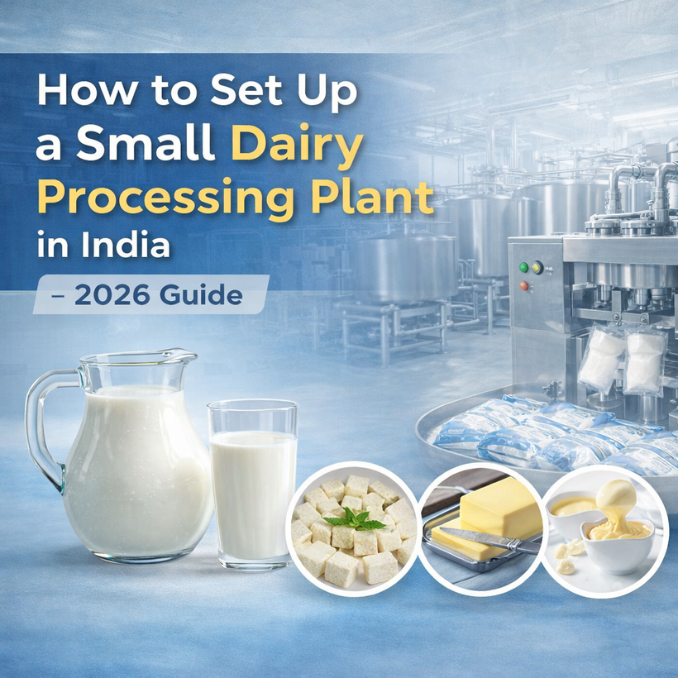
Quick Summery: Starting a small dairy processing plant in India in 2026 is a strong business opportunity driven by rising demand for hygienic, locally branded dairy products. This guide explains how to choose profitable products like paneer and milk, complete feasibility checks, secure required licenses (FSSAI, GST, Pollution NOC), design an efficient plant layout, and build a reliable milk supply chain. With government subsidies and proper execution, even a 500-LPD plant can grow into a trusted local dairy brand within a few years.
The food business operates under a secret that industry professionals recognize but do not disclose to others. India holds the title of world’s leading milk producer because its annual output exceeds 230 million metric tonnes. In small towns throughout Bihar and Madhya Pradesh and Odisha and parts of Maharashtra people still buy raw milk which vendors transport through bicycles that carry aluminum cans.
The farmer earns no profits from his work because he needs to wake up at 4 AM to produce milk that remains unprocessed and unbranded.
The distance between the milk can and the modern consumer’s refrigerator represents an undiscovered business opportunity which exists in front of us during the year 2026.
The dairy processing business presents a daunting challenge to those who want to start it because they need to overcome its high expenses and complex technical requirements. The entrepreneurs I talked with had exactly the same doubts about their business projects. The majority of them express the same thought after they completed their work “I wish I had started sooner.”
Let us begin the discussion. The guide shows actual steps to create a small dairy processing plant in India for the year 2026 without including unnecessary content or difficult technical terms.
Small Dairy Processing Plant in India – The Hidden Business Opportunity in 2026
The Indian dairy industry continues to grow because its expansion rates have reached new heights.
People today prefer packaged food products that meet hygiene standards because they want to keep their healthy eating habits from the pandemic. Urban and semi-urban consumers today actively search for brandable dairy products that let them track their origin. They want to know where their paneer came from. They check packaging. They prefer local brands they can trust over faceless national players.
The organised dairy brands provide inadequate service to Tier-2 and Tier-3 cities throughout India. Amul and Mother Dairy control the metropolitan markets while the area beyond 50 kilometres from urban centers remains unexploited.
The government possesses this information. The NABARD Dairy Entrepreneurship Development Scheme and PMFME scheme together with various state-level dairy development programs, provide financial assistance to small dairy business operators, beginning in 2026. This program provides actual financial support which people can obtain through application.
The opportunity exists for better access than any other time in history.
Step 1 – Choose Profitable Products for Your Small Dairy Processing Plant in India
Although this task seems simple, people who pursue equipment purchasing proceed without solving this key problem which needs their attention.
What dairy product will you actually process and sell?
The best products for small plant operators to process in 2026 include paneer, ghee, curd, and pasteurised milk pouches. These products maintain daily customer demand, which does not require advanced machinery and they create good profit margins. A well-operated paneer business direct to local restaurants and sweet shops and households can achieve profit margins between 20 and 30 percent.
High-Demand Dairy Products with Strong Profit Margins in 2026
Your area needs your attention as well. People in Gujarat and Maharashtra will buy shrikhand because it matches their existing preferences and they will pay extra for high-quality products. The people of West Bengal maintain a strong dedication to mishti doi, which all national brands fail to establish at the community level. Lassi and makhan have created permanent cultural demand in Punjab.
Begin with one or two products. Achieve product excellence through them. You can start developing more products after you establish control over your business operations.
Step 2 – Feasibility Study Before Starting a Dairy Processing Plant in India
You need to complete all necessary preparations before making any financial commitments.
I cannot stress this enough — please do a proper feasibility check before you commit money to land, equipment, or construction.
Your project requires no expensive consultant services at this point. You just need honest answers to four questions:
Four Critical Questions Before Setting Up a Dairy Plant
Is there a reliable raw milk supply within 20 to 30 kilometres of where you plan to set up?
Can you actually find paying customers for your product in your area who will buy from you?
Do you have enough working capital to buy milk every single day for at least three to four months before your revenue stabilises?
And finally, does your proposed location have dependable power supply and clean water and road access to support daily milk collection and product delivery?
You can proceed to the next stage when all four answers confirm your situation. You need to resolve any problem that exists before you continue with your work. The dairy business becomes extremely difficult to manage when fundamental operations are not established.
Step 3 – Dairy Plant License Requirements in India (FSSAI, GST & Pollution NOC 2026)
Licensing is usually the part that makes people nervous. But honestly, once you understand what you need and why, it becomes much more manageable.
These are the requirements which every small dairy processing plant in India needs to meet during 2026.
FSSAI Manufacturing License
FSSAI Manufacturing License is your most important document. A State FSSAI license is required when your annual turnover falls below ₹20 crore. You need to apply through the FoSCoS online portal. You must complete this process immediately because FSSAI approvals require 30 to 60 days for processing and you are not allowed to operate your business until you receive it.
MSME Udyam Registration
The government provides free Udyam Registration under the MSME category which takes about 10 minutes online and allows you to access subsidies and priority bank lending and all government scheme benefits. There is absolutely no reason not to do this.
GST Registration
GST Registration becomes mandatory once your turnover crosses ₹20 lakhs annually, or ₹10 lakhs if you are in a special category state.
State Pollution Control Board NOC
The State Pollution Control Board NOC which new dairy entrepreneurs need to obtain. Dairy processing generates whey effluent and wash water. You need a proper effluent treatment plan and environmental clearance. The situation where pollution board shuts down your operation after you invested money into your business becomes a painful situation which should not exist.
Local Body Trade License
Local Body Approvals require you to obtain a trade licence from your municipal corporation or gram panchayat according to your current location.
One genuine piece of advice here: spend a small amount on a food licensing consultant to handle your FSSAI application. The fee is worth every rupee if it saves you two or three months of delays and rejections.
Step 4 – Dairy Plant Layout and Milk Processing Plant Setup Design
Your plant does not need to look impressive from the outside. The interior design needs to create a pathway which allows milk to travel from its entry point until it reaches its exit point without any signs of contamination.
Ideal Dairy Plant Process Flow
Milk Reception → Raw Storage → Pasteurisation → Processing → Packaging → Cold Storage
This single-direction layout is the foundation of good hygiene practice and will make your FSSAI audits much smoother.
Space, Utilities and Infrastructure Requirements
A 500-litre-per-day plant requires 1,500 to 2,000 square feet of operating space. Dairy processing requires three litres of water to process each litre of milk, so you must create systems which guarantee constant water access. Power backup is non-negotiable. You must construct your drainage system correctly during initial building work because later modifications will incur high costs and operational disturbances.
Cold storage is not optional. A walk-in chiller protects your finished products, extends shelf life, and is one of the clearest signals to your customers that you take quality seriously.
Step 5 – Milk Procurement Strategy for a Successful Dairy Processing Business in India
The processing plant relies on the milk which arrives at the facility.
Build genuine, trust-based relationships with local dairy farmers or village milk cooperative societies. Pay them on time — ideally within 24 to 48 hours of collection. In a business where farmer loyalty is everything, prompt payment is your single most powerful tool.
Quality Control at Collection Stage
The collection point requires you to install a Bulk Milk Cooler. Chilling fresh milk within two hours of milking is critical for maintaining quality and staying compliant with FSSAI standards. The laboratory needs to test all incoming milk samples for fat percentage and Solids-Not-Fat content and common adulterants through a Lactoscan or similar milk analyser.
The quality you put in at this stage determines everything that comes out at the other end. The processing technology fails to correct defects which exist in contaminated raw milk.
Step 6 – Government Subsidies for Small Dairy Processing Plant in India (2026)
The part of the conversation where most small business owners experience excitement begins at this moment.
NABARD Dairy Entrepreneurship Development Scheme
NABARD’s Dairy Entrepreneurship Development Scheme provides applicants with general category access to 25% back-end capital subsidy while SC/ST entrepreneurs and hilly or northeastern region residents receive 33.33% back-end capital subsidy. The bank loan account receives this money after your project verification process completes. The money functions as a grant. The money does not need to be returned.
PMFME Scheme
The PMFME Scheme provides credit-linked grants which reach up to ₹10 lakhs to support micro food processors while offering branding and marketing assistance that enables new local dairy brands to establish themselves.
Several states — Maharashtra, Rajasthan, Tamil Nadu, Uttar Pradesh, and others — have additional dairy-specific schemes running alongside these central programs in 2026. Visit your nearest NABARD district development office or State Animal Husbandry Department to get the most current information for your specific state and category.
Do not leave this money on the table. It exists precisely for entrepreneurs like you.
Step 7 – Marketing Strategy for Small Dairy Processing Business in India
Great dairy products require marketing efforts to achieve initial sales success.
Start your delivery service by sending products to nearby kirana stores and local sweet shops and dhabas and school canteens and small restaurants. The customers who buy from you will remain loyal because they value fresh products and personal connections which are not available from big corporate suppliers.
Use WhatsApp Business to receive and process your daily orders. Create a clean, professional logo and pouch design — good packaging tells customers that you care about quality before they even open the product. Get your Google Business Profile live and optimised for local searches like “fresh paneer in [your city]” or “milk delivery near me [your area].” This service generates real customers without any associated costs.
Is Starting a Small Dairy Processing Plant in India Profitable in 2026?
India’s dairy sector has room for thousands of local dairy processing entrepreneurs in 2026. The raw material exists. The consumer demand is growing. The government provides actual support which people can obtain.
The industry requires additional honest processors who maintain high standards of quality and possess deep knowledge about their local markets. The multinational brand cannot copy your unique selling point because it gives you an advantage which you can develop today.
You do not require high financial resources. You do not need a business degree. The process requires you to develop a specific strategy while obtaining necessary documents and establishing dependable milk sources and maintaining daily product excellence.
A person who establishes a 500-litre plant today and executes all tasks correctly will become the trusted dairy brand for the community within five years.
The right equipment makes or breaks a dairy plant. At Mahesh Eng. Works, we understand exactly what small dairy processors need — reliable, food-grade, GMP-compliant machinery that works hard every single day without burning a hole in your budget.
FAQs
Q1. How much does it cost to set up a small dairy processing plant in India in 2026?
A small dairy processing plant handling 500 litres per day will typically cost between ₹20 and ₹30 lakhs when you include equipment, civil construction, licensing, and initial working capital. A larger 2,000-litre-per-day unit generally requires ₹50 to ₹70 lakhs in total investment. Costs can vary depending on your state, location, and the specific product line you choose.
Q2. What licenses are required to start a dairy processing unit in India?
At minimum, you will need an FSSAI manufacturing license, Udyam MSME registration, GST registration, a No Objection Certificate from your State Pollution Control Board, and local trade approvals from your municipal body or gram panchayat. Product-specific certifications may also apply depending on what you process.
Q3. Is a dairy processing business profitable in India in 2026?
Yes, genuinely profitable when managed well. Products like paneer and ghee offer margins of 20 to 40 percent. The key variables are your raw milk procurement cost, waste management efficiency, and how strong your local distribution network is. Small processors with direct farmer relationships and local customer bases tend to perform very well.
Q4. Can I get a government subsidy for setting up a dairy plant?
Absolutely. NABARD’s Dairy Entrepreneurship Development Scheme offers 25 to 33.33% back-end capital subsidies linked to bank loans. The PMFME scheme provides credit-linked grants up to ₹10 lakhs. Many states offer additional incentives on top of these central programs. Contact your nearest NABARD district office for current eligibility and application details.
Q5. What is the minimum space needed for a small dairy processing plant?
A 500-litre-per-day processing unit can operate comfortably within 1,500 to 2,000 square feet, provided the layout properly separates milk reception, processing, packaging, and cold storage zones — with adequate drainage and utility access.

Mahesh Eng. Works
Written by Mahesh Engineering Works, specializing in precision dairy machinery and hygienic stainless-steel dairy solutions for small and medium dairy plants in India.
Have a technical question? Contact our team →