

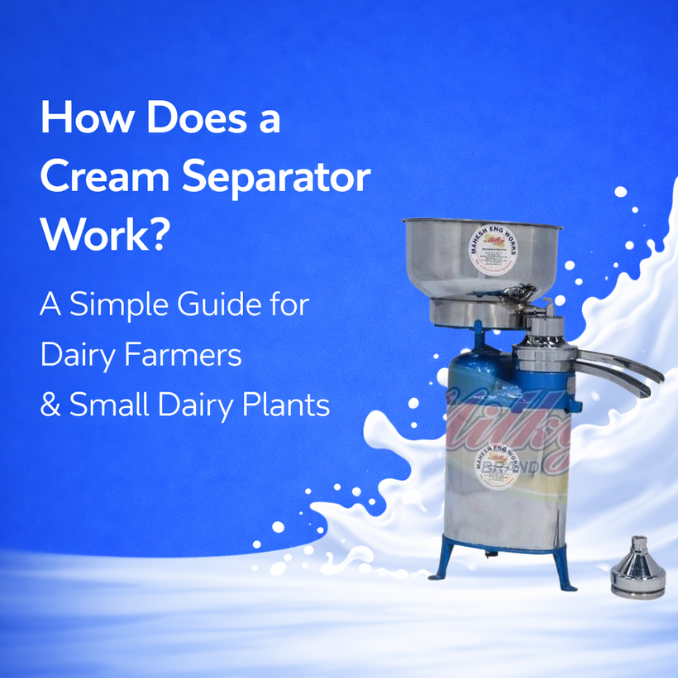
In every dairy operation—whether it’s a village-level milk collection center or a growing small dairy plant—cream separation plays a crucial role in milk quality and profitability. Yet many dairy farmers and plant owners still ask a basic but important question: how does a cream separator actually work?
A cream separator is more than just a machine—it’s the heart of efficient milk processing. It helps extract cream accurately, improves fat recovery, supports FSSAI-compliant dairy production, and directly impacts the return on investment for small and medium dairy plants in India. Understanding its working principle can help you choose the right machine, avoid common operational mistakes, and get the best value from your dairy equipment.
In this simple guide, we break down how a cream separator works, step by step, using easy explanations suited for dairy farmers, milk producers, and small dairy plants (500–10,000 LPD). Whether you’re planning to start a milk processing unit or upgrade existing dairy machinery, this article will help you make informed decisions with confidence.
What Is a Cream Separator and Why Is It Essential?
A cream separator is a dairy machine that divides milk into two parts:
- Cream – the fat-rich portion
- Skim milk – the low-fat portion
This separation is crucial for dairy processing. Cream is used to produce high-value products such as butter, ghee, and fresh cream, while skim milk can be processed into toned milk, curd, paneer, or milk powder.
For dairy plants processing 500 to 10,000 liters of milk per day, a cream separator plays a key role in daily operations. It helps recover maximum fat from milk, ensures consistent and standardized milk quality, speeds up the processing workflow, and ultimately improves overall profitability by reducing losses and improving output quality.
The Science Behind Cream Separation
Milk is a natural mixture of water, fat, proteins, and minerals. The principle behind cream separation is simple: fat is lighter than milk, while skim milk is heavier.
When milk is kept aside, the fat in it slowly comes up and forms a cream layer on the surface. But this natural method is slow, can take many hours, and is greatly affected by temperature, which often leads to uneven and unreliable results.
A cream separator accelerates the same process using centrifugal force, allowing cream and skim milk to separate quickly, accurately, and continuously.
How a Cream Separator Works
Understanding the working principle is easier than it sounds. The process can be broken down into three clear stages:
1. Milk Feeding Stage
Fresh milk is poured into the separator’s inlet tank. For optimal results, milk is usually warmed to 35–40°C. At this temperature, fat globules move more freely, which enhances separation efficiency.
2. High-Speed Rotation and Centrifugal Force
Inside the machine, there is a fast-spinning bowl with a set of conical discs. This bowl rotates at very high speed. As the milk spins, the heavier skim milk moves outward, while the lighter cream naturally shifts toward the center. Because this spinning force is much stronger than gravity, the separation happens quickly and with better accuracy.
3. Separation and Collection
Once separated:
- Cream flows out through one outlet
- Skim milk exits through another
Advanced machines allow operators to adjust cream fat content according to production needs. The process takes only a few seconds and runs continuously, making it ideal for modern dairy operations.
Types of Cream Separator Machines
Selecting the right machine depends on milk volume, power availability, and long-term business goals.
Manual Cream Separator
- Hand-operated and affordable
- Ideal for very small dairy farmers or areas with limited electricity
- Requires physical effort
- Not suitable for consistent, large-scale commercial operations
Automatic (Electric) Cream Separator
- Best suited for small and medium dairy plants in India
- Faster processing and higher fat recovery
- Ensures consistent cream quality
- Reduces labor dependency
For dairies focused on growth and scalability, electric separators offer greater efficiency and better long-term returns.
Key Benefits of Using a Cream Separator
- Higher Fat Recovery – Accurate separation maximizes cream extraction, directly boosting revenue.
- Time and Labor Savings – What used to take hours now takes just minutes.
- Consistent Product Quality – Standardized cream and skim milk enhance butter, ghee, and packaged milk.
- Improved Hygiene and Compliance – Modern machines are easy to clean and help meet FSSAI standards.
- Strong ROI – For a small dairy plant, a cream separator can pay for itself quickly through higher yields and efficiency.
What to Consider Before Buying a Cream Separator
Before investing, evaluate:
- Daily milk processing capacity (LPD)
- Manual vs. automatic operation
- Power consumption and voltage stability
- Ease of cleaning and maintenance
- Availability of spare parts and after-sales service
Choosing a trusted dairy machinery manufacturer in India ensures reliable performance, technical support, and long-term peace of mind.
Common Myths and FAQs
Does milk need to be heated before separation?
Yes. Slightly warm milk separates more efficiently than cold milk.
Can one machine handle both cow and buffalo milk?
Most modern separators can handle both, with minor adjustments.
Is cream separation accurate?
High-quality machines consistently separate fat when operated correctly.
Are cream separators suitable for village dairies?
Yes. Compact models help village-level dairies increase income from cream and ghee production.
Conclusion
Understanding how a cream separator works makes one thing clear: it’s no longer optional for modern dairy processing.
From faster operations and higher fat recovery to improved consistency and scalability, a cream separator significantly boosts efficiency. Whether you run a small dairy plant in India or plan to expand, investing in the right machine delivers long-term value.
If your dairy still relies on slow, manual separation, now is the time to upgrade. Partnering with an experienced dairy machinery manufacturer ensures your cream separator matches your milk volume, power conditions, and growth plans.
So, if you run a dairy plant and regularly need to separate or standardize milk, a centrifugal cream separator is the right choice for smooth and consistent operations.
Take a look at Mahesh Engineering Works’ range of milk cream separators, designed for Indian dairy conditions and trusted by small and medium dairy plants for reliable performance and long service life.