

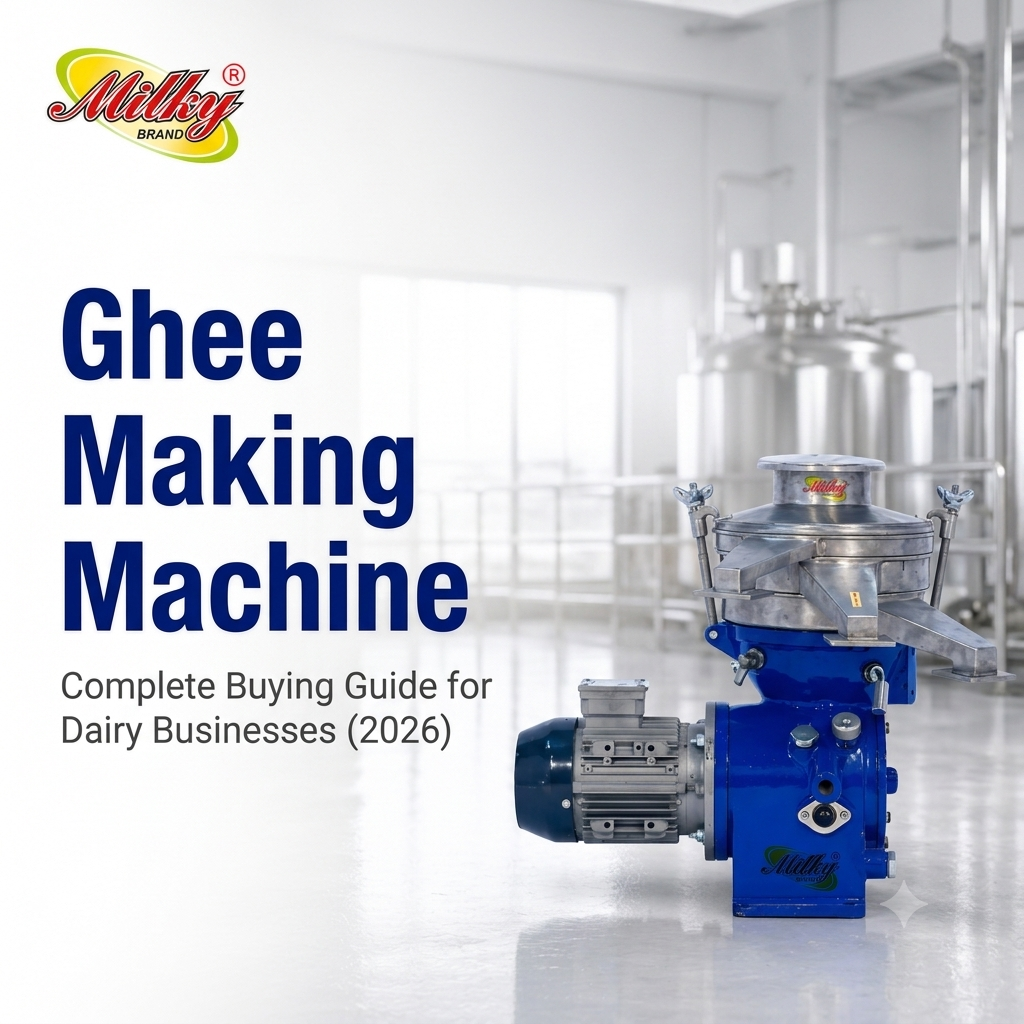
A ghee making machine (also called a ghee machine or ghee maker) converts butter or cream into pure ghee by heating, separating moisture and milk solids, and clarifying the fat. Machines range from simple ghee boilers for small dairies to fully automatic continuous systems for large-scale plants. Price depends on capacity, automation level, material grade, and heating type not on brand name alone.
Introduction
If you’re running a dairy business, adding ghee to your product line usually means one decision point: which machine actually fits your scale and budget. Search results are full of scattered specs and vague pricing, which makes comparing a ghee boiler, a ghee kettle, and a ghee clarifier harder than it should be. This guide breaks down exactly how these machines work, which type suits which business size, and what genuinely drives the price up or down so you can talk to a manufacturer with clear questions instead of guesswork.
What Is a Ghee Making Machine?
A ghee making machine is dairy processing equipment that converts butter or cream into clarified butter (ghee) by heating it, removing moisture and milk solids, and refining the remaining fat. It’s used by dairy farms, commercial ghee producers, cooperatives, and exporters who need consistent output at a scale manual methods can’t support.
Unlike traditional stovetop ghee-making, a machine controls temperature and separation mechanically, which reduces fat loss, shortens processing time, and produces a more uniform product batch after batch.
Ghee can also be made from malai, the cream that collects on boiled milk, using the same principle of heating to remove moisture and separate the milk solids.
How a Ghee Making Machine Works
The process moves through five stages — preparation, melting, stratification, clarification, and cooling/packing regardless of whether the machine is a basic kettle or a fully automatic line.
- Cream/Butter Preparation – Cream is separated from milk using a cream separator, or butter (made in a butter churner) is fed directly into the machine.
- Melting & Boiling – The butter is heated in a jacketed vessel until it liquefies and moisture begins evaporating.
- Stratification – As it heats, the mass separates into layers: a top layer of denatured milk solids, a middle layer of clear fat, and residue at the bottom.
- Clarification & Moisture Removal – The clarifier stage removes remaining impurities, moisture, and solid particles, leaving pure golden ghee with its characteristic aroma developing at this point.
- Cooling, Filtration & Packing – The ghee is filtered, cooled, and moved to packaging.
In continuous systems, these stages happen in sequence along one line rather than in separate batch steps, which is why continuous machines suit high-volume operations better than small dairies.To see how clarification affects yield and profit, read our ghee clarifier yield and efficiency guide.
Types of Ghee Making Machines
- Ghee Boiler / Ghee Kettle – A heated vessel, often with a motorized scraper, used for melting and initial boiling of butter. Common in small to mid-scale operations.
- Ghee Clarifier – A dedicated unit that removes moisture and impurities from heated butter to produce clear, packaging-ready ghee. Usually the final stage before packing.
- Batch-Type Machines – Process one load at a time. Flexible, lower upfront cost, suited to smaller or seasonal production.
- Continuous Ghee Making Systems – Process raw material continuously through multiple stages at once. Suited to large dairies needing consistent, high-volume output.
- Semi-Automatic vs. Fully Automatic – Semi-automatic machines need manual monitoring at key steps; fully automatic machines control temperature, timing, and flow with minimal supervision, at a higher cost.
Mini/small-scale machines exist for home-based or startup ghee businesses, typically lower capacity and simpler to operate, but built on the same working principle as commercial units.
Ghee Boiler vs. Ghee Kettle vs. Ghee Clarifier
| Equipment | Function | Stage in Process | Output |
| Ghee Boiler | Heats and melts butter | Melting & boiling | Liquefied, stratifying butter |
| Ghee Kettle | Same role as a boiler; often used interchangeably | Melting & boiling | Same as above |
| Ghee Clarifier | Removes moisture, solids, and impurities | Final clarification | Clear, pure, packaging-ready ghee |
Most commercial setups use a boiler/kettle and a clarifier together the boiler handles the heating stage, and the clarifier finishes the product.
Traditional (Bilona) vs. Machine-Made Ghee
| Parameter | Bilona (Traditional) | Machine-Made |
| Process | Manual churning and slow simmering | Mechanical heating and clarification |
| Scale | Very small, artisanal | Small to industrial |
| Consistency | Varies by batch | Uniform, repeatable |
| Time | Longer | Faster |
| Best for | Premium/heritage branding | Commercial volume and export |
Neither method is “better” outright bilona suits niche, premium positioning, while machine production suits businesses that need volume, consistency, and food-safety documentation for commercial sale.
Ghee Maker Machine for Home and Small-Scale Use
Home-based producers and startups usually begin with a small batch ghee maker machine, such as a boiler or kettle, and add a clarifier as volume grows. Before buying any ghee machine for home or small-scale use, check the batch size in litres, the heating type, whether it has a stirrer, the food-grade steel used for milk-contact parts (SS 304/316), and the warranty.
Our smallest clarifier, the GC-150 (150 Ltr/hr), is aimed at small to medium dairy units, ghee suppliers and traditional ghee producers. See the full ghee clarifier range.
Capacity Guide
Choosing capacity should be based on your daily milk or cream volume, not on what a competitor bought.
| Model | Capacity | S.S. Discs | Motor | Suited for |
|---|---|---|---|---|
| GC-150 | 150 Ltr/hr | 19–21 | 0.75 HP | Small to medium dairy units, ghee suppliers, traditional producers |
| GC-250 | 250 Ltr/hr | 34 | 0.50 HP | Medium-scale dairy farms, ghee processing companies, cooperatives |
| GC-750 | 750 LPH | 45–47 | 1 HP | Commercial dairy plants, branded ghee manufacturers, industrial units |
If you’re unsure where your volume falls, discuss your hourly throughput directly with a manufacturer before choosing a model. Undersizing leads to bottlenecks, and oversizing wastes capital. For ghee boilers or batch kettles, contact our team.
Price Guide
Ghee making machine prices are quoted on request. Price depends mainly on capacity, motor and phase, steel grade (SS 304 or SS 316), and options such as a CIP attachment, not on brand alone. We quote each model against your requirement.
To get a price, request a quote for GC-150, GC-250 or GC-750 and tell us your hourly volume and power supply (single-phase or three-phase).
| What affects your quote | Why it matters |
|---|---|
| Capacity (Ltr/hr) | Larger bowls, more discs and stronger motors cost more |
| Motor and phase | Single-phase vs three-phase supply changes the motor and electricals |
| Steel grade (SS 304 / SS 316) | Higher grades cost more and resist corrosion better |
| CIP attachment | Reduces manual cleaning; available on GC-150 |
| Customization and quantity | Special requirements and bulk orders change the quote |
Applications
- Dairy farms adding ghee as a value-added product
- Commercial and branded ghee production units
- Dairy cooperatives and milk unions
- Export-oriented dairy processors
- Small entrepreneurs starting home-based ghee businesses
Buying Checklist
- Body and contact parts are food-grade stainless steel (SS 304/316)
- Motor rating and power consumption match your electricity setup
- Automation level fits your staffing and monitoring capacity
- Manufacturer provides installation guidance and after-sales support
- Certification (ISO, FSSAI-relevant compliance) is documented
- Spare parts are readily available
Maintenance & Cleaning
- Clean the vessel and clarifier after every production cycle to prevent residue buildup.
- Run a periodic CIP (clean-in-place) or manual descaling cycle to remove mineral and fat deposits.
- Inspect motor bearings and scraper assemblies for wear.
- Check gaskets and seals for leaks.
- Schedule professional servicing at regular intervals rather than only when a problem appears.
Troubleshooting
Common issues to watch for:
- Uneven heating – often linked to scaling or a heating element issue; needs inspection rather than DIY fixes.
- Unclear or cloudy ghee output – usually a clarification-stage problem, not a boiler issue.
- Unusual motor noise – typically a bearing or alignment concern.
For any electrical or heating fault, contact the manufacturer’s service team rather than attempting repairs without training this protects both safety and warranty coverage.
Expert Tips & Common Mistakes
Tips:
- Match capacity to your actual daily volume, with modest headroom for growth not your five-year projection.
- Prioritize material grade over automation features if budget is limited; hygiene and durability matter more long-term.
- Ask for a spec sheet, not just a price, so you can compare machines on equal terms.
Common mistakes:
- Buying based on lowest price without checking material grade.
- Choosing full automation before volume justifies it.
- Skipping FSSAI/compliance checks until after commercial sale begins.
FAQs
What is a ghee making machine?
It’s dairy equipment that converts butter or cream into clarified ghee through controlled heating, separation, and clarification.
How does a ghee making machine work?
It heats butter until moisture evaporates and milk solids separate, then clarifies the remaining fat into pure ghee before cooling and packing.
What is the difference between a ghee boiler and a ghee clarifier?
A boiler melts and heats the butter; a clarifier removes moisture and impurities to finish the ghee.
Is machine-made ghee as good as bilona ghee?
Both are valid; bilona suits artisanal, small-batch branding, while machine-made ghee suits consistent commercial-scale production.
How much does a ghee making machine cost?
Prices are quoted on request, based on capacity, motor and phase, steel grade and options. Request a quote for the GC-150 (150 Ltr/hr), GC-250 (250 Ltr/hr) or GC-750 (750 LPH).
What capacity do I need for a small dairy business?
Base it on your daily milk/cream volume; smaller operations typically start with lower-capacity batch equipment.
Do I need an FSSAI license to sell machine-made ghee?
Commercial ghee sale in India generally requires FSSAI registration confirm current requirements on the official FSSAI portal.
How do I clean a ghee making machine?
Clean after every cycle, run periodic descaling, and inspect seals and moving parts regularly.
Can one machine handle both boiling and clarification?
Some setups combine both functions; others use separate boiler and clarifier units depending on scale.
Can I make ghee from malai with a machine?
Yes. Malai (the cream that collects on boiled milk) can be heated to remove moisture and separate the milk solids, which is the same principle as butter-to-ghee. Check the batch capacity, heating type and stirring before you choose a machine.
Which ghee making machine is best for home or small-scale use?
It depends on your batch size, heating type and steel grade. Home-based producers often start with a small batch boiler or kettle. Our smallest clarifier, the GC-150, is meant for small to medium dairy units and ghee suppliers.
Conclusion
Choosing the right ghee making machine comes down to three decisions: the type of equipment your process needs, the capacity that matches your daily volume, and the specification checklist that protects your investment. Get those right, and the price conversation becomes straightforward rather than confusing.
Ready to find the right ghee making machine for your business? Request a quote from Mahesh Eng. Works for the MILKY® GC-150, GC-250 or GC-750 ghee clarifiers.

Mahesh Eng. Works
Written and reviewed by Mahesh Eng. Works Editorial Team a dairy machinery manufacturer since 1980, making ghee clarifiers, cream separators, butter churners, milk pasteurizers, bulk milk coolers and complete dairy processing solutions for dairy farms, milk collection centers and processing plants.
Have a technical question about ghee making machines? Contact our team →