

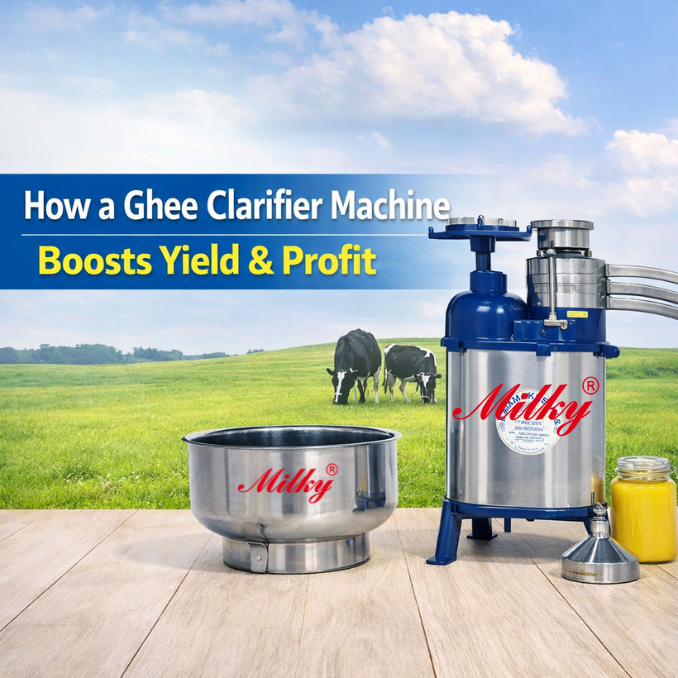
For many small and medium dairies, ghee is not just another dairy product — it’s often the most profitable item they produce. Yet, a large number of dairy owners unknowingly lose money during the ghee-making process, even when milk quality is good and demand is strong.
The issue usually isn’t raw material. It’s inefficient ghee clarification.
From avoidable fat losses to high fuel consumption and inconsistent quality, the wrong setup quietly reduces margins every single day. The right ghee clarifier machine, however, can significantly improve yield, profit, and processing efficiency, especially for dairies working with limited labor and tight operating budgets.
Why Ghee Clarification Has a Direct Impact on Profitability
In ghee production, even small inefficiencies matter.
According to industry observations from cooperative and private dairies in India:
0.5–1.5% fat loss is common in traditional or poorly controlled clarification setups
Fuel and energy costs can account for 12–18% of total ghee processing cost
Manual clarification increases batch variability and rejection risk
For a dairy producing just 30–50 kg of ghee per day, these losses translate into lakhs of rupees annually.
This is why experienced dairy operators treat ghee clarification not as a cooking step, but as a critical control point.
What a Ghee Clarifier Machine Actually Improves (Beyond Heating)
While the basic function is moisture removal and milk solid separation, a purpose-built ghee clarifier machine offers much more control over the process.
It helps by:
Maintaining uniform heating across the entire batch
Preventing localized burning of milk solids
Allowing proper settling and separation for better grain structure
Reducing oxidation, which preserves aroma and shelf life
This controlled environment is what separates consistent, high-yield ghee from batch-to-batch variability.
Yield Improvement: Where the Numbers Really Add Up
Typical Fat Recovery Comparison
| Processing Method | Average Fat Loss | Yield Consistency |
|---|---|---|
| Open kettle / manual setup | 1.0–1.5% | Low |
| Improvised heated vessels | 0.8–1.2% | Medium |
| Purpose-built ghee clarifier machine | 0.2–0.5% | High |
Even a 0.8% improvement in fat recovery can result in:
Extra 8 kg ghee per 1,000 kg butter
Higher monthly output without increasing milk procurement
Better profitability with the same raw material
This is one of the strongest ROI drivers for upgrading equipment.
Processing Efficiency: Time, Fuel, and Labor Savings
Small and medium dairies often underestimate how much time and energy inefficient clarification consumes.
Average Processing Performance Comparison
| Parameter | Traditional Method | Ghee Clarifier Machine |
|---|---|---|
| Batch processing time | 90–120 minutes | 45–70 minutes |
| Fuel/energy consumption | High & inconsistent | Optimized & stable |
| Operator dependency | Very high | Moderate |
| Batch repeatability | Low | High |
Shorter processing cycles allow dairies to:
Run more batches per day
Align ghee production with milk inflow
Reduce overtime and operator fatigue
Over a year, fuel savings alone can recover a significant portion of the machine cost.
Consistent Quality = Better Market Acceptance and Pricing
Buyers today — wholesalers, retailers, and institutional customers — are increasingly strict about ghee quality.
A well-designed ghee clarifier helps maintain:
Uniform grain structure
Clean golden color
Natural aroma without burnt notes
Lower moisture levels, improving shelf life
Consistent quality reduces:
Product rejections
Customer complaints
Price negotiations
Many dairies find that once quality stabilizes, they can sell ghee faster and at a slightly higher price, improving cash flow.
Choosing the Right Machine for Your Dairy Size
Oversizing or undersizing a ghee clarifier often leads to measurable efficiency losses. In small dairies handling 100–500 liters of milk per day, batch-type ghee clarifiers in the 50–100 kg range typically achieve the best balance between processing time and energy use. Using a larger machine at this scale often results in 20–30% idle capacity, increasing per-batch energy cost without improving output. For medium dairies processing 500–3,000 liters per day, higher-capacity batch or semi-automatic clarifiers reduce total processing time by 25–40% compared to smaller units and help stabilize fuel consumption across multiple batches. Dairies planning expansion benefit from selecting clarifiers with scalable capacity, as early under-sizing can force equipment replacement within 2–3 years. In practice, the most efficient setups are not the largest ones, but those that match daily throughput closely, minimizing idle time while avoiding processing bottlenecks.
Hygiene, Compliance, and Long-Term Reliability
Food safety regulations are becoming stricter across India and export markets.
A proper ghee clarifier machine ensures:
Food-grade stainless steel construction
Easier cleaning and sanitation
Reduced contamination risk
Better compliance with FSSAI and buyer audits
What to Check Before Buying a Ghee Clarifier Machine
Before investing, dairy owners should realistically assess:
Actual daily ghee requirement
Heating method availability (electric, steam, gas)
Ease of cleaning and maintenance
Spare part accessibility
After-sales technical support
A machine’s value is determined not just by its price, but by how reliably it runs over years.
Mahesh Eng. Works develops ghee clarifier machines keeping the day-to-day realities of small and medium dairies in mind. The emphasis is on steady performance, efficient heating, and designs that are easy to operate and maintain in real production environments.
By focusing on fat recovery, energy efficiency, and durable stainless-steel construction, the equipment supports consistent ghee quality and smoother processing. This practical approach helps dairies improve efficiency over time without investing in unnecessary complexity.
Conclusion:
A ghee clarifier machine is more than just a piece of processing equipment; it plays a direct role in how efficiently a dairy converts raw material into saleable ghee. When the right machine is chosen, it helps improve yield, reduce fuel and labor costs, and maintain consistent quality across batches. Over time, this consistency builds buyer confidence and reduces avoidable losses. For small and medium dairies, investing in the right clarifier can turn ghee production into a reliable, scalable revenue stream rather than a daily operational challenge.
FAQs
1. How much yield improvement can a ghee clarifier machine provide?
A ghee clarifier machine can improve ghee yield by 0.5% to 1.3% by reducing fat loss during clarification. For a small dairy producing 30 kg of ghee per day, a 1% yield improvement can add 8–10 kg of extra ghee per month without increasing milk or cream input.
2. Is a ghee clarifier machine profitable for small dairies?
Yes, ghee clarifier machines are profitable for small dairies due to lower fuel costs, reduced labor time, and consistent quality. Most small dairies see 15–25% energy savings and 30–40% labor reduction, allowing them to recover their investment within 8–18 months, depending on production volume.
3. What is the difference between manual ghee making and using a clarifier machine?
Manual ghee making depends heavily on operator skill, leading to inconsistent quality and higher losses. A ghee clarifier machine offers controlled heating, higher fat recovery, lower fuel usage, and reduced risk of burning, resulting in consistent batches and predictable output for regular ghee producers.
4. How much energy does a ghee clarifier machine consume?
Ghee clarifier machines typically use 15–30% less energy than traditional open kettles due to efficient heat transfer and temperature control. Steam-heated systems work best for medium dairies, while electric or gas-based clarifiers are suitable for smaller batch operations with limited infrastructure.
5. What capacity ghee clarifier machine is best for small and medium dairies?
The ideal ghee clarifier capacity depends on daily ghee production, not peak milk volume. Small dairies handling 100–500 liters of milk per day usually require a 50–100 kg batch clarifier, while medium dairies processing 500–3,000 liters per day benefit from 100–300 kg batch or semi-automatic systems.
6. Does a ghee clarifier machine improve shelf life?
Yes, a ghee clarifier machine improves shelf life by reducing moisture content and preventing overheating. Controlled clarification lowers free fatty acid development, preserves natural aroma, and can extend shelf stability by several weeks compared to inconsistently processed ghee.