

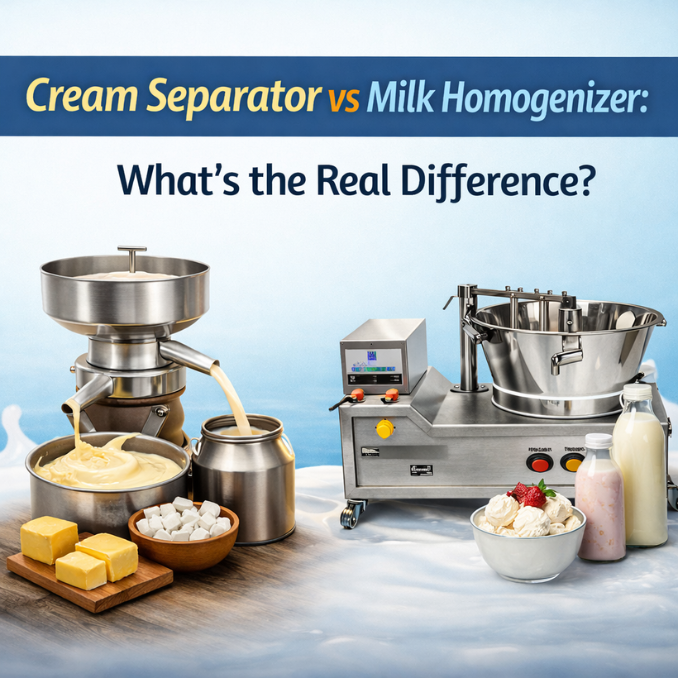
These two machines both deal with fat in milk. That is where the similarity ends.
A cream separator pulls fat out. A milk homogenizer breaks fat down so completely that it can never come back out. One splits milk into two products. The other locks it into one permanent uniform whole. Picking the wrong one does not just affect efficiency — it changes your product entirely.
Here is what each machine actually does, and how to know which one your operation needs.
What Is a Cream Separator?
Leave fresh whole milk undisturbed for 12 to 24 hours and cream rises to the top naturally. Fat globules are lighter than the surrounding liquid — gravity does the work, just slowly.
A cream separator does the same thing using centrifugal force at 6,000 to 8,000 RPM. Heavier skim milk flies to the outer edge. Lighter cream concentrates at the centre. Both exit through separate outlets at the same time. What takes gravity a full day, a separator does in seconds.
The best cream separators leave less than 0.01% fat in the skim milk — compared to 25% fat left behind by traditional gravity separation.
The output is two distinct products: cream (typically 35–45% fat) and skim milk with almost no fat. Nothing is wasted. You are redirecting fat, not removing it.
Best used for:
- Butter, ghee, and cream products — concentrated cream is non-negotiable
- Paneer and fresh cheese — fat standardisation controls texture and yield
- Skim milk and low-fat dairy — the only way to properly remove fat
- Milk standardisation — removing fat and blending it back at a precise percentage
What Is a Milk Homogenizer?
A homogenizer does not separate anything. It does the opposite — it destroys the fat globule structure so completely that separation becomes physically impossible.
Fresh milk has fat globules averaging 3.5 micrometres in diameter. Large enough for gravity to pull them upward over time. A homogenizer forces milk through an extremely narrow valve under high pressure — 1,450 to 3,625 PSI. Fat globules shear apart into particles below 1 micrometre. At that size, buoyancy force becomes negligible. They stay suspended permanently.
Fat globule size drops from ~3.5 µm to below 1 µm during homogenization — making separation physically impossible without specialist industrial equipment.
The result: milk that looks whiter, tastes creamier, and stays uniform from first pour to last drop. And this is a permanent change. You cannot un-homogenize milk — the fat globule membrane is structurally altered and cannot be reversed.
Best used for:
- Packaged retail milk — consumers expect no cream line
- UHT and long-life milk — homogenization is standard before ultra-high temperature treatment
- Flavoured milk and dairy beverages — emulsion stability is non-negotiable
- Ice cream mix — fat distribution controls texture directly
- Infant formula — smaller particle size improves digestibility
Quick Comparison: Cream Separator vs Milk Homogenizer
| Feature | Cream Separator | Milk Homogenizer |
|---|---|---|
| What it does | Splits fat from milk | Locks fat into milk |
| How it works | Centrifugal force | High pressure valve |
| Output | Cream + skim milk | One uniform product |
| Reversible? | Yes | No — permanent |
| Used for | Butter, ghee, paneer | Packaged milk, UHT |
| Energy use | Moderate | High |
Which One Does Your Operation Need?
You need a cream separator if:
You make butter, ghee, cream, or paneer. You produce skim or low-fat milk. You need to standardise fat content before processing. Basically — if working with fat as a separate ingredient is part of your operation, this is your machine.
You need a homogenizer if:
You sell packaged retail milk. You produce UHT, flavoured milk, or dairy beverages. You need shelf life, visual consistency, and a product that does not separate on the shelf. No cream line means no returns, no complaints.
When you need both:
Most commercial dairy operations need both — in sequence. Separate and standardise fat content first, then homogenize to lock that composition permanently. Never the other way around. Homogenizing before standardising means you cannot adjust fat content after — the change is irreversible.
Frequently Asked Questions
Can a homogenizer replace a cream separator? No. A homogenizer bonds fat permanently into milk — it cannot extract or separate fat. If your process involves cream, butter, or skim milk production, you need a separator. They solve completely different problems.
Which machine comes first in a dairy plant? The cream separator always comes first. Separate and standardise fat content, then homogenize. If you homogenize first, you cannot adjust fat percentage afterwards — the change is irreversible.
Can homogenized milk make good paneer? Not really. Homogenized milk forms a weaker, softer curd that is difficult to press and dewater properly. For paneer, fresh cheese, or traditional dairy products, non-homogenized milk gives significantly better results every time.
Does homogenized milk taste different? Most people find it creamier and smoother even at the same fat percentage. The smaller fat globules interact differently with taste receptors. Non-homogenized milk tastes richer at the top, thinner at the bottom. It is a product positioning choice, not a quality difference.
What capacity separator do I need for a small farm? 50 to 100 litres per hour for home or small farm use. 200 to 500 litres per hour for small commercial operations. Always buy with headroom above your peak daily volume — running any separator at maximum capacity continuously shortens its lifespan.

Mahesh Eng. Works
Written by Mahesh Engineering Works, specializing in precision dairy machinery and hygienic stainless-steel dairy solutions for small and medium dairy plants in India.