

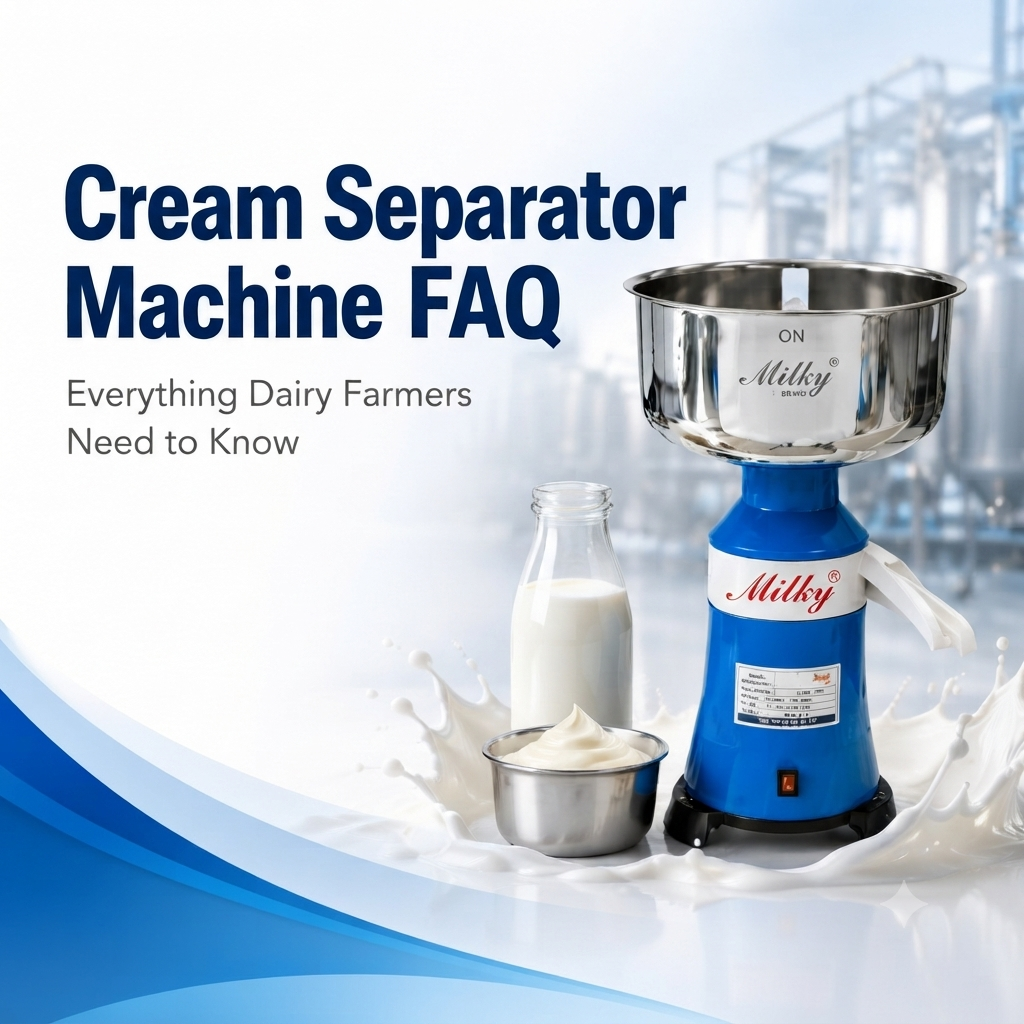
If you’ve ever searched “cream separator machine” online, you’ve probably ended up with more questions than answers. Capacity numbers that don’t match your farm size, manual vs. electric debates, confusing price ranges, and vague claims about “efficiency” it’s a lot to sort through before you’re ready to spend real money on equipment that has to work every single day.
That’s exactly why this cream separator machine FAQ exists. Over the years, we’ve fielded the same core questions from dairy farmers, cooperative managers, and small dairy plant owners some buying their first machine, others troubleshooting one that isn’t performing the way it used to. This guide brings those real-world questions together in one place, organized so you can jump straight to what you need or read start to finish if you’re still in the research stage.
Understanding Cream Separators
What is a cream separator machine?
A cream separator machine mechanically splits raw milk into cream and skim milk using centrifugal force, spinning milk inside a disc-stacked bowl to separate the two in seconds. This replaces the old gravity method, which took hours and gave far less control. For dairy farmers, it means faster processing, consistent cream quality, and control over exactly how rich the final cream turns out. You can explore our full range of cream separator machines to see available capacities and configurations.
How does a cream separator work?
A cream separator works by spinning raw milk at high RPM inside a bowl fitted with stacked conical discs. Centrifugal force pushes denser skim milk outward while lighter fat globules move toward the center, exiting through separate outlets. Most machines run between 6,000-9,000 RPM. Milk temperature also plays a big role, since warmer milk separates far more cleanly than cold milk. For a deeper, step-by-step breakdown, read our detailed breakdown of the separation process.
Why is cream separated from milk?
Cream is separated from milk to standardize fat content and unlock multiple revenue streams, like butter, ghee, and paneer production, instead of selling only whole milk at a fixed price. Since raw milk’s natural fat content varies by breed, season, and feed, separation also gives processors precise control over the final fat percentage in every batch they produce.
What industries use cream separators?
Cream separators are used across dairy farms, milk collection centers, cooperatives, ghee and butter units, paneer and cheese plants, and ice cream production facilities. Small food processing businesses and hospitality operations with in-house dairy handling also rely on smaller manual units. Essentially, any business processing meaningful volumes of raw milk benefits from mechanical separation over slower gravity-based methods.
Buying Questions
Which capacity should I choose?
Choose a capacity rated 20-30% above your current daily milk volume, not exactly matching it. Running a machine at its absolute maximum daily strains the motor and bearings, shortening its life. A farm processing 200 liters a day is better served by a 300 LPH unit than one rated exactly at 200 LPH, since headroom also covers natural seasonal volume increases.
Can one machine process both cow and buffalo milk?
Yes, most cream separators handle both cow and buffalo milk without needing separate machines. Buffalo milk’s higher fat content makes it more viscous, so separation may take slightly longer or need adjusted cream screw settings for the desired richness. If your farm regularly processes both types, mention this to your supplier so bowl disc spacing can be tuned accordingly.
Manual vs. electric cream separator?
Manual separators suit very small operations under 100 liters a day where budget is tight and labor is available. Electric models are better for anything beyond that, running continuously without operator fatigue and delivering more consistent RPM, which directly improves separation quality. Most farms start manual and upgrade to electric as daily volume and collection demands grow. See our full comparison of manual and electric models for a detailed breakdown.
Which stainless steel grade is best?
SS 304 is the industry standard for milk-contact parts like the bowl, discs, and spouts, offering strong corrosion resistance at a reasonable cost. SS 316 handles harsher chemicals and conditions but costs more, and suits export-grade or heavy-duty use. For most Indian dairy farms, SS 304 balances hygiene, durability, and affordability well, provided all milk-contact parts use it.
How much does a cream separator machine cost?
Cream separator prices in India (2026) range from around ₹10,000-₹55,000 for a basic 100 LPH manual or electric unit to ₹1.8-3 lakh for a 1,000 LPH industrial model, and ₹12-50+ lakh for fully automatic 5,000+ LPH plant-grade separators. The most commonly purchased range, 500 LPH electric SS 304 units for dairy cooperatives, typically falls between ₹25,000-₹75,000+. Exact pricing depends on stainless steel grade, automation level, and motor power, so see our current cream separator price ranges by capacity for a full breakdown.
Note: Prices are indicative ex-works estimates and may vary by specification, GST, and transportation. Contact us directly for a current quote.
| Daily Milk Volume | Recommended Capacity (LPH) | Typical Use Case |
|---|---|---|
| Up to 50 liters/day | 60 LPH | Individual farmers, home dairy |
| 100-150 liters/day | 165 LPH | Small farms, household clusters |
| 200-400 liters/day | 300-550 LPH | Milk collection centers, growing farms |
| 500-800 liters/day | 750-1000 LPH | Dairy cooperatives, small plants |
| 1,000+ liters/day | 1500 LPH and above | Processing plants, larger cooperatives |
Performance & Efficiency
What is the ideal milk temperature for separation?
The ideal separation temperature is 35°C-40°C (95°F-104°F), roughly body-warm milk straight from the animal. At this range, milk fat stays fluid enough to separate cleanly and quickly. Cold milk below 10°C separates poorly, since the fat becomes semi-solid and doesn’t rise through the disc stack efficiently, leaving more fat trapped in the skim milk output.
How much cream can be recovered from milk?
Cream recovery typically ranges between 8-12% of total volume for cow milk and 10-15% for buffalo milk, depending on breed, feed, and season. A well-tuned separator running at correct temperature and RPM consistently hits the higher end of this range. Poor temperature control or worn discs, on the other hand, leave usable fat behind in the skim milk.
Does buffalo milk produce more cream than cow milk?
Yes, buffalo milk generally produces more cream, since it naturally contains higher fat content, often 6-8% compared to cow milk’s typical 3.5-4.5%. This is why buffalo milk is preferred for ghee and khoya production across much of India. Its higher viscosity does mean separators may need slightly adjusted settings to avoid clogging the disc stack during processing.
What affects separation efficiency?
Separation efficiency depends mainly on milk temperature, RPM consistency, disc cleanliness, and steady milk flow into the bowl. Voltage instability causing RPM fluctuations is a common but overlooked culprit. Worn or scratched discs also reduce efficiency over time, and feeding milk faster than the machine’s rated capacity is another frequent mistake that leaves fat behind in the skim milk.
Cleaning & Maintenance
How often should the machine be cleaned?
The bowl, discs, and all milk-contact parts should be cleaned after every single use, without exception. Milk residue left for even a few hours breeds bacteria and shortens gasket and seal life. Daily cleaning involves disassembling the bowl and washing all discs individually, while a weekly inspection of gaskets, bearings, and the drive mechanism catches wear before it worsens. For the full routine, follow our complete cleaning and maintenance schedule.
Which parts require regular maintenance?
The bowl discs, rubber gaskets, drive belt, and bearings need the most regular attention. Discs should be checked for scratches or bent edges that disrupt flow, while gaskets wear out from repeated cleaning and need periodic replacement. A slipping drive belt directly reduces RPM and separation quality, and unusual bearing noise is often the earliest warning sign of trouble.
How long does a cream separator last?
With proper maintenance, a good-quality cream separator typically lasts 10-15 years, sometimes longer for well-built stainless steel units used within their rated capacity. Machines pushed beyond their rated LPH or cleaned inconsistently often fail within 3-5 years instead. Machine longevity depends far more on cleaning discipline than on the original purchase price.
What common mistakes reduce machine life?
The most common mistakes are skipping daily cleaning, running the machine beyond rated capacity, using cold milk regularly, and ignoring early warning signs like noise or vibration. Overloading a 300 LPH machine to handle 400+ liters daily strains the motor and bearings, while letting milk residue dry inside the bowl accelerates corrosion and gasket wear over time.
Troubleshooting
Why is my cream too thin?
Thin cream usually means the cream screw needs adjustment, milk temperature is too low, or milk is being fed too fast into the bowl. Most separators have an adjustable screw controlling fat concentration in the output, and a slight adjustment often fixes this immediately. If that doesn’t help, confirm milk temperature falls within the recommended 35-40°C range.
Why is cream mixing with skim milk?
Cream mixing with skim milk typically happens due to worn or damaged discs, incorrect bowl assembly, or running the machine above its rated capacity. Bent, scratched, or missing discs disrupt the separation flow, letting fat escape into the skim milk stream. Check that all discs are correctly seated and in good condition, especially after using replacement parts.
Why is the machine vibrating?
Vibration is almost always caused by an imbalanced bowl, worn bearings, or an uneven surface underneath the machine. Improper bowl reassembly after cleaning is the most common cause, since even slight disc misalignment throws off balance at high RPM. If reassembly isn’t the issue, check bearings for wear and confirm the machine sits level and securely bolted down.
Why is milk leaking from the machine?
Milk leaks are usually caused by worn gaskets, a cracked bowl seal, or incorrect bowl assembly after cleaning. Since gaskets get cleaned and handled daily, they wear out fastest and a leak is often the first visible sign they need replacing. Inspect all rubber seals during your next cleaning cycle and confirm the bowl is fully reassembled before each run.
Why is separation quality poor overall?
Poor separation quality usually traces back to incorrect milk temperature, worn discs, RPM inconsistency from power fluctuations, or the machine running past its rated capacity. Work through these in order: check temperature first since it’s the easiest fix, then inspect discs, then confirm your daily volume genuinely matches the machine’s rated LPH before assuming a deeper fault.
Final Buying Advice
Choosing the right cream separator comes down to five practical factors:
- Daily milk volume — size the machine to your actual volume, with 20-30% headroom for growth
- Future expansion — if you’re planning to scale collection or add value-added products like ghee or butter, buy one capacity tier above your current need
- Power availability — confirm voltage stability in your area before committing to a fully automatic electric model
- Budget — balance upfront cost against long-term durability; the cheapest option often costs more in early replacement
- Hygiene requirements — SS 304 on all milk-contact parts is non-negotiable for food safety compliance
Getting this decision right the first time saves years of frustration and unnecessary repair costs.
If you’re still unsure which capacity or model fits your operation, our team at Mahesh Eng. Works (MILKY®) has spent decades helping dairy farmers, cooperatives, and processing plants across India and abroad choose equipment that actually fits their volume and growth plans. Reach out for a straightforward recommendation based on your specific milk volume, budget, and future plans.

Mahesh Eng. Works
Written and reviewed by Mahesh Eng. Works, a dairy machinery manufacturer specializing in milk cream separator machines and hygienic stainless steel dairy equipment. Since 1980, we have been designing and manufacturing cream separators, butter churners, milk pasteurizers, bulk milk coolers, and complete dairy processing solutions for dairy farms, milk collection centers, and processing plants.