

What Is a Milk Analyzer, and Why Does Your Dairy Need One?
A milk analyzer is an instrument that measures the composition of raw milk fat, solids-not-fat (SNF), protein, lactose, and water content in seconds, without lab chemicals. Dairy plants, milk collection centers (BMCs), and even individual farmers use a milk fat testing machine for one core reason: milk is priced by its fat and SNF content in India, so an accurate analyzer directly protects your payout accuracy and margins.
Before analyzers became common, most centers relied on the manual Gerber method or a simple lactometer. Both work, but they’re slow, require chemicals, and depend heavily on the operator’s technique. A modern milk analyzer removes that variability.
Milk Analyzer vs. Milk Tester Machine vs. Lactometer
These terms get used loosely, so it helps to separate them:
- Lactometer — a simple float-based instrument that estimates density, and from that, roughly infers SNF. No fat reading, no adulteration detail.
- Gerber test kit — a chemical-based manual method for fat only. Accurate when done correctly, but slow (around 5 minutes per sample) and needs sulphuric acid and amyl alcohol.
- Milk tester machine / milk analyzer — a digital instrument that tests multiple parameters at once, usually in 30–60 seconds, without reagents.
If your business handles more than a handful of samples a day, a dedicated milk analyzer will save far more in labor and consistency than it costs.
Types of Milk Fat Testing Equipment Available in India
| Type | How it works | Speed | Chemicals needed | Best for |
|---|---|---|---|---|
| Lactometer | Density/float based | Instant, but limited data | No | Rough field checks only |
| Gerber method | Acid-based fat separation | ~5 minutes/sample | Yes | Labs verifying disputed samples |
| Single-sensor ultrasonic analyzer | One ultrasonic sensor reads composition | 30–60 sec | No | Low-volume centers, tight budgets |
| Double-sensor ultrasonic analyzer | Two sensors cross-check readings for stability | 30–40 sec | No | Medium-high volume BMCs and plants |
| Infrared (FTIR) analyzer | Infrared spectroscopy, lab-grade | Fast, batch capable | No | Large processing plants, QC labs |
For day-to-day procurement at a collection center, ultrasonic analyzers (single or double sensor) dominate the Indian market because they’re reagent-free and affordable. FTIR units are more common in large processing plants and referee labs due to their higher cost.
What Parameters Should a Good Milk Analyzer Test?
At minimum, a reliable milk analyzer should cover:
- Fat — the primary pricing parameter
- SNF (Solids-Not-Fat) — second pricing parameter
- Protein — increasingly used in quality-linked pricing
- Lactose
- Density
- Added water — critical for catching adulteration
- Temperature and, on better units, freezing point (a stronger adulteration indicator than density alone)
A machine that only reads fat and SNF is fine for very small operations, but if adulteration detection or protein-linked pricing matters to your business, look for a model that reports all of the above.
How Accurate Should a Milk Analyzer Be?
Accuracy in this category is usually expressed as a margin on fat readings. A well-calibrated double-sensor ultrasonic milk analyzer typically holds fat accuracy within ±0.05% to ±0.1%, which is tight enough for commercial procurement and quality control use. Two things matter more than the spec sheet number, though: regular calibration, and clean sample handling a poorly maintained machine won’t hit its rated accuracy regardless of the technology inside it.
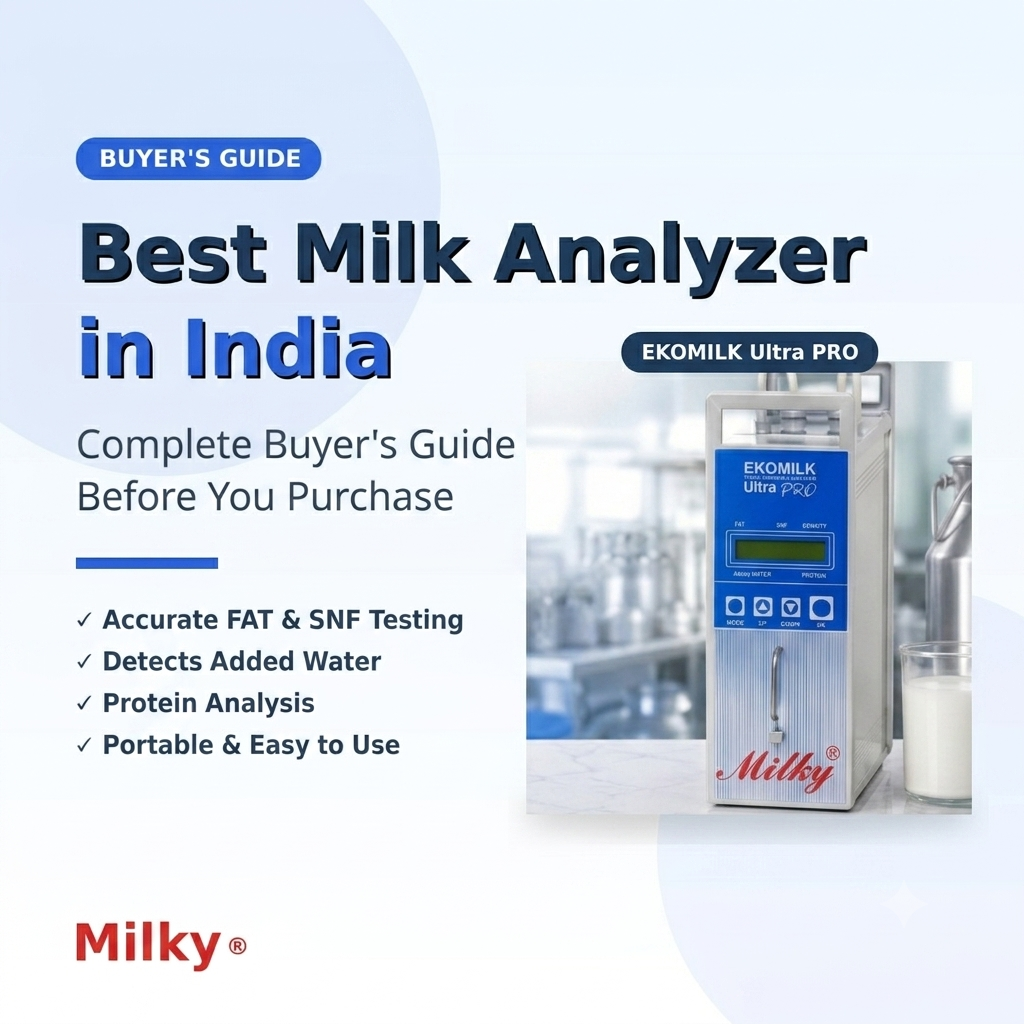
Ekomilk Ultra Pro Double Sensor — A Closer Look
Among double-sensor ultrasonic analyzers sold in India, the Ekomilk Ultra Pro Double Sensor is a widely used option in milk collection centers and dairy plants. Key specifications:
| Spec | Detail |
|---|---|
| Technology | Ultrasonic, dual-sensor |
| Parameters tested | Fat, SNF, protein, lactose, density, added water, temperature, freezing point |
| Fat accuracy | ±0.05% to ±0.1% |
| Test time | 30–40 seconds per sample |
| Milk types supported | Cow, buffalo, mixed |
| Adulteration detection | Yes, via density and freezing point analysis |
| Chemicals required | None |
| Typical price range in India | ₹35,000–₹80,000 (varies by accessories, printer, and calibration/installation support) |
The double-sensor design is the key differentiator over single-sensor units: with two ultrasonic sensors cross-referencing each reading, results stay more stable across varying milk quality and higher daily volumes which matters in a BMC handling farmer samples all morning.
Milk Analyzer Price in India: What Drives the Cost
Prices for milk fat testing machines in India commonly range from roughly ₹15,000 for basic single-parameter units to ₹2,50,000 for full-featured double-sensor or software-integrated models. What actually changes the price:
- Number of parameters tested — fat-only units cost less than 6–7 parameter machines
- Sensor type — double-sensor units cost more than single-sensor
- Included accessories — thermal printer, data software, cloud connectivity
- Installation and calibration support from the seller
- After-sales service network — a real cost factor even if it’s not on the price tag
Be cautious of unusually cheap listings without service backup; a milk tester machine that can’t be recalibrated locally becomes an expensive paperweight after the first drift.
How to Choose the Right Milk Analyzer: A Buying Checklist
Before you purchase, verify:
- Parameter coverage — does it test everything your pricing model requires?
- Accuracy range — ask for the fat accuracy spec in writing, not just “highly accurate”
- Sample testing speed vs. your daily volume
- Chemical-free operation to control running costs
- Cow/buffalo/mixed calibration if you handle more than one milk type
- Adulteration detection capability (density + freezing point, not density alone)
- Local calibration and service support — critical for uptime
- Warranty terms and spare-part availability
Best Milk Analyzer by Use Case
- Milk collection centers (BMCs): Double-sensor ultrasonic analyzers strike the best balance — fast enough for daily farmer traffic, accurate enough for fair pricing.
- Large dairy processing plants: May justify an FTIR-based lab analyzer alongside a floor-level ultrasonic unit for quick checks.
- Small farms or single-outlet dairies: A single-sensor ultrasonic unit or even a well-maintained Gerber kit may be sufficient if volume is low.
Common Mistakes Buyers Make
- Choosing on price alone and ignoring service/calibration support
- Not confirming the machine is calibrated for buffalo milk if that’s a major part of local supply
- Skipping adulteration-detection features to save cost, then losing more to undetected dilution
- Buying from a reseller with no local presence, making warranty claims difficult
FAQs
What is the price of a milk analyzer in India?
Milk analyzer prices in India generally range from ₹20,000 to ₹80,000+, depending on parameters tested, sensor type, and included accessories.
Which milk analyzer is best for a milk collection center?
A double-sensor ultrasonic milk analyzer, such as the Ekomilk Ultra Pro Double Sensor, is generally best suited to BMCs due to its speed, accuracy, and reagent-free operation.
Does a milk fat testing machine need chemicals?
Modern ultrasonic milk analyzers don’t require chemicals. Only the traditional Gerber method uses reagents like sulphuric acid.
Can a milk analyzer detect adulteration?
Yes — analyzers that measure density and freezing point (not density alone) can reliably flag water adulteration.
How long does milk analyzer testing take?
Most modern ultrasonic milk analyzers, including double-sensor models, test a sample in 30–40 seconds.
Is a milk analyzer better than a lactometer?
Yes, for any commercial use. A lactometer only estimates density; a milk analyzer measures multiple parameters directly with far greater accuracy.
Conclusion
Choosing the right milk analyzer comes down to matching parameter coverage, accuracy, and service support to your actual daily volume — not just picking the cheapest listing. For most Indian milk collection centers and dairy plants, a double-sensor ultrasonic milk analyzer offers the strongest combination of speed, accuracy, and low running cost.