

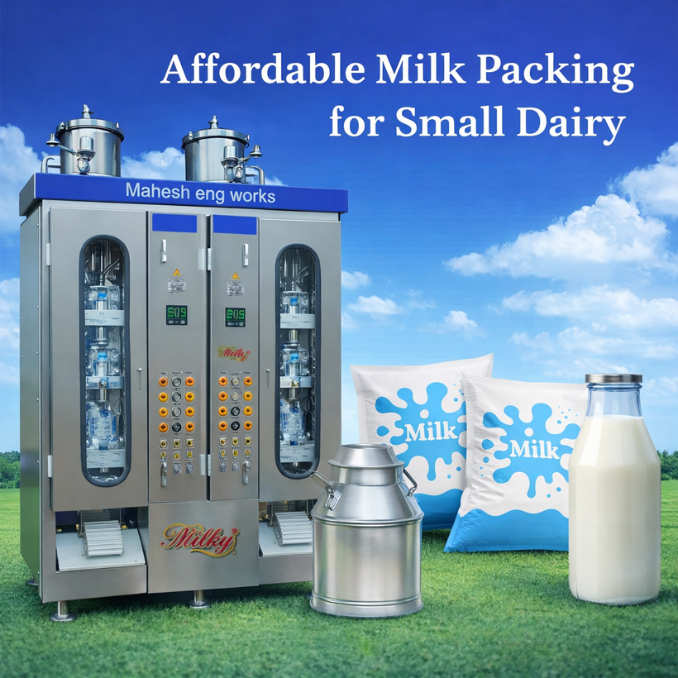
Running a small dairy is a daily balancing act. Every litre matters, time is always tight, and profit margins don’t forgive small mistakes. While most dairy owners focus heavily on milk quality and sourcing, packaging is often the silent profit killer—or, when done right, a major efficiency booster.
If you’re still packing milk manually or relying on temporary setups, you’ve likely faced the usual problems: leakage, wastage, hygiene risks, slow packing speed, and growing dependence on labour. It’s no surprise that many small and medium dairy businesses are now searching for an affordable milk packing machine that actually matches their current production—not a machine built for some distant future.
This guide is written for real dairy operators, not theory. Whether you pack 300 litres a day or closer to 2,000, you’ll learn what “affordable” really means, how to choose the right machine capacity, what kind of return on investment to expect, and how to avoid costly buying mistakes while selecting the right milk packing machine for your dairy.
Why Packaging Turns Into a Bottleneck for Small Dairies
In many small and medium dairies, milk production grows faster than the packing setup. At the beginning, manual filling feels manageable. One or two people, a few cans, and the job gets done. But as volumes increase, cracks start to show.
Typical issues include:
Uneven pouch weights
Milk spillage and leakage
Weak or inconsistent sealing
Hygiene risks from excessive handling
Heavy dependence on skilled labour
Industry data suggests that manual milk packing can waste anywhere between 3% and 7% of daily production, mainly because of spillage and inaccurate filling. If you’re processing around 1,000 litres a day, that loss isn’t small — it shows up directly in your monthly numbers.
This is where a milk packing machine for small dairy businesses stops being a luxury and starts making sense as a practical operational upgrade.
What Does “Affordable” Actually Mean in a Milk Packing Machine?
An affordable milk packing machine isn’t the cheapest option on the market. In fact, the cheapest machine often turns out to be the most expensive one over time.
For small dairies, “affordable” usually means:
Capacity that matches your real daily output
Simple operation that doesn’t need highly skilled staff
Low and predictable maintenance
Consistent, reliable sealing
Easy access to service and spare parts
A price that delivers value, not unnecessary features
These machines are commonly used for:
Milk pouch packing
Curd and lassi packaging
Flavoured milk
Other liquid dairy products
You might also hear them called:
Milk pouch packing machine
Liquid packing machine
Dairy pouch filling machine
Milk sachet sealing machine
Different names, same basic job.
Manual Packing vs Machine Packing: A Ground-Level Comparison
| Factor | Manual Packing | Semi-Automatic Machine | Automatic Machine |
|---|---|---|---|
| Output per hour | 50–100 pouches | 300–800 pouches | 1000+ pouches |
| Labour required | High | Medium | Low |
| Hygiene level | Low | Good | Very high |
| Packing accuracy | Inconsistent | Consistent | Highly accurate |
| Milk wastage | High | Low | Very low |
| Best suited for | Very small dairies | Small & medium dairies | Growing dairies |
For most small dairy businesses, semi-automatic or entry-level automatic machines hit the sweet spot. They improve speed and hygiene without pushing investment too far.
How Much Does an Affordable Milk Packing Machine Cost?
This is usually the first question — and it should be.
Typical Price Range in India
| Machine Type | Approximate Price |
|---|---|
| Semi-Automatic Milk Packing Machine | ₹2.5 – ₹4 lakh |
| Entry-Level Automatic Packing Machine | ₹4 – ₹6.5 lakh |
| Mid-Range Automatic Machine | ₹6.5 – ₹10 lakh |
Pricing depends on things like:
Packing speed
Level of automation
Build quality
Control system (manual or PLC)
After-sales support
A useful way to look at cost is not just the machine price, but how much it costs you per pouch over time. That’s where affordable machines usually prove their value.
Choosing the Right Capacity for a Small Dairy
One of the most common mistakes small dairies make is buying a machine that’s bigger than they actually need — just in case.
Here’s a simple, realistic guide:
| Daily Milk Output | Recommended Capacity |
|---|---|
| 300–500 litres/day | 300–400 pouches/hour |
| 500–1,000 litres/day | 500–800 pouches/hour |
| 1,000–2,000 litres/day | 800–1,200 pouches/hour |
A properly sized machine:
Uses less power
Faces less wear and tear
Costs less to maintain
Delivers faster ROI
Bigger isn’t always better — especially in dairy operations.
Features That Actually Matter (Not the Sales Talk)
When you’re comparing machines, it’s easy to get distracted by fancy features. Instead, focus on what helps you day to day.
Features that genuinely matter for small dairies:
Food-grade stainless steel body
Keeps the process hygienic and extends machine life.Accurate filling system
Helps avoid under-filled or over-filled pouches.Strong, consistent sealing
Fewer leaks, fewer retailer complaints.Simple control panel
Your operator should be comfortable in a day, not a week.Easy-to-clean design
Saves time during daily wash routines.
Advanced options like servo motors or PLC panels can be useful — but only if your production volume really justifies them.
What ROI Looks Like in the Real World
ROI is a big concern for most small dairy owners, and understandably so.
Based on real operating experience:
Labour costs often drop by 30–50%
Milk wastage reduces by 10–15%
Packing speed improves 3 to 5 times
ROI is typically achieved within 8–14 months
A common example:
A dairy packing about 800 litres per day manually shifts to a semi-automatic machine:
Two labourers per shift are saved
Daily milk loss reduces noticeably
Pouches look cleaner and more professional
Retail acceptance improves
Maintenance: Keeping an Affordable Machine Affordable
A machine stays affordable only if it’s looked after.
Simple daily habits go a long way:
Clean filling nozzles after each shift
Wash milk-contact parts with hot water
Check sealing temperature regularly
Inspect pouch film quality
With basic care, many milk packing machines run smoothly for 10–12 years or more.
Common Mistakes Small Dairy Owners Should Avoid
Buying high-capacity machines “for future expansion”
Ignoring availability of local service support
Choosing machines without proper sealing trials
Not checking spare part availability
Overlooking power supply requirements
In dairy operations, a practical machine almost always beats a flashy one.
Frequently Asked Questions
What is the best affordable milk packing machine for a small dairy?
For most small dairies, a semi-automatic or entry-level automatic machine with 300–800 pouches per hour capacity works best.
How much electricity does a milk packing machine consume?
Most small dairy machines run on single or three-phase power and have moderate energy consumption, suitable even for semi-urban and rural setups.
Can one machine handle milk, curd, and lassi?
Yes. Many machines are designed to pack multiple liquid dairy products with minor adjustments.
Is operator training required?
Basic training is usually enough. Most operators are comfortable within a day or two.
How long does installation take?
Installation typically takes one to two days, including testing and training.
Final Thoughts
An affordable milk packing machine isn’t about cutting corners. It’s about making a smart, sensible investment that supports steady growth. For small dairy businesses, the right machine improves hygiene, reduces losses, saves labour, and helps present a more professional product to the market.
When chosen based on real production needs — not assumptions — a milk packing machine often turns out to be one of the most profitable upgrades a dairy can make.
If you’re serious about packing milk cleanly and efficiently, the right machine can save you a lot of daily headaches. At Mahesh Eng. Works, we build milk packing machines that are practical, affordable, and made for real small dairy operations. No overcomplicated tech—just solid performance and easy maintenance. Take a look at our range and choose a solution that actually fits how your dairy works.