

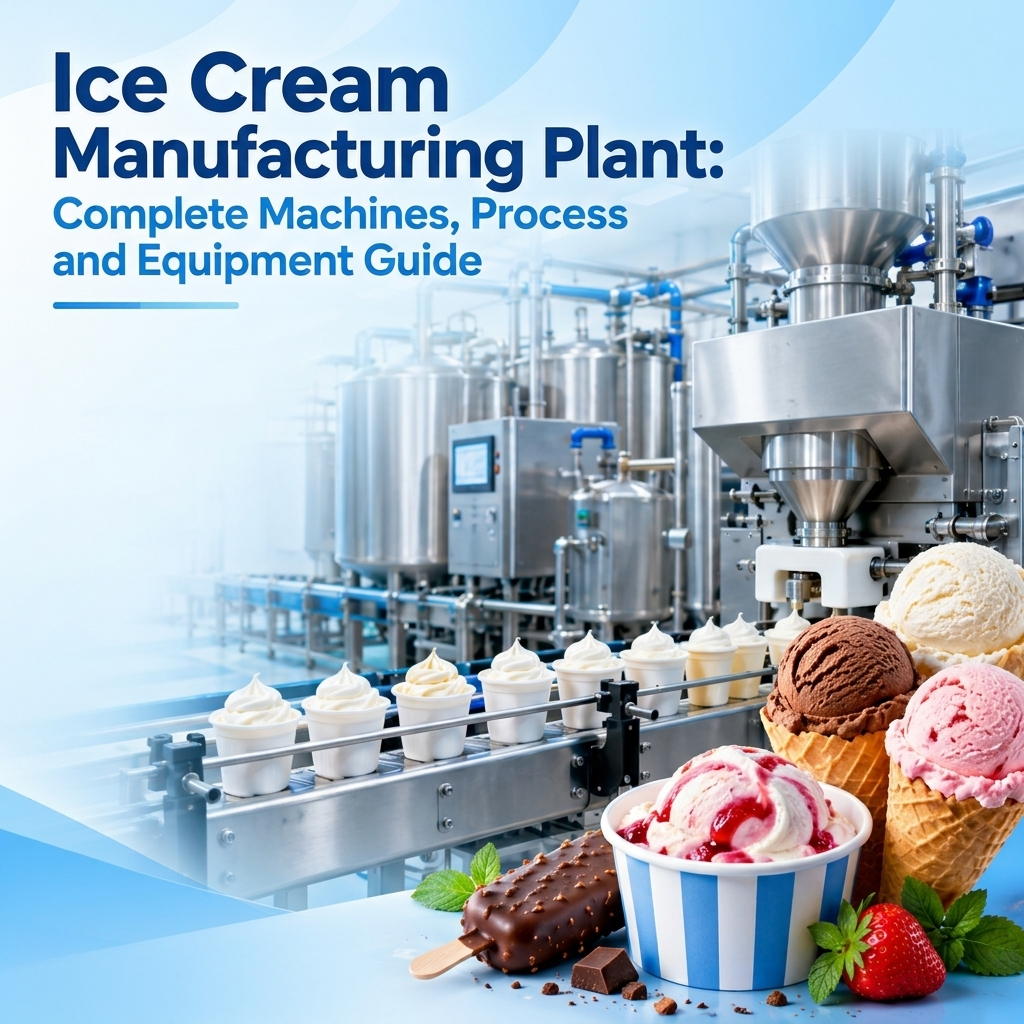
An ice cream manufacturing plant does six jobs in order. It receives and prepares the mix, pasteurizes it, homogenizes and ages it, freezes it with air, fills or forms it, then hardens and stores it. Cleaning and utility systems support every stage.
This guide covers each ice cream factory machine, what it does, and whether it is essential, optional or product-specific. Not every plant needs every machine. A cup-and-tub factory and a stick-novelty factory share the same mix room but differ after the freezer.
What Machines Does an Ice Cream Manufacturing Plant Need?
At minimum, a Ice Cream plant needs mix preparation and pasteurizing equipment, ageing vats, a freezer, a filling or packing machine, a hardening tunnel, cold storage, CIP cleaning and utilities. The ice cream factory equipment list below follows process order.
| Stage | Machine | What it does | Status |
|---|---|---|---|
| Raw material reception | Milk and cream chilling and storage tanks, powder storage | Holds dairy and dry ingredients | Essential (type depends on raw material) |
| Mix preparation | Blending tank, ingredient scales, filter, mix pump | Combines and dissolves ingredients | Essential |
| Pasteurization | Batch pasteurizer or HTST unit with plate heat exchanger | Heats the mix to destroy pathogens | Essential |
| Homogenization | Homogenizer | Breaks fat into smaller, more uniform droplets | Commonly included; depends on recipe and plant design |
| Cooling and ageing | Plate cooler, ageing vats | Chills the mix and holds it before freezing | Essential |
| Freezing | Continuous freezer (batch freezer at small scale) | Freezes the mix while whipping in air | Essential |
| Filling or forming | Cup, cone, tub filler or stick line | Portions and shapes the product | Essential, type depends on format |
| Hardening | Hardening tunnel or blast freezer | Rapidly freezes packed product | Essential for packed products |
| Storage | Cold room | Holds finished product | Essential |
| Cleaning | CIP unit | Cleans tanks and pipes without dismantling | Essential |
| Utilities | Boiler, chiller, refrigeration, cooling tower, compressed air | Power the process | Essential |
| Inclusions | Fruit and nut feeder, ripple pump | Adds pieces and sauces | Optional |
| Inspection and packing | Wrapping, cartoning, coders, metal detector | Packs and checks finished units | Optional or format-dependent |
| Novelty lines | Stick, extrusion, sandwich lines | Forms specific products | Product-specific |
How an Ice Cream Manufacturing Plant Works: Process and Equipment Sequence
Each step depends on the one before it.
- Reception and storage. Milk, cream and dry ingredients are held under suitable conditions.
- Blending. Ingredients are weighed, mixed and filtered.
- Pasteurization. The mix is heated to destroy pathogens.
- Homogenization. The mix passes through a homogenizer so fat stays evenly dispersed. Its exact position in the line depends on the plant design.
- Cooling. A plate heat exchanger chills the mix.
- Ageing. The mix rests in ageing vats before freezing.
- Freezing and aeration. The continuous freezer freezes the mix while whipping in air.
- Filling or forming. Product goes into cups, cones, tubs or moulds, with inclusions added at this stage.
- Hardening and storage. Packed product is hardened quickly, then held in a cold room.
Core Processing Equipment
Raw material reception and mix preparation
Plants that start from fresh milk need chilled storage tanks, and some may also use a cream separator to manage fat content, depending on the recipe. Plants that use milk powder and butter need dry storage and good dissolving equipment instead.
A blending tank with an agitator dissolves sugar, milk solids and stabilizers. A filter and mix pump then move the mix on. Poor dissolving at this stage can cause lumps and uneven texture later.
Pasteurizer
A pasteurizer heats the mix to destroy harmful bacteria. A batch pasteurizer holds the mix in a vat for a set time. An HTST unit heats it continuously in a plate heat exchanger, usually for a much shorter time at a higher temperature.
The required temperature and holding time depend on your recipe and on the food safety regulations in your country. Confirm them with your local authority and your equipment supplier before choosing a system. Batch systems are generally used in smaller plants and HTST in larger, continuous production.
Homogenizer
A homogenizer forces the mix through a narrow valve under high pressure, breaking fat into smaller, more uniform droplets. This helps give a smoother texture and reduces fat separation. It is commonly included in industrial ice cream lines, but whether you need one depends on your recipe and plant design, so confirm this with your equipment supplier.
Ageing vats
Ageing vats are jacketed, agitated tanks that hold the chilled mix before freezing. This rest period allows the mix to develop body and whip well in the freezer. Ageing time depends on the recipe and the plant’s process, so follow your formulation and supplier guidance. The total volume of your ageing vats also affects how continuously the mix room can supply the freezer.
Continuous freezer
The continuous freezer is the central machine in an industrial ice cream plant. It freezes the mix inside a scraped-surface barrel while whipping in air. The amount of air is called overrun. It affects texture, weight per unit and melt behaviour, and the target level depends on the product.
This industrial ice cream machine sets the plant’s output rate and delivers a steady stream to the filling machine.
| Feature | Batch freezer | Continuous freezer |
|---|---|---|
| Output pattern | One batch at a time | Steady, uninterrupted flow |
| Typical use | Small, artisan or gelato production | Industrial and medium-scale plants |
Continuous Ice Cream Freezer are generally chosen where steady output and automatic filling are needed, while batch freezers are more common in small and artisan production. Confirm which suits your product with your supplier.
Filling and Packaging Equipment
Filling equipment depends on your product:
- Cup and tub fillers portion ice cream into containers, then lid or seal them.
- Cone fillers fill cones, often with toppings.
- Stick moulding or extrusion lines form bars and novelties.
- Wrapping and cartoning machines pack finished units.
- Coders and metal detectors add traceability and safety checks.
Choose the filler to match the freezer’s output, not the other way round.
Refrigeration and Hardening Equipment
Packed ice cream is still soft when it leaves the filler. A hardening tunnel or blast freezer cools it quickly to a much lower temperature before storage. Rapid hardening helps keep ice crystals small and the texture smooth, while slow hardening can lead to a coarser product. Hardening temperature and time depend on product size, format and your equipment, so take these figures from your process design.
A cold room then holds finished goods at the low storage temperature your product and local regulations require.
Behind hardening and storage sits the refrigeration system: compressors and a chilling circuit that serve ageing, freezing, hardening and storage. Hardening and cold storage usually place significant demand on refrigeration, so size the system for peak production and discuss the load with your refrigeration supplier.
Cleaning and Utility Equipment
| System | Purpose |
|---|---|
| CIP (clean-in-place) unit | Cleans tanks, pipes and freezers without dismantling them |
| Boiler or hot water generator | Supplies heat for pasteurization |
| Chiller (glycol or ice water) | Cools the mix and supports heat exchangers |
| Cooling tower | Removes heat from refrigeration and process cooling |
| Compressed air system | Supports pneumatic valves and filling equipment |
| Water treatment | Supplies suitable process and cleaning water |
Hygiene depends heavily on CIP. Larger plants may use multi-tank CIP systems.
Optional and Product-Specific Machines
Optional ice cream production machinery
- Fruit and nut feeder for inclusions
- Ripple pump for sauces and swirls
- Coders and metal detectors
- Cartoning and palletizing
- PLC control and data logging for batch and temperature records
Product-specific machines
- Stick moulding line for lollies and bars
- Extrusion and hardening line for shaped novelties
- Sandwich machine for wafer or cookie products
- Cone filling line
- Chocolate coating tank for coated bars
- Batch freezers for gelato or artisan lines
Ice Cream Plant Equipment by Capacity
Used-plant listings show how some plants are configured at different scales. These are illustrative examples only, not fixed categories. Your own configuration will depend on your product, capacity and supplier.
| Scale | Example configuration seen in a listing |
|---|---|
| Smaller example | Pasteurizer, homogenizer, ageing tank, plate heat exchanger, cooling tower, Continuous Ice Cream Freezer, compressor and stainless steel piping |
| Medium example | Mix plant with boiler and chiller, several ageing tanks, continuous freezer, ripple pump and CIP |
| Larger example | Larger mix plant and ageing vats, multiple freezers, linear and robotic filling, coder, metal detector, multi-tank CIP, steam generator and air compressor |
As scale rises, plants tend to add automation, packaging and refrigeration capacity. They do not simply buy bigger versions of the same machines.
How to Match Machine Capacities in a Plant
Machines in an ice cream production line must be sized together.
- Freezer to filler: If the filler outruns the freezer, it starves. If it runs slower, product warms and weight can vary.
- Ageing volume to daily production: Ageing capacity affects how many hours a day the mix room can support.
- Hardening to filler output: An undersized tunnel slows the whole line.
- Refrigeration to peak load: Size for hot-season production.
- Growth: Leave space and utility headroom for a second freezer or filler.
Practical Equipment Selection Advice
- Start with product and capacity. Every other decision follows from them.
- Turnkey or separate suppliers. A single supplier simplifies integration and responsibility. Separate suppliers may give more choice but put matching and commissioning on you.
- New or used. Used plants can lower upfront cost, but check condition, running hours, spare parts availability and whether the capacity suits your product.
- Ask for a trial run or references where possible.
- Check spares and service support in your country before you buy.
- Match automation to your team. More automation helps consistency, but needs trained operators and maintenance.
Ice Cream Manufacturing Plant Setup Considerations
- Layout follows flow. Arrange raw material, mix room, ageing, freezing, filling, hardening and cold store in a clear line.
- Utilities. Confirm power supply, water quality, steam or hot water, cooling and refrigeration capacity.
- Hygiene. Plan drainage, washable surfaces and separation of raw and finished zones.
- Regulations. Check local food safety and labelling requirements, plus certifications for export markets.
- Expansion. Reserve room for added capacity.
Ice Cream Plant Machinery Cost Factors
Prices vary too much for a general figure. Common cost drivers are:
- Plant capacity
- Automation level and control system
- Product formats and filling lines
- Refrigeration scope, including hardening and cold storage
- Stainless steel grade and build quality
- Installation, commissioning and training
- Shipping and local compliance
Ask suppliers to separate machinery, installation and utilities, so quotes can be compared fairly.
Information to Prepare Before Requesting a Quotation
- Product type and packaging format
- Target hourly capacity, now and in future
- Raw material source (fresh milk, cream, powder, butter)
- Plant location and available utilities
- Power supply details
- Available floor space
- Preferred automation level
- Hardening and cold storage needs
- New plant or expansion
- Timeline
If you are still defining capacity or product mix, Mahesh Eng. Works (MILKY brand) welcomes enquiries from dairy entrepreneurs at the planning stage.
Frequently Asked Questions
What machines are needed for an ice cream manufacturing plant?
A plant needs mix preparation equipment, a pasteurizer, a homogenizer, ageing vats, a continuous freezer, a filling or packing machine, a hardening tunnel, a cold room, CIP and utilities. Optional and product-specific machines depend on your product range.
What is the correct order of ice cream production machines?
Reception and blending, pasteurization, homogenization, cooling, ageing, freezing, filling, hardening and cold storage. Each machine feeds the next, so capacities must match.
What does a continuous freezer do?
It freezes the aged mix while whipping in air, controlling texture and overrun. It delivers a steady stream of semi-frozen ice cream to the filling machine.
Is a homogenizer always required?
It is commonly included in industrial lines because it supports a smoother texture. Whether you need one depends on your recipe and plant design, so confirm with your equipment supplier.
Do I need a hardening tunnel and a cold room?
For packed products, generally yes. Hardening helps set the texture, and the cold room holds finished goods. Both depend on a refrigeration system sized for peak load.
Which ice cream factory machines depend on the product?
Stick lines, extrusion lines, sandwich machines, cone fillers and coating tanks are product-specific. You only need those for the formats you make.
How does plant capacity change the equipment list?
Larger plants tend to add automation, more ageing and freezing capacity, packaging lines and bigger refrigeration and CIP systems. Small plants can run on a batch pasteurizer and a single freezer.
What affects the cost of an ice cream plant?
Capacity, automation, product formats, refrigeration scope, build quality and installation scope. Ask suppliers to itemize machinery, installation and utilities.
Conclusion
A complete ice cream factory is a connected system. The mix room, freezer, filling line, hardening tunnel and refrigeration must be sized together, and the right machine list depends on your product and capacity, not on a template.
Mahesh Eng. Works (MILKY brand) is a dairy processing equipment manufacturer and exporter based in Rakanpur, Kalol, Gandhinagar district, Gujarat, India, serving Indian and international dairy processors. If you are planning an ice cream manufacturing plant, send your product type, capacity and location through our enquiry page, and our team will tell you whether and how we can help.