

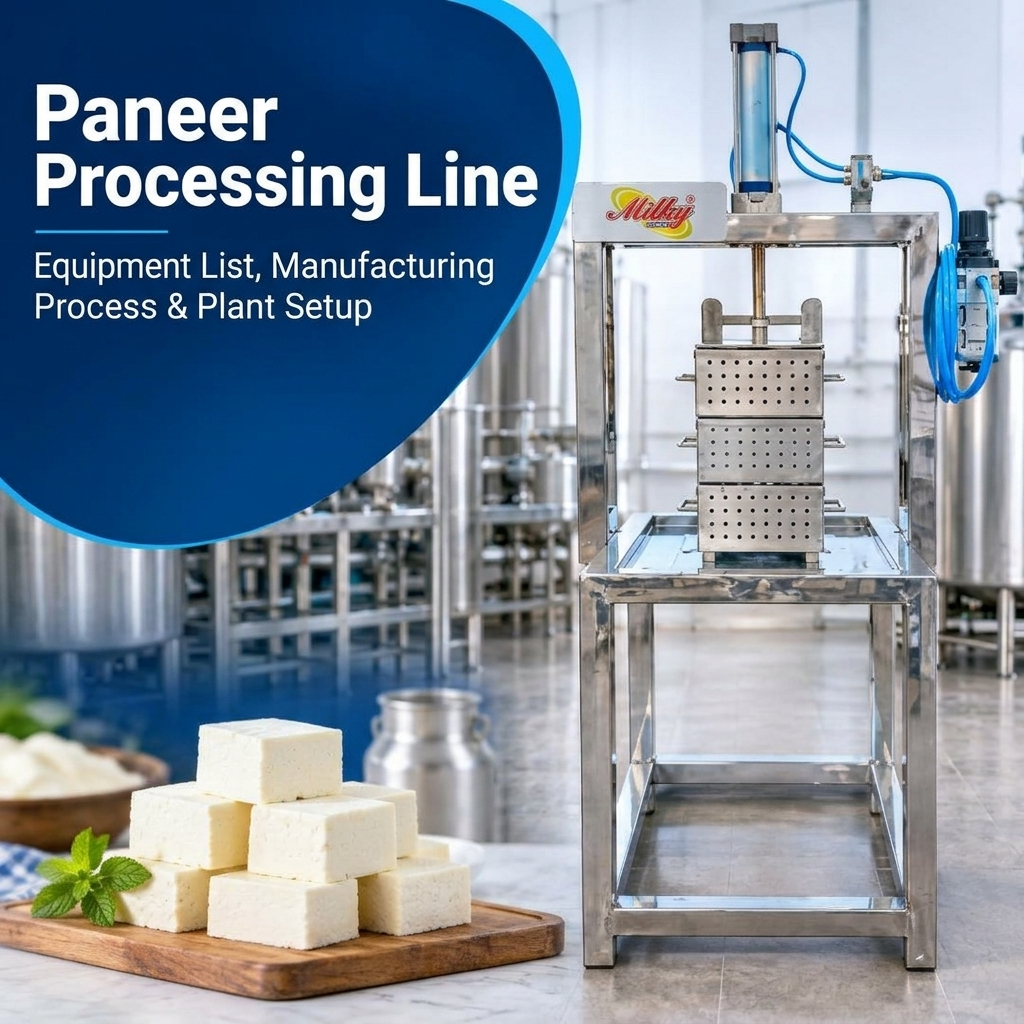
A paneer processing line is a connected set of machines that takes raw milk through pasteurization, coagulation, whey drainage, pressing, chilling and packing to make paneer blocks at commercial scale. It suits dairy entrepreneurs, paneer manufacturers and food processors whose volumes have outgrown a single machine.
What Is a Paneer Processing Line?
An individual paneer machine performs one task, such as pressing. A processing line coordinates several stages so milk moves from receiving to refrigerated storage, with each machine sized to suit the next.
Equipment selection therefore depends on milk input, production target, batch size and plant layout. A press suited to a small batch is not automatically right for a paneer manufacturing plant handling much larger volumes of milk.
Commercial Paneer Manufacturing Process
The sequence below reflects general industry practice. Exact temperatures, acid dosing and timings depend on the milk and the equipment, so follow your supplier’s operating instructions.
- Milk reception and inspection: Milk is received, measured and tested for quality before entering the plant.
- Filtration and standardization: Filtration removes visible impurities. Standardization adjusts fat content for consistent paneer.
- Pasteurization: Heat treatment makes the milk microbiologically safe for processing.
- Heating and coagulation: Milk is brought to coagulation conditions, and a food-grade acid separates curd from whey.
- Whey drainage: Whey is drained so the curd can be handled and pressed.
- Curd filling and moulding: Curd is placed into moulds or hoops sized for the required block.
- Pressing: Pressure removes remaining whey and forms a firm block.
- Cooling and chilling: Pressed blocks are cooled promptly to protect quality and shelf life.
- Cutting and packaging: Blocks are cut to size and packed for retail or institutional supply.
- Refrigerated storage: Packed paneer is held under cold-chain conditions until dispatch.
Equipment Required for a Paneer Processing Line
The table shows what each stage needs and which equipment is part of the MILKY range.
| Processing stage | Required equipment | Main purpose | Company offering or availability status |
|---|---|---|---|
| Reception and testing | Weighing, quality testing, cans | Confirms milk quantity and quality | General industry requirement |
| Milk transfer | Milk pump | Moves milk between stages | MILKY milk pump |
| Milk storage and chilling | Insulated storage tank, bulk milk chiller | Holds and cools milk before processing | MILKY storage tanks (500–5,000 L standard, larger on request); MILKY bulk milk chillers (250–2,000 L) |
| Filtration | Inline filter | Removes impurities | General industry requirement |
| Pasteurization | Batch pasteurizer | Heat-treats milk | MILKY batch pasteurizers |
| Heating and coagulation | Jacketed vessel with agitator | Heats milk, forms curd | General industry requirement |
| Whey drainage | Drain screen, outlet, whey tank | Separates and collects whey | General industry requirement |
| Moulds and pressing | Hoops, mechanical or pneumatic press | Shapes blocks, removes whey | MILKY mechanical and pneumatic paneer presses |
| Chilling of pressed blocks | Chilling arrangement | Cools pressed blocks | General industry requirement |
| Cutting | Cutter | Portions blocks | General industry requirement |
| Packaging | Packing suited to paneer blocks | Protects and presents product | General industry requirement |
| Cold storage | Cold room | Holds packed paneer | General industry requirement |
Items marked “general industry requirement” are needed by the process itself, and the equipment for them is selected to suit your project.
Pasteurizer specifications apply only to their own models. The 500 L batch milk pasteurizer uses SS304 jacketed construction, three 6 kW heaters, a stated 35–85°C range, PID control and a Pt100 sensor. The 1,000 L model uses three 12 kW heaters with a stated 35–80°C range. Our milk storage tanks have an insulated outer jacket and an optional slow-speed agitator.
Paneer Press Machine Options
Pressing sets block firmness and moisture, so the choice affects daily workflow. Both options are listed in our paneer making machine range.
- Mechanical paneer press: A manual, screw-operated press in SS304, measuring 8 × 12 × 12 inches, with 2.4 mm thickness and a 6.20 mm hole size. Stated capacity is about 7–8 kg per batch. The operator applies pressure by hand, which suits small batches.
- Pneumatic paneer press: An SS304 single-head press with a 1 HP three-phase compressor, adjustable pressing force and compatibility with standard moulds. Stated capacity is 40–50 kg/hour.
Pneumatic pressing replaces manual effort with compressed air and lets operators adjust force for softer or firmer paneer. The 40–50 kg/hour figure is a press rating, not guaranteed finished output or whole-plant capacity, because curd preparation, chilling and packing also set the pace.
How to Plan Paneer Processing Line Capacity
Work through these steps in order:
- Define daily milk input in litres.
- Set the daily finished paneer target in kilograms, using your own trial results or yield data confirmed by your supplier.
- Choose a batch size in kilograms of paneer.
- Divide the daily target by the batch size to get batches per day. For illustration only, a 200 kg/day target with 40 kg batches means five batches.
- Check that the press can handle each batch within your shift.
- Check that chilling and packaging can keep pace.
Keep four measures separate: litres of milk processed, kilograms of paneer per batch, kilograms per hour, and daily finished output. The slowest stage sets plant capacity.
Factors Affecting Paneer Processing Plant Cost
Costs depend on project scope, so we quote against specifications and do not publish fixed investment figures here. The main drivers are:
- Milk processing capacity
- Number of machines
- Stainless steel specification
- Manual or pneumatic pressing
- Heating arrangement
- Chilling requirements
- Packaging arrangement
- Automation level
- Installation and utilities such as power, water, compressed air and drainage
For machine-level pricing guidance, see our paneer making machine price guide.
Individual Paneer Machines vs Customized Processing Line
Buy an individual machine if you already run pasteurization, storage and chilling and need to add or upgrade pressing. Consider an integrated line for a new plant, higher volumes, or when stages must be matched in capacity and layout.
Mahesh Eng. Works manufactures individual paneer machines and can integrate equipment into a customized project. Not every component of a complete line is made in-house, so we identify which items we manufacture, which we integrate and which are sourced to project requirements.
Why Choose Mahesh Eng. Works for Paneer Processing Equipment?
- Dairy equipment manufacturing since 1980 under the MILKY® brand
- ISO 9001:2015 certified manufacturer based in Rakanpur, Gujarat
- Individual paneer machinery and customized line solutions
- Equipment selection and installation guidance, including our paneer machine installation guide
Frequently Asked Questions
What equipment is required for a paneer processing line?
A line typically needs milk reception and testing, storage, filtration, pasteurization, a heating and coagulation vessel, whey drainage, moulds and presses, chilling, cutting, packaging and cold storage. Exact configuration depends on the project.
What is the difference between a paneer press and a paneer processing line?
A press shapes and compresses curd into blocks. A processing line covers every stage from milk receiving to cold storage.
How do I select the right paneer plant capacity?
Start with the daily finished paneer target, then work backward to batch size, batches per day and the capacity of each stage.
What factors affect paneer manufacturing plant cost?
Capacity, machine count, steel specification, pressing type, heating, chilling, packaging, automation and utility infrastructure all influence cost.
Can Mahesh Eng. Works provide a customized paneer processing line?
Yes. We provide customized, integrated solutions depending on project requirements, and we identify which equipment we manufacture and which is integrated or sourced.
Which paneer press is suitable for commercial production?
The pneumatic press, rated at 40–50 kg/hour, suits continuous work better than the manual press, which handles about 7–8 kg per batch. Match either to your batch plan.
Planning a Paneer Plant?
To help us recommend suitable individual machines or a customized processing line, share these details through our contact page:
- Daily milk processing capacity
- Desired paneer production
- Required level of automation
- Available factory space
- Project location

MILKY BRAND
Mahesh Panchal
CEO | Dairy Equipment Manufacturer & Exporter at Mahesh Eng. Works
Mahesh Panchal brings over 30 years of experience in the dairy machinery industry. At Mahesh Eng. Works, he is associated with dairy machinery manufacturing, milk processing equipment and dairy equipment exports. The company’s blog shares practical insights to help dairy farmers, milk processors and businesses understand dairy equipment and milk processing solutions.