

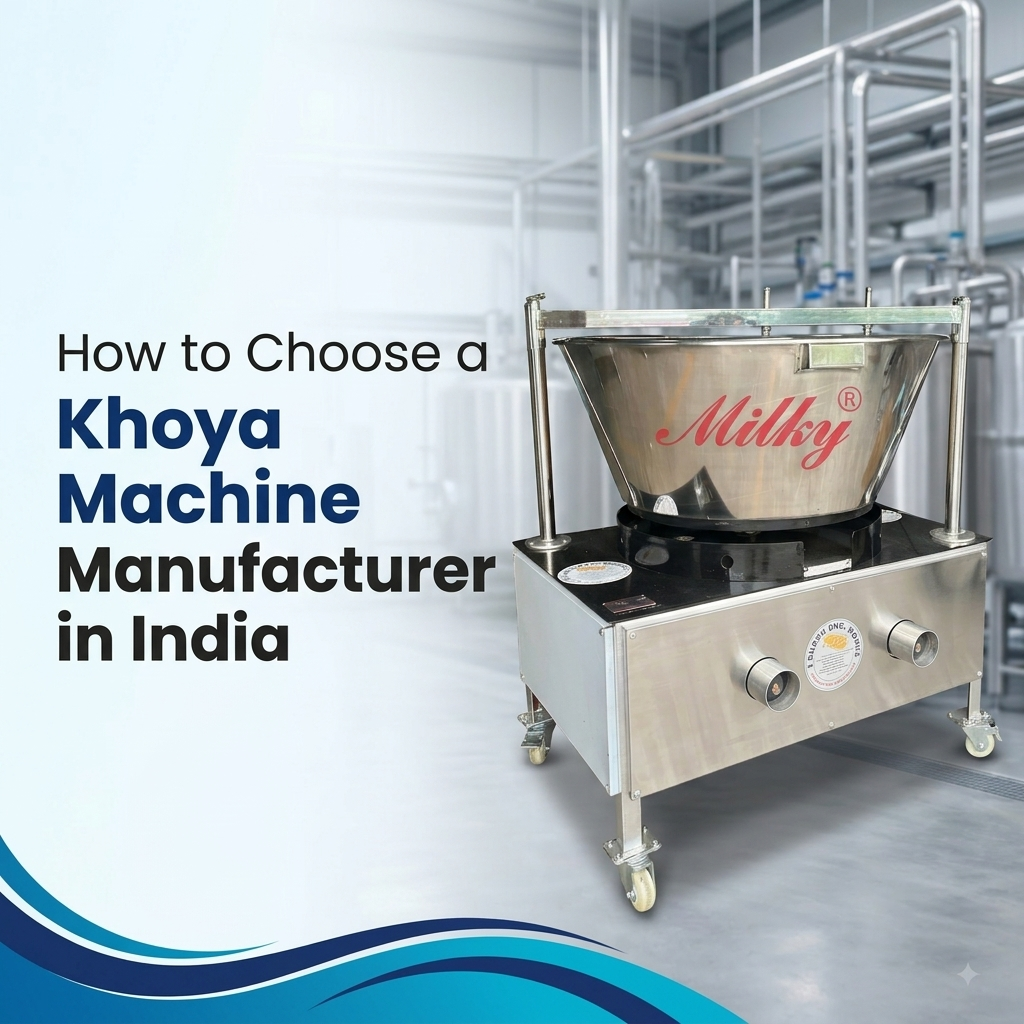
Khoya (also called mawa or khoa) is the base for many Indian sweets, and a commercial machine replaces long, continuous stirring over a flame. Choosing the maker is harder than choosing the machine. Capacity figures use different labels, materials vary and warranty terms are often unclear.
This guide gives you a seven-step process to evaluate any khoya machine manufacturer in India. It works for dairies, sweet makers and commercial kitchens.
Quick answer: the 7 steps
- Work out your daily milk volume and number of batches.
- Read capacity figures correctly (vessel, working capacity, output).
- Choose a heating type that suits your site.
- Check construction and steel grade.
- Check motor, stirrer, tilting and cleaning access.
- Verify who actually makes the machine and what its certificates mean.
- Compare written quotations on the same basis.
Step 1: Define your production need
Start from your milk, not from a machine size.
- Daily milk volume you plan to convert
- Batches per day your staff and schedule allow
- Products: khoya only, or also basundi and milk boiling
- Growth: expected volume in the next year or two
A simple check: batches per day = daily milk (L) ÷ working milk capacity per batch (L). As an illustration only, 400 L of milk per day on a machine with 80 L working capacity means 5 batches. Ask each supplier for the time per batch to see whether that fits your day.
Step 2: Read capacity correctly
Three different numbers all get called “capacity”:
- Vessel (barrel) volume: the size of the vessel.
- Working milk capacity per batch: how much milk it can process at once.
- Finished khoya output per batch: it depends on milk composition, the process and the moisture you want.
Published figures for a 120 L vessel show how labels differ:
| Maker | Published milk figure | Published khoya figure |
|---|---|---|
| Maker A | Milk boil 70 L per batch | “Milk in to mava” 10 L (label unclear) |
| Maker B | Max milk boiling 80 L in 20 minutes | Max conversion 10 L in 20 minutes |
| Mahesh Eng. Works | Working capacity of milk boil at 90°C: 80 L | Not stated on page |
Labels and test conditions differ, so these figures are not directly comparable. Ask every supplier for working capacity and finished output in writing, at your milk’s fat level.
Step 3: Choose the heating type
Across the pages reviewed, makers list gas or LPG, diesel or kerosene, electric and steam options. Weigh:
- Fuel availability and cost at your site
- Batch size and daily routine
- Temperature control
- Cleaning and maintenance
- Installation needs such as a gas line, ventilation and power supply
Fuel figures use different bases. One maker lists approximate use per batch and another per hour. Ask each supplier for the same basis.
Step 4: Check construction and steel grade
Stainless steel is the usual material, but not every machine is stainless throughout. One maker lists stainless walls with a 16 mm mild-steel bottom. Another describes a stainless jar with a 16 mm stainless bottom plate and a mild-steel inner structure. Ask for:
- The grade of all milk-contact parts (for example SS304), in writing
- Which parts are mild steel, and where they sit
- Bottom-plate thickness, weld finish and drainage
Step 5: Check motor, stirrer, tilting and cleaning
- Motor and gearbox: published motor sizes range from 0.5 to 2 HP across models. One listing gives different motor ratings in its specification and description, so get the figure in writing.
- Stirrer and scraper: ask about design and material.
- Fixed or tilting: a tilting vessel makes emptying easier, while a fixed vessel needs manual removal. See our tilting khoa machines.
- Cleaning and safety: check access to the vessel, guards around moving parts and operator safety.
Step 6: Verify the manufacturer
Manufacturer or trader? Some websites list “manufacturer, exporter, supplier, trader” together. Ask for the factory address, GST registration and fabrication photos or video, and confirm who handles warranty claims.
What certificates mean. ISO 9001 certifies a quality management system, not a specific machine. Ask for the certificate copy, scope and validity date. One maker lists the older ISO 9001:2008 version, so ask for a current certificate.
Other checks:
- Years of operation and customer references with a similar machine size
- A live demonstration
- Spare-parts availability and service in your region
Step 7: Compare written quotations
Get at least three quotations and put them side by side:
| Compare | Why it matters |
|---|---|
| Vessel and working capacity | Same definition across quotes |
| Steel grade and construction | Hygiene and durability |
| Heating type and burners | Running cost and control |
| Motor and gearbox | Reliability |
| Warranty: duration, parts, labour | Only some makers state it; two state one year |
| Taxes, freight, installation, training | Often missing from low quotes |
For cost factors, see our khoya making machine price guide. For setup, see our installation guide.
Red flags
- A website that gives no factory address
- Capacity quoted without saying vessel, working or output
- No steel grade, or a refusal to put it in writing
- A quotation that omits taxes, freight or installation
- Claims such as “best” or “No. 1” with no evidence
- No demonstration or customer reference available
Questions to ask every supplier
- Are you the manufacturer of this machine? Where is it fabricated?
- What is the vessel volume, working milk capacity and finished khoya output per batch?
- What is the steel grade of milk-contact parts, and which parts are mild steel?
- What are the motor, gearbox and stirrer specifications?
- How much fuel or power does a batch use?
- What does the warranty cover, and for how long?
- Which spare parts do you stock, and who services machines in my region?
- Can I see the machine running or speak to a customer?
FAQs
How do I choose a khoya machine manufacturer?
Define your milk volume and batches, compare written specifications for working capacity, steel grade, heating, motor and warranty, then verify the maker and request a demonstration.
What is the difference between barrel capacity and working capacity?
Barrel capacity is the vessel’s volume. Working capacity is the milk quantity it can process per batch, and it is lower than the barrel volume. Finished khoya output is a third, separate figure.
Which heating option should I choose?
It depends on fuel availability and cost at your site, batch size and temperature-control needs. Ask suppliers for fuel use on the same basis.
How do I verify the material used in a khoya machine?
Ask for the steel grade of all milk-contact parts in writing, and ask which parts are mild steel. Check the machine at a demonstration.
How can I tell a manufacturer from a trader?
Ask for the factory address, GST registration and fabrication photos or video. Confirm who makes the machine and who handles warranty service.
What should I check in a quotation?
Compare capacity definition, steel grade, heating, motor, warranty, taxes, freight, installation and training on the same basis.
Conclusion
Choose on written specifications, not on brand names. Ask each supplier the same questions, see a demonstration and confirm warranty and service terms before you order.
If you are evaluating machines for a dairy or sweet-making business, contact Mahesh Eng. Works for guidance based on your milk volume and site. It may not suit every buyer’s needs.
Disclosure: Mahesh Eng. Works publishes this guide and makes khoya machines, so we have a commercial interest. The examples below come from public khoya machine pages of six Indian makers reviewed on 9 October 2026. Names are omitted because this is a selection guide, not a ranking. We did not test machines or verify certificates.

Mahesh Eng. Works
Written and reviewed by Mahesh Eng. Works, a dairy machinery manufacturer specializing in milk cream separator machines and hygienic stainless steel dairy equipment. Since 1980, we have been designing and manufacturing cream separators, butter churners, milk pasteurizers, bulk milk coolers, and complete dairy processing solutions for dairy farms, milk collection centers, and processing plants.