
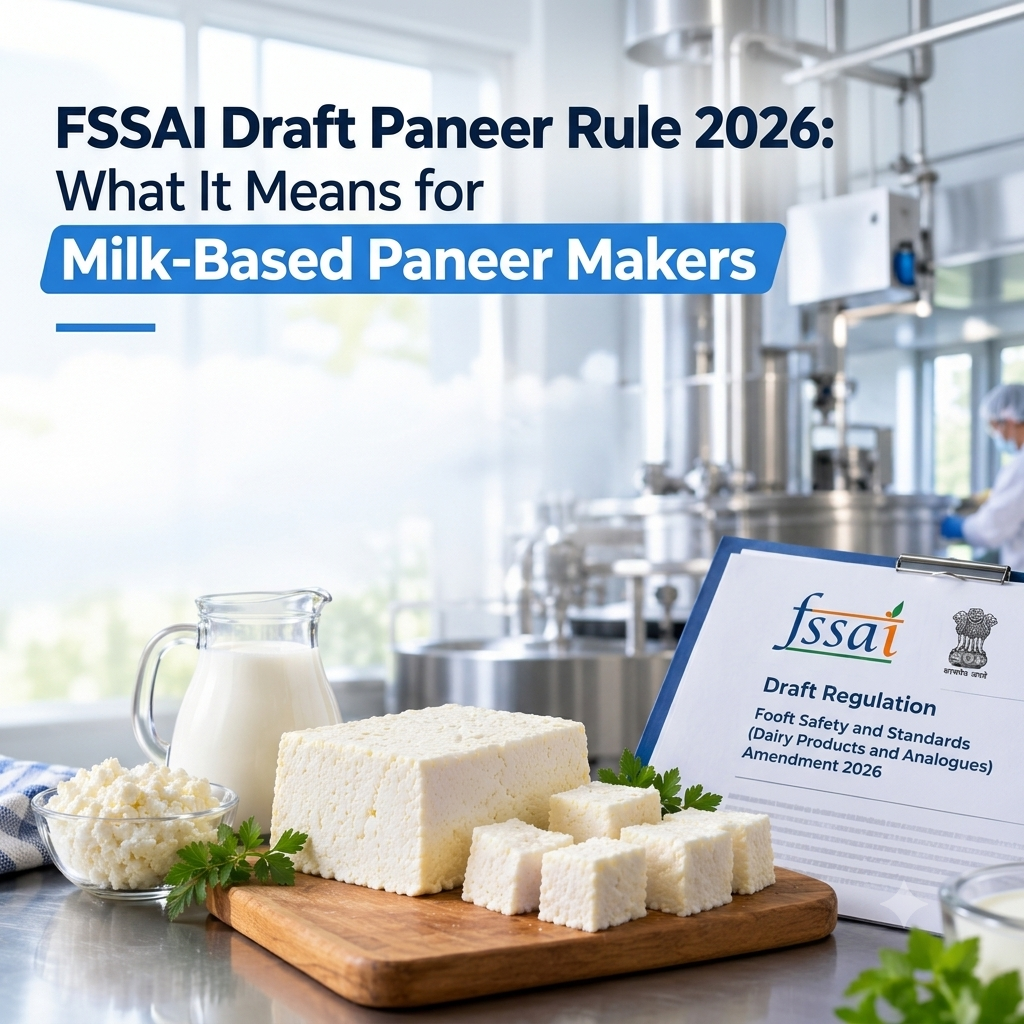
FSSAI has proposed a draft amendment that would stop products made from non-milk ingredients from being manufactured and sold as paneer. It targets analogue products, not milk-based paneer, but dairy processors making genuine paneer should understand it, because it affects how labels, menus and supplier claims may be read. As of 6 October 2026, the proposal is a draft regulation, not yet a final nationwide rule. This article explains what the draft says, what it does not say, and what milk-based paneer manufacturers can review now.
Quick Answer
The FSSAI draft paneer rule 2026 proposes that products made from constituents not derived from milk should not be sold as paneer. On its face, it does not change the standard for milk-based paneer. Milk-based makers should keep following the existing FSSAI paneer standard and review raw materials, product names, labels and marketing against it. Because the draft is not yet final, they should track the official notification before making compliance decisions.
What Has FSSAI Proposed in the 2026 Draft Paneer Rule?
- Document: the draft Food Safety and Standards (Prohibition and Restrictions on Sales) Amendment Regulations, 2026, dated 22 September 2026.
- Provision: a new clause under Regulation 2.1.1 of the 2011 regulations, covering “paneer made of constituents not derived from milk”.
- Effect on analogue products: products already licensed or registered under the “Analogue in Dairy Context” category would have to stop using the term “Paneer” in their nomenclature, labelling or marketing.
- Legal basis: issued under Section 92 of the Food Safety and Standards Act, 2006, with the previous approval of the Central Government.
- Stated purpose: preventing consumers from being misled about the nature and composition of such products.
- Consultation: FSSAI has invited objections and suggestions. The draft will be considered after 60 days from the date Gazette copies are made available to the public; reports count this from 23 September 2026.
What Is Analogue Paneer?
FSSAI’s April 2025 consultation paper defines “Analogue in Dairy Context” as a product in which non-milk-derived constituents replace milk components. Analogue paneer is therefore a paneer-like product built on that substitution. Reports describe it as typically using vegetable oils or fats and emulsifiers, and some also mention skimmed milk powder.
Genuine paneer is a milk product, made as described under the existing standard below.
Paneer vs Analogue Paneer: What Is the Difference?
| Feature | Milk-based paneer | Analogue product |
|---|---|---|
| Primary raw material | Cow or buffalo milk, or a combination | Non-milk constituents replace milk components |
| Regulatory treatment | FSSAI standard for chhana and paneer | “Analogue in Dairy Context” category |
| Use of the name “paneer” | Permitted if the product meets the standard | Proposed to be restricted under the draft |
| Labelling | Name and declarations as per the paneer standard | Distinct analogue labelling required |
Does the Draft FSSAI Rule Affect Milk-Based Paneer Manufacturers?
Not directly. The proposed clause covers paneer made from constituents not derived from milk, and the draft draws a distinction between conventional milk paneer and dairy analogues.
For a milk-based manufacturer, the practical questions are indirect:
- Nomenclature: does the product name match the applicable standard (paneer, low fat paneer, medium fat paneer)?
- Labelling and marketing: do claims describe a milk-based product accurately?
- Raw materials: is every constituent milk-derived, with no non-milk fat or starch used as a substitute?
None of the sources reviewed describe new equipment, licensing or process requirements for milk-based paneer.
Is Analogue Paneer Banned in India?
Not by a final national rule. FSSAI has proposed the change in a draft regulation; it should not be described as a final nationwide ban unless and until the amendment is officially notified and comes into force. The draft is open for comment and will be considered only after the 60-day consultation period ends.
Two points sit alongside the draft. First, FSSAI already allows analogue products to be made and sold if they are labelled correctly and not marketed as “paneer”; the draft tightens use of the name. Second, rules differ by state: Telangana’s one-year ban on analogue paneer took effect on 10 September 2026, and other states have issued time-limited orders. FSSAI West Region’s April 2026 public notice also told centrally licensed manufacturers and food service establishments that selling cheese analogue as paneer breaches the law.
What Does the Existing FSSAI Paneer Standard Say?
FSSAI’s food product standards include a sub-regulation for chhana and paneer. It requires the product to come from cow or buffalo milk, or a combination, by precipitation with sour milk, lactic acid or citric acid, and allows milk solids to be used. Paneer must contain at least 50% milk fat on a dry matter basis, and a moisture limit is also specified. Process literature notes that milk standardised to roughly 4.5 to 5.0% fat is normally needed to meet this standard. Low fat and medium fat versions carry their own product names, must be sold in sealed packs, and bear label declarations.
FSSAI has said distinct labelling rules for analogues already exist. The standard has been amended over the years, so confirm current parameters on FSSAI’s website.
What Should Paneer Manufacturers Do Now?
This is general information, not legal advice.
- Review raw materials and milk standardisation, and keep supplier records showing milk origin.
- Confirm the product category (paneer, low fat or medium fat) against the standard.
- Check names, labels and marketing claims for accuracy, including packaging, menus, websites and price lists.
- Maintain documentation: batch, traceability and production records.
- Monitor the final notification and any implementation date.
- Seek qualified regulatory advice where product category or labelling is unclear.
For dairy processors planning or expanding milk-based paneer production, equipment selection is one part of the overall production setup. A suitable paneer making machine can help standardize key processing steps, but equipment alone does not determine regulatory compliance; raw materials, formulation, hygiene, processing conditions, labelling and applicable FSSAI requirements also need to be considered.
What Does This Mean for the Future of Paneer Manufacturing?
If the draft is finalised, “paneer” on a label would more clearly signal a milk-derived product. One industry report describes a shift from loose paneer to packaged paneer with standardised moisture and longer shelf life, and clearer naming would sit alongside that shift.
- Food businesses: the April 2026 notice stressed clear disclosure when cheese analogues are used.
- Consumers: labels should make it easier to tell milk paneer from analogue products.
Frequently Asked Questions
What is FSSAI’s draft paneer rule 2026?
It is a draft amendment dated 22 September 2026 to the Prohibition and Restrictions on Sales Regulations, 2011. It proposes restricting non-milk analogue products from being sold as paneer, and analogue products would drop the word from names, labels and marketing.
Is analogue paneer banned in India?
Not by a final national rule, based on the sources reviewed. FSSAI has only proposed restricting the name “paneer” for analogue products in a draft. Some states, such as Telangana, have imposed their own one-year bans on analogue paneer, so local rules may differ.
What is analogue paneer?
Analogue paneer is a paneer-like product in which non-milk constituents replace milk components. FSSAI treats such products under “Analogue in Dairy Context”, and reports describe them as typically using vegetable oils or fats and emulsifiers. Genuine paneer, by contrast, is made from milk.
Can an analogue product be called paneer?
Under the draft, no. Products licensed or registered as Analogue in Dairy Context would have to stop using “paneer” in name, labelling or marketing. FSSAI West Region also said in April 2026 that selling cheese analogue as paneer violates the law.
Does the draft rule affect milk-based paneer manufacturers?
Not directly, as the proposed clause covers paneer made from constituents not derived from milk. Milk-based producers should still review product names, labels, raw materials and marketing against the existing paneer standard, and watch for the final notification and any implementation date.
What does “Analogue in Dairy Context” mean?
It is FSSAI’s term for products in which non-milk-derived constituents replace milk components, such as cheese analogues. Such products are meant to be labelled distinctly from dairy products, and under the draft they could not use the word “paneer” in their names, labels or marketing.
Is the FSSAI paneer rule final?
No. As of 6 October 2026, the sources reviewed describe it as a draft open to objections and suggestions. No final notification or implementation date was found. Check FSSAI’s website and the Gazette for updates before relying on this status.
What does the existing FSSAI standard say about paneer?
FSSAI’s standard for chhana and paneer defines paneer as a product of cow or buffalo milk, or a combination, set by sour milk, lactic acid or citric acid. It specifies minimum milk fat and a moisture limit. Low and medium fat variants carry separate names and labels.
References
This article is based on the following sources, checked as of 6 October 2026.
Official sources
- FSSAI: Draft Food Safety and Standards (Prohibition and Restrictions on Sales) Amendment Regulations, 2026
- Gazette of India: draft notification dated 22 September 2026
- PIB: FSSAI issues Public Notice on Correct Labelling of Cheese Analogues (29 April 2026)
- FSSAI West Region: Public Notice (Enforcement) 3/2026
Additional sources
- IndiaLaw: Dairy Analogue Regulations, FSSAI invites public comments
- Food Safety Helpline: FSSAI amendment on chhana and paneer standards
- Daily Pioneer: Telangana imposes one-year ban on analogue paneer
- e-PG Pathshala (INFLIBNET): Technology of Paneer

Mahesh Eng. Works
Written and reviewed by Mahesh Eng. Works, a dairy machinery manufacturer specializing in milk cream separator machines and hygienic stainless steel dairy equipment. Since 1980, we have been designing and manufacturing cream separators, butter churners, milk pasteurizers, bulk milk coolers, and complete dairy processing solutions for dairy farms, milk collection centers, and processing plants.