
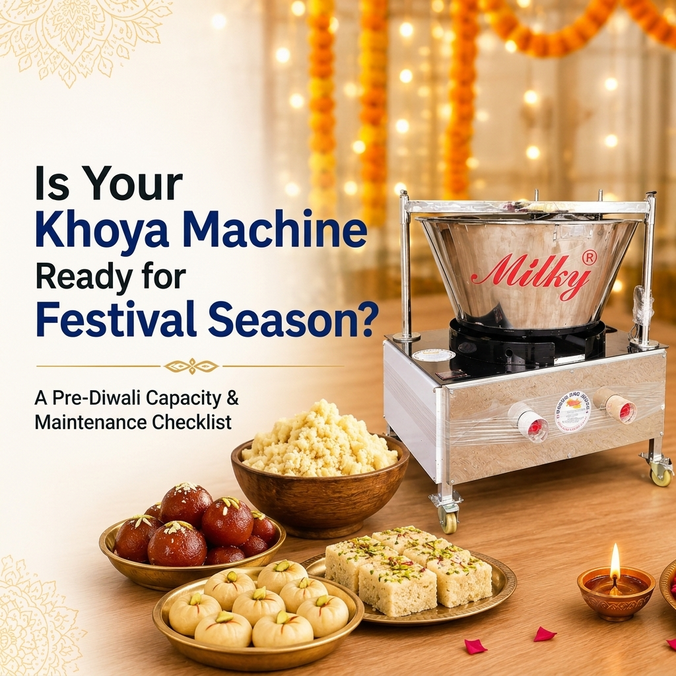
Diwali orders for gulab jamun, peda, barfi, and other khoya-based sweets don’t arrive gradually they hit all at once. A khoya making machine that runs fine through October can strain under back-to-back batches, rushed cleaning cycles, and longer daily run times in November. Before you commit to festival production volumes, check five things: your realistic batch capacity, heating performance, agitator condition, electrical and fuel safety, and whether spares are on hand if something wears out mid-rush. Sorting these out now not during the first week of Diwali orders is what separates a smooth season from a production breakdown at the worst possible time.
Is Your Khoya Making Machine Ready for Diwali Demand?
A khoya making machine is Diwali-ready when its verified batch output, over your actual available production hours, meets or comfortably exceeds expected festival-season orders with time left for cleaning, maintenance, and delays. Assessing this needs more than a visual check of the machine.
Work through this before committing to festival order volumes:
- Current daily khoya requirement vs. expected Diwali orders — Diwali demand often runs several times higher than normal months. Compare last year’s festival order volume (if you tracked it) against this year’s confirmed and expected orders.
- Available production hours and realistic batches per shift — Longer shifts don’t automatically mean proportionally more batches. Factor in loading, cooking, discharge, and cleaning time per cycle.
- Machine condition under extended operation — A machine that performs well for 2–3 batches a day may behave differently after 5–6 consecutive batches, especially on heating consistency and agitator wear.
- Operator availability and cleaning time between batches — Rushed cleaning between batches is one of the most common causes of hygiene lapses and sticking during festival rushes.
- Availability of essential consumables and spare parts — Gaskets, scraper blades, and belts are the parts most likely to fail under sustained use; check stock before, not during, peak demand.
If any of these five points is uncertain, that’s the one to resolve first not the machine’s rated capacity on paper.
Check Your Khoya Machine Capacity Before Peak Season
Rated vessel capacity is not the same as finished khoya output it only tells you how much milk the vessel can hold per batch, not how much khoya you can actually produce in a working day. Four separate figures decide your real daily output: milk input per batch, processing time per batch, number of batches your shift allows, and finished khoya yield after moisture evaporation.
Here’s an illustrative calculation, not a guaranteed performance figure:
If a machine processes 100 litres of milk per batch, and each batch takes 2.5 hours from loading to discharge, a shift that allows three batches would use a total of 300 litres of milk input for the day.
This is a milk-input figure, not a khoya-output figure the two should never be confused. Actual finished khoya yield depends on milk fat content, the heating system, ambient conditions, machine design, and how firm or soft you’re cooking the khoya (softer khoya retains more moisture; firmer khoya, cooked longer, yields less by weight).
To plan your Diwali production:
- Work out your expected daily khoya demand the total quantity your confirmed and anticipated orders require for that day.
- Compare this against your verified actual output under normal operating conditions (not the machine’s rated maximum).
- Build in time for cleaning, maintenance, product handling, and unplanned delays don’t schedule shifts back-to-back with zero buffer.
Don’t rely on generic capacity claims from anywhere, including manufacturer brochures, without checking them against your own production logs.
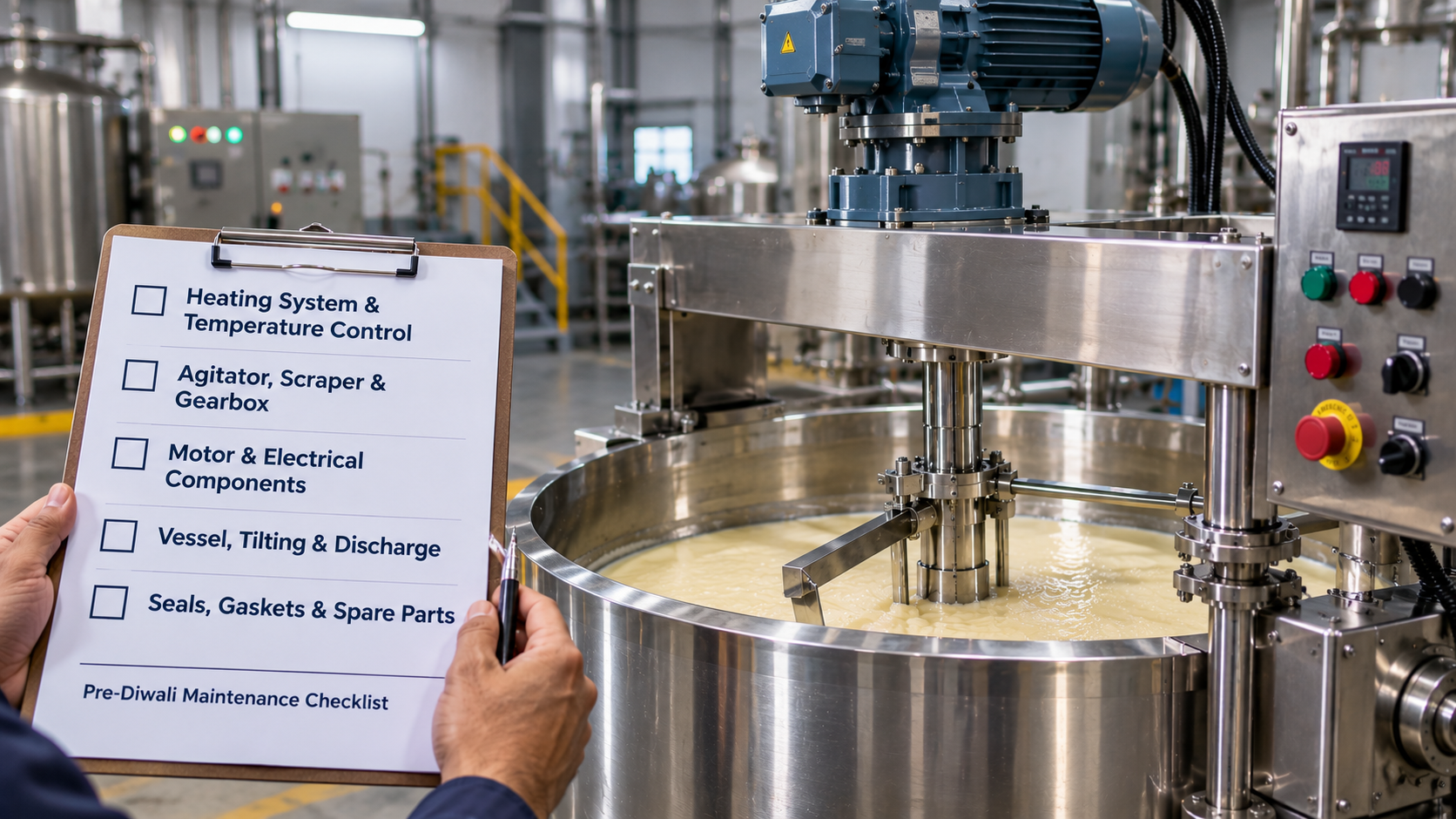
Pre-Diwali Khoya Machine Maintenance Checklist
This is the section to act on directly. Go through each area before the festival rush starts, not after the first breakdown.
A. Heating System and Temperature Control
- Inspect burners, heating elements, steam connections, or whichever heating arrangement your machine uses.
- Watch for uneven heating, unusual temperature swings, or delayed heat-up early signs of a heating fault.
- Gas models: have qualified personnel check gas lines, regulators, and burner operation before increasing run hours.
- Steam-heated models: inspect steam connections, traps, and safety devices as per your machine’s manual.
B. Agitator, Scraper, and Gearbox
- Check agitator movement, scraper condition, unusual noise, vibration, or looseness.
- Inspect belts, couplings, bearings, and gearbox lubrication where fitted.
- Worn scrapers or irregular agitation are a common cause of sticking, uneven heating, and inconsistent khoya texture — this is worth catching before Diwali, not during it.
- Replace or adjust components strictly per your machine manufacturer’s specifications.
C. Motor and Electrical Components
- Inspect wiring, switches, control panels, earthing, and protective devices.
- Note any unusual motor heating, vibration, or intermittent operation.
- Leave electrical inspection and repairs to qualified personnel only.
D. Vessel, Tilting Arrangement, and Discharge
- Check milk-contact surfaces for residue, damage, corrosion, or pitting.
- Inspect the tilting mechanism, locking arrangement, and discharge process where fitted.
- Never work beneath an unsupported tilted vessel or touch moving parts during operation.
E. Seals, Gaskets, and Spare Parts
- Inspect accessible seals and gaskets for deterioration or leakage.
- Confirm availability of manufacturer-approved replacement parts before the season starts.
- Exact maintenance requirements vary by model always follow your manufacturer’s manual.
How to Clean a Khoya Making Machine Between Batches
A safe cleaning routine follows shutdown, cooling, residue removal, food-safe cleaning, rinsing, and proper drying in that order, every time, regardless of how tight the production schedule is.
- Follow your machine’s shutdown and isolation procedure before touching any part of it.
- Safely remove any remaining product from the vessel.
- Let hot surfaces cool to a safe handling temperature before cleaning.
- Remove accessible milk and khoya residue using your machine’s approved method.
- Clean food-contact surfaces with suitable food-safe cleaning agents.
- Rinse where required and check for any remaining deposits.
- Allow proper drying and reassemble correctly before the next batch.
Cleaning frequency and approved chemicals depend on your machine’s design and food-contact materials — check your manufacturer’s instructions rather than assuming a generic routine applies. Never spray electrical controls, immerse motors, use harsh abrasives on food-contact surfaces, or clean while machinery is running.
Removing milk solids promptly, while the vessel is still warm, prevents them from hardening into deposits that take far longer to scrub off between festival batches a small habit that saves real time over a multi-batch day.
Practical Ways to Increase Khoya Production During Diwali
Before considering a new machine, these operational changes often close the gap:
- Build a daily production schedule based on actual confirmed orders, not estimates.
- Stagger milk preparation and finished-product handling so one doesn’t bottleneck the other.
- Assign operators clearly across production, cleaning, and product transfer.
- Standardize batch records and operating steps so every shift runs consistently.
- Carry out maintenance before peak demand not in the middle of it.
- Never exceed your manufacturer’s rated operating limits to squeeze out extra batches.
- Don’t compromise cleaning, food safety, or cooling and storage practices just to push output higher.
A larger or additional machine is worth evaluating when you see repeated capacity shortfalls, excessive overtime, consistently insufficient batch throughput, or recurring bottlenecks not after a single busy week.
When Should You Service or Upgrade Your Khoya Machine?
Service your khoya machine when it shows unusual vibration, abnormal heating, inconsistent stirring, leakage, damaged seals, repeated electrical trips, or unexplained changes in processing time. These are signs of wear that tend to get worse under festival-season load, not better.
A capacity upgrade is worth considering only when your actual, verified production remains insufficient even after scheduling improvements, maintenance, and workflow changes not simply because Diwali orders are higher than usual this one time.
If you do reach that point, choosing the right larger machine depends on your real milk input, verified finished output, heating method, batch duration, available utilities, installation space, cleaning requirements, and service support in your area. Our khoya and mawa making machine price guide breaks down capacity-wise pricing and configurations if you’re comparing options. For a closer look at capacity-wise pricing and what drives buying decisions at each scale, our khoya making machine price guide is a useful next read.
Frequently Asked Questions About Khoya Machine Maintenance
How often should a khoya making machine be cleaned?
A khoya machine should be cleaned after every batch, while the vessel is still warm, to prevent milk solids from hardening. Daily deeper cleaning of accessible surfaces and periodic checks of gaskets and jacket components are also needed, following your manufacturer’s specific cleaning instructions.
How do I check whether my khoya machine has enough capacity for Diwali?
Compare your verified daily output under normal conditions against your expected Diwali order volume, factoring in available production hours, cleaning time, and buffer for delays. Rated vessel capacity alone doesn’t answer this actual tested output does.
What should I inspect before running a khoya machine for long hours?
Check the heating system for even performance, the agitator and scraper for wear or looseness, motor and electrical components for unusual heating or vibration, and gaskets and seals for leaks. Have qualified personnel inspect gas or steam connections and electrical systems specifically.
Why does khoya stick or burn during machine operation?
Sticking or burning is usually caused by worn scraper blades, irregular agitation, uneven heating from a heating-system fault, or milk solids left over from incomplete cleaning of the previous batch. Addressing the scraper and heating checks above reduces this risk significantly.
Should I repair or upgrade my khoya making machine before the festival season?
Repair addresses specific faults like unusual vibration, leakage, or inconsistent heating and should be done regardless of season. An upgrade to higher capacity only makes sense if verified output remains insufficient after maintenance and scheduling improvements not as a first response to festival demand.
Getting Your Khoya Production Diwali-Ready
Festival-season khoya production comes down to knowing your real capacity, not your rated one; servicing the components most likely to fail under sustained use; following a proper cleaning routine between batches; and having spares on hand before you need them. None of this guarantees a breakdown-free season, but it substantially reduces the risk of one at the worst possible time.
If your assessment points toward needing higher capacity or a replacement machine this year, Mahesh Eng. Works manufactures a range of khoya and mawa making machines. You can explore the current range or request specifications and a quotation at maheshengworks.com.

Mahesh Eng. Works
Written and reviewed by Mahesh Eng. Works, a dairy machinery manufacturer specializing in milk cream separator machines and hygienic stainless steel dairy equipment. Since 1980, we have been designing and manufacturing cream separators, butter churners, milk pasteurizers, bulk milk coolers, and complete dairy processing solutions for dairy farms, milk collection centers, and processing plants.