
A cream separator that's installed incorrectly rarely fails outright ,it just underperforms. Poor fat recovery, excess vibration, leakage at the seals, or a machine that never quite reaches stable separation can usually be traced back to the installation stage, not the equipment itself. For dairy farms, milk collection centres, cooperatives, ghee units and sweet manufacturers, getting the setup right from day one protects both output and equipment life.
This guide walks through how to install a MILKY® milk cream separator machine from site preparation through commissioning so operators know what to check at each stage. MILKY® cream separator machines are manufactured by Mahesh Eng. Works, and installation guidance is available for every model supplied.
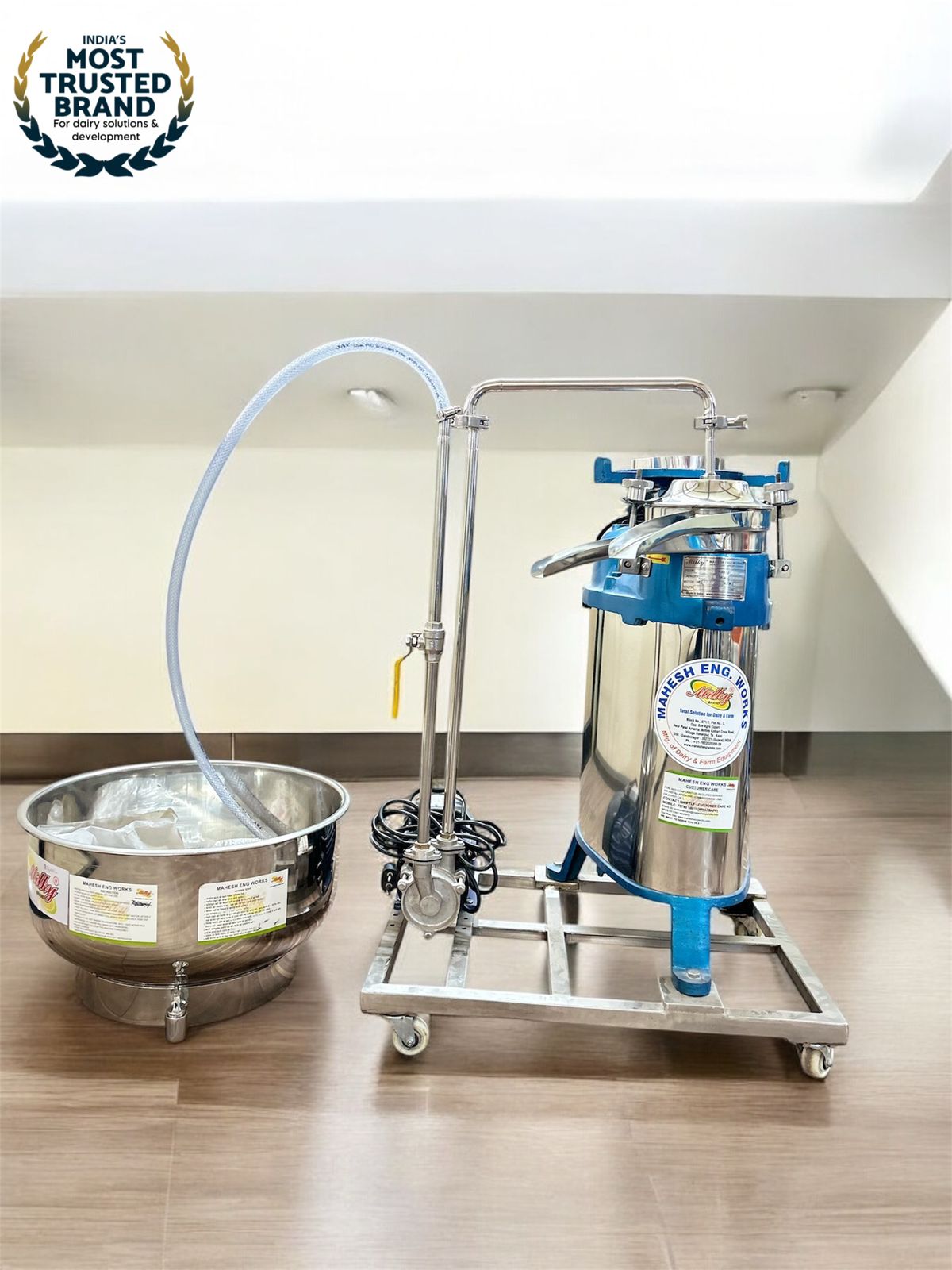 Installation Support
 Mahesh Eng. Works is an ISO 9001:2015 certified dairy equipment manufacturer based in Gandhinagar, Gujarat, with experience since 1980 across cream separators, ghee clarifiers, khoya machines and paneer-making equipment. Every MILKY® cream separator is built for continuous, food-grade operation, and the company provides installation guidance and after-sales support to help businesses set up their machine correctly rather than guessing through the process.
Before installing a Cream Separator, confirm the machine capacity, installation surface, electrical supply, earthing, bowl and disc assembly, and milk/product connections. Ensure the machine is level and stable, all connections are secure, and the separator completes an initial trial run before regular operation.
Choosing the right capacity depends on your daily milk volume and shift duration. Businesses planning to scale often choose a model slightly above their current need to avoid early equipment upgrades.
| No. | Technical Data | What to Do |
|---|---|---|
| 1 | Inspect the machine | Check against delivery documentation for transit damage and confirm the bowl, disc stack, motor and fittings are all present. |
| 2 | Prepare the installation location | Choose a clean, well-ventilated area with a stable floor, adequate drainage, and clearance for operation and cleaning. |
| 3 | Position and stabilize the machine | Place the separator on a level surface — an unstable base is a common cause of vibration at operating speed. |
| 4 | Check electrical supply and earthing | Have a qualified electrician confirm the supply matches the machine's rating and earthing is in place before wiring. |
| 5 | Assemble the bowl and disc stack | Clean thoroughly, then assemble in the correct sequence and orientation. |
| 6 | Tank Capacity | Connect milk inlet and product outlets |
| 7 | Check connections before startup | Recheck mechanical, electrical and pipe/hose joints — this catches most errors early. |
| 8 | Perform initial startup | Run without milk first and confirm the bowl reaches stable speed smoothly. |
| 9 | Introduce milk and check separation | Introduce milk gradually and observe cream and skim-milk flow at the outlets. |
| 10 | Complete commissioning checks | Confirm consistent separation, no leakage or abnormal noise, and stable operation over a short trial run. |
Download Full Brochure
Get drawings, full specifications, layout requirements and pricing on email.
MILKY® Cream Separator Machines are designed around the practical needs of dairy and sweet businesses. Key features include:

Stable and level

Matches machine spec single phase for smaller models, three phase for larger ones

Properly provided before connection

Suitable inlet arrangement

Correctly positioned for cream and skim milk

Easy removal of wash water

Adequate operator and service access

Clean, food-grade processing environment

Clean the bowl, discs, and related components before assembly to prevent residue buildup and separation issues.

Position every disc in the correct order and direction as specified for your MILKY® machine model.

A correctly arranged disc stack helps prevent vibration, excessive noise, and uneven separation during operation.

Ensure the locking ring and fastening components are properly seated and tightened before starting the machine.

Disc count, stacking sequence, and bowl configuration can vary according to machine capacity and model.

Proper bowl assembly supports stable high-speed rotation and consistent cream recovery.
Never operate the separator until the bowl and disc assembly is completely secured according to the supplied instructions.

Electrical
Have a qualified electrician connect the wiring to the machine’s rated supply. Ensure proper earthing and electrical protection before powering on, and never work on live equipment.

Connect the milk inlet, cream outlet, and skim-milk outlet securely. If using a feed pump, connect and check it separately. Ensure all fittings are leak-free before operation.

Confirm all mechanical, electrical and piping connections are complete and secure.

Run without milk first and confirm stable speed, with no unusual noise or vibration.
Check cream flow, skim-milk flow, and separation consistency at the outlets.
Machine stability and bowl/disc assembly
Choose a model 20–25% above your current peak to allow for growth.
Milk temperature, flow rate, and assembly
Fittings and seals
Milk supply consistency and flow
Stop and inspect before continuing
Electrical supply and protection devices
Mahesh Eng. Works provides installation guidance and after-sales support for MILKY® cream separator machines supplied across India and to export markets. Whether you’re setting up a new machine or troubleshooting an existing installation, the team can help you get it running correctly.
Milk temperature directly affects viscosity, which in turn affects how efficiently cream separates from skim milk. Across MILKY® cream separator models, separation is generally most effective in the 35–40°C range. That said, the ideal operating temperature can vary by model and configuration, so operators should follow the specification supplied for their particular machine rather than applying one figure universally.
Get Quote for Your CityA milk cream separator is generally installed by preparing a stable location, positioning the machine, checking electrical supply and earthing, assembling the separator bowl and discs, connecting the milk and product outlets, checking all connections, and commissioning the machine according to the model-specific operating instructions.
You'll need a stable, level, hygienic floor space, a matching electrical supply with proper earthing, adequate drainage, and enough clearance for operation and cleaning. Confirming the exact model and capacity beforehand helps avoid mismatched requirements.
Electrical connections should always be handled by a qualified electrician, and bowl/disc assembly should follow the model-specific instructions closely. For first-time installations, working with the manufacturer's guidance reduces the risk of assembly or wiring errors.
The bowl and discs must be cleaned thoroughly, then assembled in the correct sequence and orientation, with locking components fully seated and tightened. The exact sequence depends on the model, so follow the supplied documentation.
Separation is generally most effective between 35-40°C across MILKY® models, though the ideal figure can vary by model. Confirm the exact specification for your machine.
Vibration is usually caused by an unstable or uneven floor, or by incorrect bowl/disc assembly throwing off the balance of the rotating stack. Both should be checked before continued use.
Poor separation is commonly linked to incorrect milk temperature, inconsistent flow rate, or assembly issues in the bowl and disc stack. Checking these three areas resolves most cases.
Yes. Proper earthing is a standard electrical safety requirement and should be verified by a qualified electrician before the machine is connected to power.
Yes. Mahesh Eng. Works provides installation guidance and after-sales support for MILKY® cream separator machines supplied across India and to export markets.
Confirm all mechanical, electrical, and piping connections are complete and secure, then run the machine briefly without milk to check for smooth startup, before introducing milk and checking separation.
Talk to Mahesh Eng. Works today for the latest price, technical guidance, capacity recommendation, and machine configuration.