
Kolhapur is one of western Maharashtra's most active dairy processing and sweet manufacturing centres. The city and surrounding tehsils Karveer, Hatkanangle, Shirol, and Kagal have a high concentration of registered sweet shops, small dairy processors, and milk cooperative collection points. The region's strong mithai culture, particularly demand for peda and khoya-based sweets around festivals and weddings, creates year-round commercial demand for efficient khoya production equipment.
Most sweet shop owners and small dairy operators in Kolhapur currently produce khoya manually or on basic open-pan setups, which limits batch consistency and throughput during peak season. A MILKY® Khoya Making Machine reduces per-batch time, standardises texture, and allows one operator to manage the process practical advantages for any Kolhapur business looking to scale without adding headcount.
Mahesh Eng. Works supplies and installs machines across Kolhapur district and coordinates delivery to Sangli, Satara, Karad, and Ichalkaranji on request.
 Installation Support
 Mahesh Eng. Works is an ISO 9001:2015 certified manufacturer based in Gandhinagar, Gujarat, with experience since 1980 across dairy equipment including Commercial Khoya Machine , milk cream separator machine, ghee clarifier machine, and paneer making machines. The company offers customized capacities, installation support, and after sales service for businesses across India.
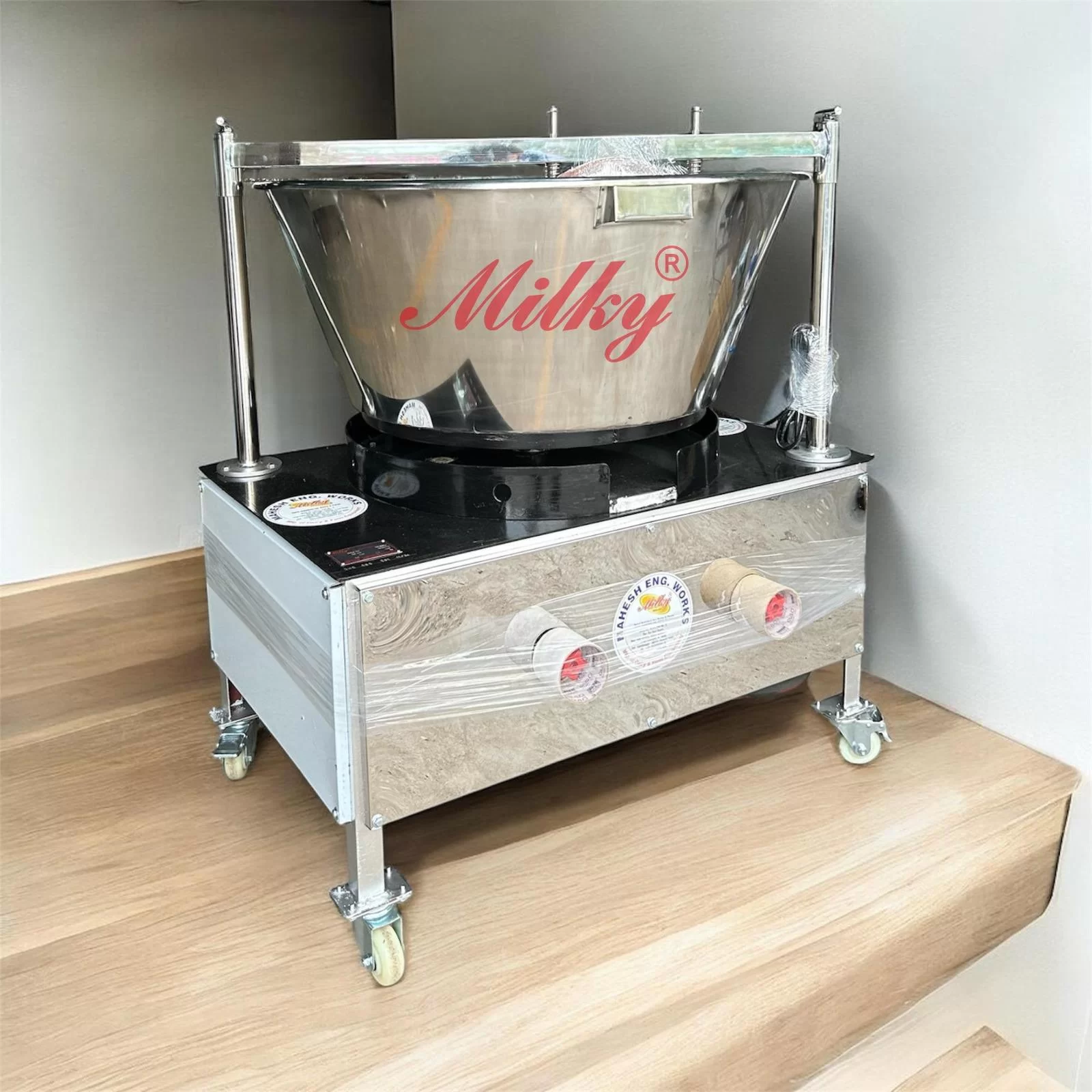
Milky Brand Automatic Khoya Making Machine are available in 120 litre, 200 litre, and 300 litre barrel capacities to suit businesses of different sizes. Smaller capacities work well for sweet shops and entrepreneurs starting out, while the larger 300 litre model suits dairy plants and cooperatives with higher daily milk processing volumes. Each model can run on a gas burner or electric motor depending on your site setup.
Choosing the right capacity depends on how much milk your business processes daily and your expected growth over the next few years. Businesses planning to scale production often prefer a slightly higher capacity than their current need.
| No. | Technical Data | 120 LTR Model | 200 LTR Model | 300 LTR Model |
|---|---|---|---|---|
| 1 | Dimensions — W × L × H | 40″ × 20″ × 32″ | 46″ × 25″ × 32″ | 60″ × 30″ × 36″ |
| 2 | Stainless Steel Vessel with M.S. Bottom Capacity | 55 LTR | 110 LTR | 200 LTR |
| 3 | Motor Capacity (Vessel / Blower) | 1/2 H.P. – 1/8 H.P. | 1/2 H.P. – 1/4 H.P. | 1 H.P. – 1/2 H.P. |
| 4 | Weight – Diesel Burner Machine | 150 KG | 250 KG | 350 KG |
| 5 | Weight – Gas Burner Machine | 150 KG | 225 KG | 310 KG |
| 6 | Fuel Consumption per Batch (Diesel/Kerosene) | 0.5 – 0.75 LTR | 1.25 – 1.5 LTR | 2 – 2.5 LTR |
| 7 | Power Consumption per Hour | 1.5 Units | 1.6 Units | 2.8 Units |
| 8 | Production Time per Batch | 12 – 15 Minutes | 15 – 20 Minutes | 20 – 35 Minutes |
| 9 | Milk Conversion into Mava (Khoya) | 5 LTR | 10 LTR | 20 LTR |
| 10 | Milk Conversion into Basundi | 15 LTR | 30 LTR | 60 LTR |
Download Full Brochure
Get drawings, full specifications, layout requirements and pricing on email.
Milky Brand Industrial Khoya Making Machine are designed around the practical needs of dairy and sweet businesses. Key features include:

Even heat distribution reduces monitoring and helps prevent batch variation.

Stainless steel construction supports hygiene standards in dairy production.

Smooth surfaces allow quick cleanup between batches and production shifts.

Simple design, minimal servicing required.

Built to reduce power consumption.

Durable construction for years of daily use.

Larger batches, less manual effort, higher output.

Preparing khoya-based mithai in bulk with consistent quality.

Processing milk into khoya alongside ghee, paneer, and other products.

Converting daily milk collection volumes efficiently.

Turning surplus milk into khoya.

Scaling up commercial khoya output.

Dedicated production at consistent volumes.

Machine handles stirring and heating, freeing up staff.

Uniform results batch after batch for commercial reliability.

Stainless steel build, easier to clean.

Processes larger volumes than manual methods.

Especially useful during peak demand periods.

Less supervision, fewer batch failures, better use of raw milk.

Practical payback timeframe for most businesses.
Plan in kg/day of khoya output; this drives the batch size required.
Match litres per batch to your daily output and shift hours.
Steam jacketed for plants; electric/gas for sweet shops.
Power phase, steam boiler, water supply, and floor area.
Manual, semi-auto with auto-scraper, or fully automatic.
Free technical advisory and capacity sizing call.
The price of a Mava Making Machine depends on capacity, heating type, automation level, and material quality. Larger batch sizes and higher-grade stainless steel cost more, while steam based heating and added automation increase price further.
Since requirements vary by business, Mahesh Eng. Works provides custom quotations based on your specific capacity and production needs.
Mahesh Eng. Works supplies Industrial Khoya Making Machines to dairy plants, sweet manufacturers, and cooperatives across Kolhapur. The team coordinates delivery based on your location and provides installation support to help businesses set up correctly from day one.
Get Quote for Your CityA khoya making machine is dairy processing equipment that converts raw milk into khoya (mawa) through controlled heating and continuous mechanical stirring. It replaces manual open-pan cooking, producing consistent texture with less labour and better hygiene. MILKY® machines are available in 120, 200, and 300 litre barrel capacities.
The price depends on the machine's milk capacity, heating source, and build quality. Pricing breakdown for commercial-grade models:120 Litre Model: Prices start from approximately ₹85,000.200 Litre Model (Most Popular): Costs between ₹1,10,000 and ₹1,40,000, depending on specific automation features.300 Litre Model (Heavy-Duty): Prices start from ₹1,80,000 onwards for large-scale industrial operations.Note: The prices listed above are base rates. A standard 18% GST, packaging, and transportation charges will be calculated extra at the time of final billing. Prices may vary based on custom structural requirements.
Estimate your daily khoya output in kg, then work back: approximately 5–6 litres of milk yields 1 kg of khoya. A 120 LTR machine suits sweet shops producing up to 15–20 kg per shift. A 200 LTR machine handles medium dairies producing 30–40 kg per shift. The 300 LTR model suits large plants or factories requiring 50+ kg per shift. Mahesh Eng. Works can guide you based on your current and projected volumes.
Yes. Khoya making machines can be customized in terms of capacity, heating method, automation level, and additional attachments. This allows dairy plants, sweet manufacturers, and cooperatives in Kolhapur to get equipment suited to their specific production workflow.
Yes. Mahesh Eng. Works provides installation guidance and after-sales support for machines supplied to Kolhapur and nearby regions. The team assists with setup, initial operation training, and ongoing maintenance queries to ensure smooth production.
Yes. Mahesh Eng. Works supplies khoya making machines across Maharashtra including Kolhapur, Sangli, Satara, Karad, Ichalkaranji, Solapur, Pune, and Nashik as well as to other states across India. Delivery and installation support are coordinated based on your location.
Yes. Mahesh Eng. Works supplies khoya making machines across Maharashtra, including Kolhapur, Sangli, Satara, Karad, Ichalkaranji, and Pune, as well as other states across India. Delivery and basic installation support are coordinated based on the client's location.
The 120 LTR model runs on a 0.50 HP single-phase motor. The 200 LTR model uses a 1 HP single-phase motor. The 300 LTR model requires a 2 HP single-phase motor. Gas burner consumption depends on batch duration and fuel type — the 2T standard burner on smaller models uses approximately 400–600 grams of LPG per batch. Actual electricity costs are low relative to output value, as the bulk of heat energy comes from the gas burner.
Khoya making machines are used by sweet shops, dairy plants, milk processing units, cooperative milk societies, and food processing businesses. Any business producing khoya, mawa, or related dairy sweets at a commercial scale benefit from automated equipment.
On average, 5 to 6 litres of full-fat cow milk produces approximately 1 kg of khoya. For buffalo milk with higher fat content (6–8%), the yield is slightly better closer to 4.5 to 5 litres per kg. This conversion ratio is the key number to use when sizing your machine capacity against your daily milk supply.
Talk to Mahesh Eng. Works today for the latest price, technical guidance, capacity recommendation, and machine configuration.