

Introduction
Khoya (also called mawa or khoa) is the backbone of India’s traditional sweet industry. From gulab jamun and barfi to halwa and peda, dozens of iconic Indian mithai depend on khoya as their primary ingredient. The Indian dairy confectionery sector consumes millions of kilograms of khoya every year, and demand grows consistently with rising urban consumption and the organized sweet retail sector.
Traditionally, khoya is made by simmering and stirring whole milk in an open pan over direct flame for 2–4 hours until the moisture evaporates and milk solids concentrate into a thick, dough-like mass. This process requires continuous manual stirring, skilled labor, and significant energy and it does not scale. As dairy businesses grow, manual khoya preparation becomes the single biggest bottleneck: inconsistent quality, high labor cost, risk of burning, and inability to process large volumes.
This is where the khoya making machine transforms dairy operations. An automated or semi-automatic khoya machine replicates the evaporation and concentration process with precise temperature control, mechanical stirring, and consistent output reducing batch time, eliminating manual stirring labor, and delivering uniform product quality every time.
This article explains what a khoya making machine is, how it works, the types and capacities available, pricing in India, and what dairy entrepreneurs and sweet manufacturers need to know before buying one.
What is a Khoya Making Machine?
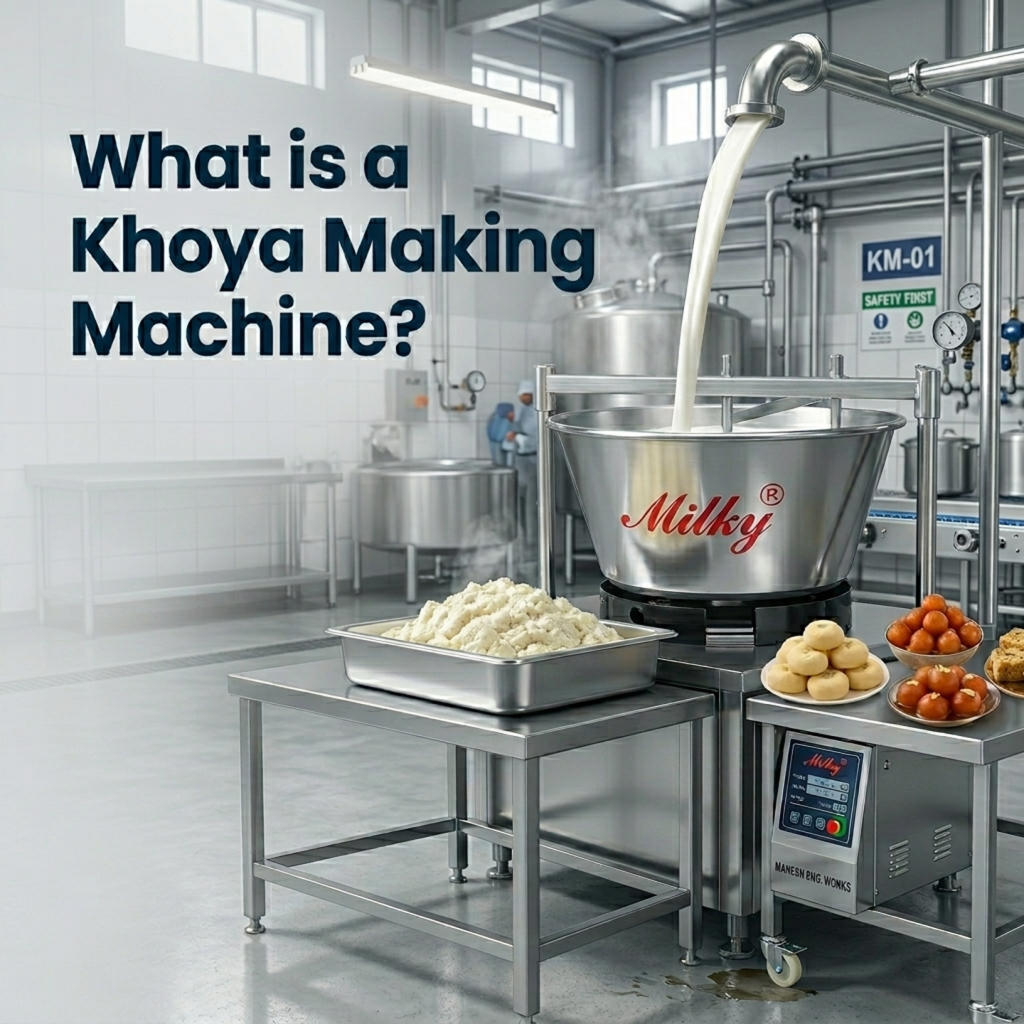
A khoya making machine is a stainless steel dairy processing machine designed to automatically evaporate moisture from whole milk and concentrate it into khoya (milk solids). It replaces the traditional open-pan, manual-stirring method with a mechanized heating and agitation system that produces consistent khoya at scale.
The machine is also called a mawa making machine or khoa making machine. It is an essential piece of equipment for:
- Commercial sweet manufacturers (mithai units)
- Dairy farms and milk processing units
- Ghee and dairy product manufacturers
- Cooperative dairies and MSME dairy entrepreneurs
- Caterers and industrial food processors requiring bulk khoya
How Does a Khoya Making Machine Work? (Step-by-Step Process)
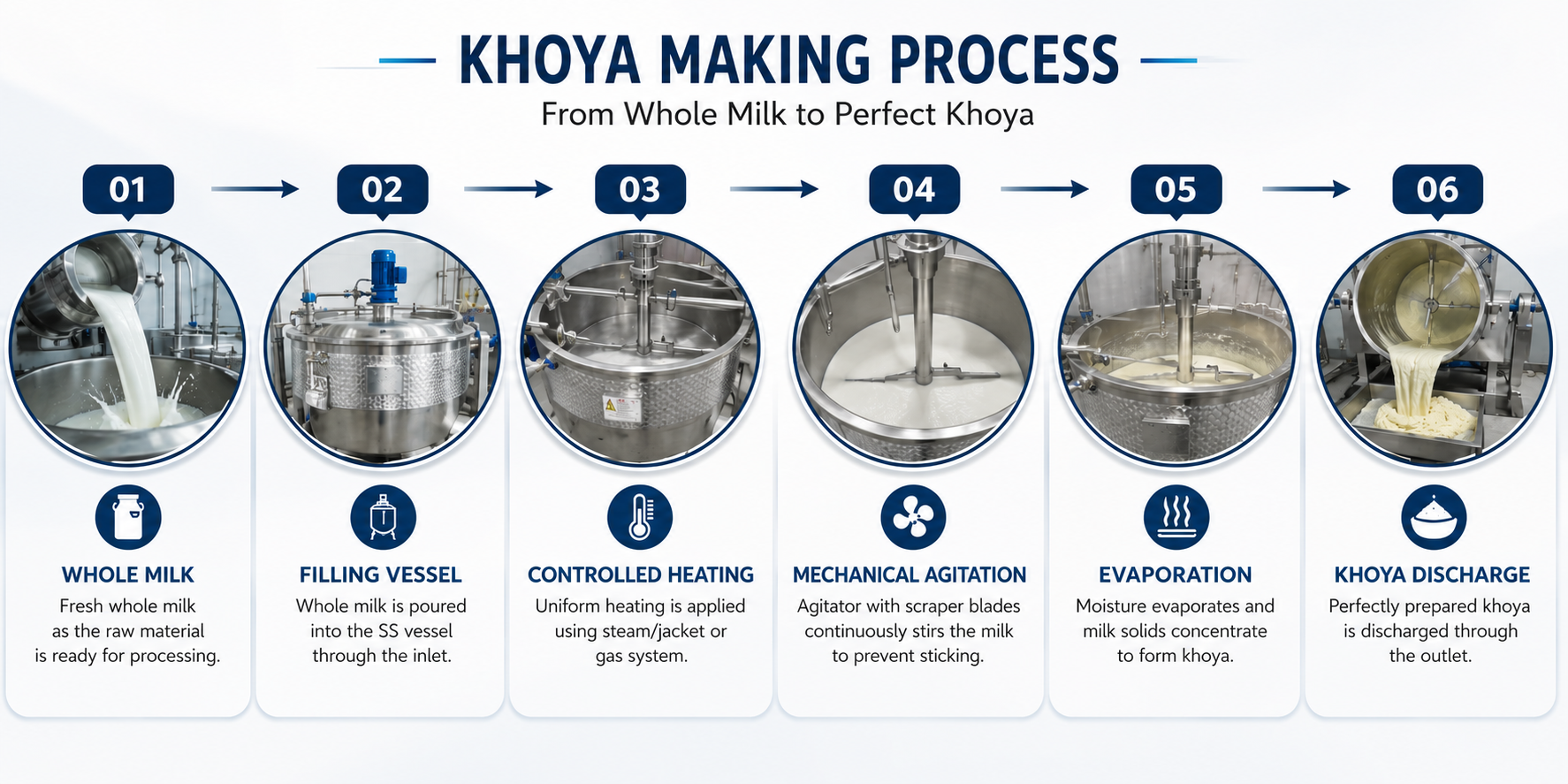
- Step 1: Milk Loading Whole milk is poured into the SS304 jacketed vessel through the top inlet. The vessel is designed for easy filling and is sized to the machine’s rated capacity.
- Step 2: Controlled Heating The heating system (gas burner, steam jacket, or electric element) brings milk to controlled temperature. Jacketed heating distributes heat evenly, preventing hot spots that cause burning or scorching.
- Step 3: Continuous Agitation A mechanical agitator (scraper blade or paddle) continuously stirs the milk as it heats. The agitator scrapes the vessel walls to prevent sticking and ensures uniform concentration throughout the batch.
- Step 4: Evaporation and Concentration As moisture evaporates under heat and agitation, milk volume reduces and solids concentrate. The machine operator monitors temperature and consistency throughout this phase.
- Step 5: Discharge When the milk solids reach the correct moisture content and texture (determined by visual check or temperature), heating stops and the agitator slows. The finished khoya is discharged through the bottom outlet.
Main Components and Construction Materials
Quality and longevity of a khoya making machine depend on the materials and components used. Here is what a well-built commercial machine should include:
SS304 Jacketed Vessel
The main vessel is fabricated from food-grade AISI 304 stainless steel. The double-wall jacketed construction circulates steam or hot water in the outer jacket, delivering uniform heat to milk without direct flame contact. This prevents scorching and produces consistent khoya colour and texture.
Mechanical Agitator and Scraper Blades
The agitator assembly is driven by a gear-reduced motor and fitted with stainless steel scraper blades that maintain contact with the vessel wall. Scraper geometry is critical well-designed blades continuously remove concentrated milk solids from the wall, preventing burning while improving heat transfer efficiency.
Heating System
Heating options include: gas-fired burner (LPG or PNG), steam jacket (connected to a boiler), or electric heating element. Each method has different operating costs and infrastructure requirements. Steam-heated machines offer the most uniform temperature control and are preferred in larger dairy plants.
Gearbox and Drive Motor
A helical gearbox reduces motor speed to the agitator shaft, providing high torque at low RPM suitable for stirring thick milk concentrates. Motor sizing is matched to vessel capacity typically 0.5 HP to 3 HP for machines from 50 kg to 500 kg batch capacity.
Bottom Discharge Outlet
A bottom-mounted discharge valve allows finished khoya to be easily removed from the vessel. The outlet should be full-bore (no pockets where product can collect) and fitted with a food-grade gasket for hygienic discharge.
Types of Khoya Making Machines Available
| Type | Heating Source | Agitation | Best For | Capacity Range |
| Gas-Fired | LPG / PNG burner | Manual or mechanical | Small to medium mithai units | 20–200 kg/batch |
| Steam-Heated | Steam jacket (boiler) | Mechanical | Dairy plants, cooperatives | 100–500 kg/batch |
| Electric | Electric element | Mechanical | Areas without gas/boiler infrastructure | 20–100 kg/batch |
| Semi-Automatic | Gas or steam | Mechanical agitator | Growing dairy businesses | 50–200 kg/batch |
| Fully Automatic | Steam or gas | Automated agitation + PLC control | Large-scale plants, consistent output | 200–500+ kg/batch |
For most Indian dairy entrepreneurs and sweet manufacturers, a semi-automatic gas or steam-heated machine with mechanical agitation offers the best balance of cost, output quality, and ease of operation.
Khoya Making Machine Capacity Range and Applications
| Batch Capacity | Milk Required (approx.) | Suitable Application |
| 20–50 kg | 150–400 litres | Small mithai shops, home-based producers, pilot dairy units |
| 50–100 kg | 400–800 litres | Medium sweet manufacturers, small cooperative dairies |
| 100–200 kg | 800–1,600 litres | Commercial mithai factories, district-level cooperative plants |
| 200–300 kg | 1,600–2,400 litres | Large dairy processing units, industrial sweet manufacturers |
| 300–500 kg | 2,400–4,000 litres | Integrated dairy plants, large cooperative processing centres |
Rule of thumb: approximately 7.5–8 litres of whole cow milk yield 1 kg of khoya. Buffalo milk yields approximately 1 kg from 5.5–6 litres due to higher fat and solid content.
Benefits of Using a Khoya Making Machine
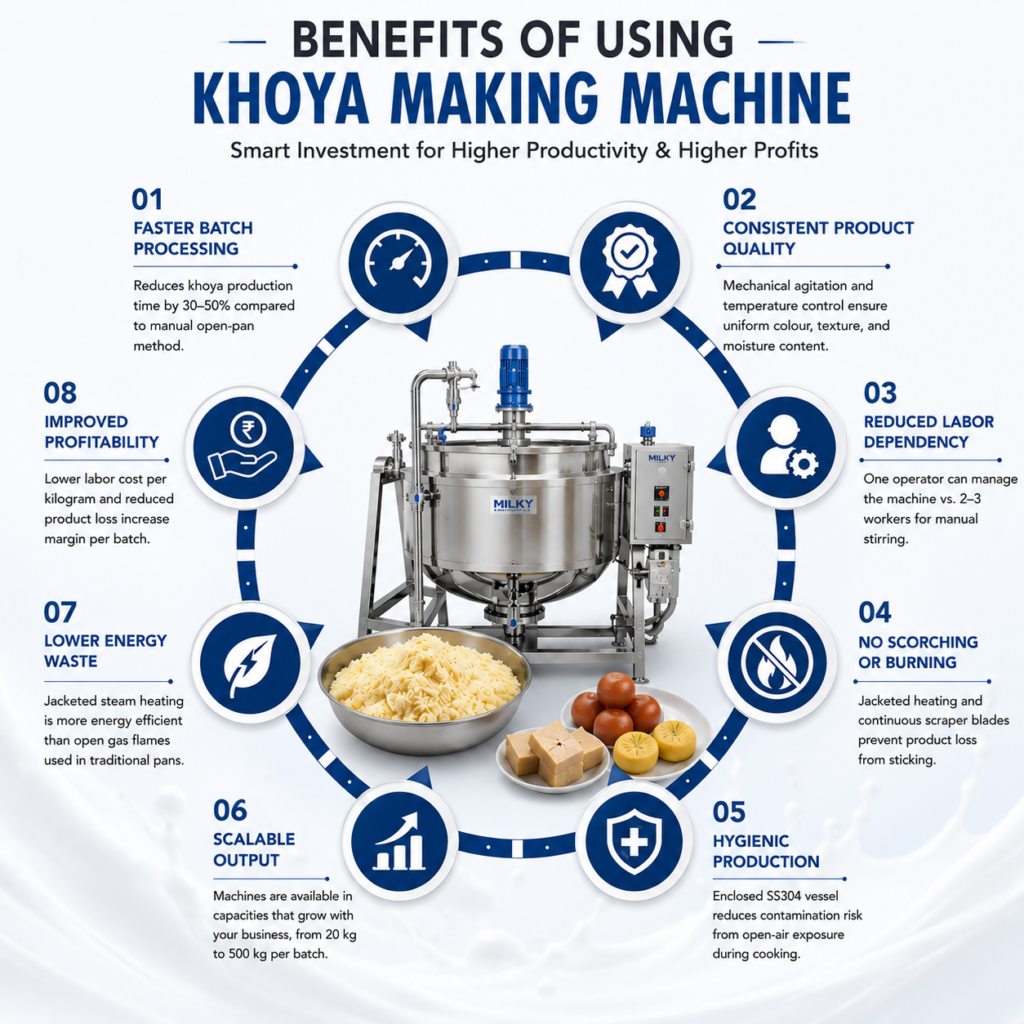
Switching from manual to machine based khoya production delivers measurable advantages across productivity, quality, and cost:
- Faster batch processing — reduces khoya production time by 30–50% compared to manual open-pan method.
- Consistent product quality — mechanical agitation and temperature control eliminate batch-to-batch variation in colour, texture, and moisture content.
- Reduced labor dependency — one operator can manage a fully mechanical machine versus 2–3 workers required for manual stirring.
- No scorching or burning — jacketed heating and continuous scraper blades prevent product loss from sticking.
- Hygienic production — enclosed SS304 vessel reduces contamination risk from open-air exposure during cooking.
- Scalable output — machines are available in capacities that grow with your business, from 20 kg to 500 kg per batch.
- Lower energy waste — jacketed steam heating is more energy efficient than open gas flames used in traditional pans.
- Improved profitability — lower labor cost per kilogram and reduced product loss increase margin per batch.
Why Dairy Businesses, Sweet Manufacturers, and Entrepreneurs Need a Khoya Making Machine
For Sweet Manufacturers (Mithai Units)
Khoya is a direct input cost. Buying market khoya exposes you to price volatility and quality inconsistency. Manufacturing your own khoya with a dedicated machine gives you cost control, assured quality, and the ability to scale production for festivals and peak demand periods.
For Dairy Farms and Milk Collection Centers
Surplus milk particularly during flush season can be profitably converted into khoya rather than sold at depressed fresh milk prices. A khoya making machine allows dairy farmers to add value at source and access retail or wholesale sweet markets.
For MSME Dairy Entrepreneurs
Khoya production is a viable standalone dairy business. Starting with a 50–100 kg batch machine, an entrepreneur can supply local sweet shops, caterers, and cooperative dairies. The capital investment is relatively modest and the product has consistent local demand throughout the year, peaking during Diwali, Holi, and Eid.
What to Consider Before Purchasing a Khoya Making Machine
1. Define Your Daily Production Requirement
Calculate daily khoya requirement in kg. Divide by batch capacity to determine how many batches per day you need. Choose a machine that allows you to complete required batches within your working hours with a 20% buffer.
2. Choose the Right Heating Method
If you have an existing boiler or steam line, a steam-jacketed machine is most efficient. If not, a gas-fired machine is the simpler starting point. Avoid electric heating for capacities above 100 kg operating costs become prohibitive.
3. Verify Material Specifications
Confirm SS304 for all product-contact surfaces: vessel interior, agitator, scraper blades, and discharge outlet. Request a material certificate or written specification. Do not accept SS202 or MS (mild steel) contact surfaces for food-grade dairy production.
4. Inspect Agitator and Scraper Design
Ask to see the agitator and scraper blade design. Scrapers should maintain full wall contact throughout the vessel curve. Poorly designed scrapers leave dead zones where milk solids accumulate and burn.
5. Check After-Sales Service and Spare Parts
Confirm that the manufacturer stocks wearing parts scraper blades, gaskets, seals, and gearbox oil. Ask for the typical replacement interval and cost for each. A machine that cannot be serviced locally causes expensive downtime.
6. Request a Live Demonstration or Reference Visit
For machines above ₹2 lakh, request a demonstration at the manufacturer’s facility or a reference site visit to a current customer operating the same model.
Frequently Asked Questions (FAQs)
What is a khoya making machine used for?
A khoya making machine is used to convert whole milk into khoya (mawa) by continuously heating and stirring milk in a stainless steel vessel until moisture evaporates and milk solids concentrate. It is used by sweet manufacturers, dairy farms, cooperatives, and MSME dairy entrepreneurs.
How does a khoya making machine work?
The machine fills whole milk into a jacketed SS304 vessel, applies controlled heat (gas, steam, or electric), and continuously stirs using a mechanical agitator with scraper blades. Over 2–3 hours, moisture evaporates and milk solids concentrate into khoya. The finished product is discharged through a bottom outlet.
What is the price of a khoya making machine in India?
Khoya making machine prices in India range from approximately ₹80,000 for a 20–50 kg gas-fired model to ₹15,00,000 or more for a fully automatic 300–500 kg steam-heated machine. Price depends on capacity, heating type, automation level, and material specifications.
How much milk is needed to make 1 kg of khoya?
Approximately 7.5–8 litres of cow milk or 5.5–6 litres of buffalo milk is required to produce 1 kg of khoya. Buffalo milk yields more khoya per litre due to its higher fat and total solids content.
What is the difference between a semi-automatic and automatic khoya making machine?
A semi-automatic khoya machine uses a mechanical agitator to eliminate manual stirring but requires the operator to monitor temperature, control heating manually, and discharge the product. A fully automatic machine uses PLC controls to manage heating temperature, agitation speed, and discharge automatically, reducing operator intervention.
Which industries use khoya making machines?
Khoya making machines are used by sweet (mithai) manufacturers, dairy farms, milk collection centers, cooperative dairies, catering units, halwa and confectionery producers, ice cream manufacturers, and MSME dairy entrepreneurs entering value-added dairy processing.
What material should a khoya making machine be made from?
All product-contact surfaces must be AISI 304 stainless steel (SS304). This material is food-grade, resistant to milk acids, and compatible with standard dairy cleaning chemicals. Avoid machines with SS202 or mild steel contact surfaces, as these corrode in dairy environments and compromise food safety.
How long does it take to make khoya in a machine?
A typical batch takes 2–3 hours from milk loading to finished khoya, compared to 3–4 hours for manual open-pan production. Batch time varies with milk volume, fat content, heating intensity, and the moisture level required for the type of khoya being produced.
Can a khoya machine process buffalo milk?
Yes. Khoya making machines are suitable for both cow and buffalo milk. Buffalo milk’s higher fat and solid content produces denser khoya faster, which requires careful temperature monitoring to avoid rapid thickening. Agitator speed may need adjustment for buffalo milk batches above 200 kg.
Do I need a boiler to run a khoya making machine?
Only steam-jacketed khoya making machines require a boiler. Gas-fired and electric models do not require boiler infrastructure. For capacities above 200 kg, steam heating offers better temperature uniformity and is the preferred choice in professional dairy plants.
What is the lifespan of a khoya making machine?
A well-built SS304 khoya making machine with proper daily cleaning and scheduled maintenance typically lasts 10–15 years. Wearing parts — scraper blades, shaft seals, and gearbox oil — require periodic replacement. Gearbox life is typically 5–10 years depending on load and lubrication frequency.
What types of khoya can be produced using a machine?
A khoya making machine can produce batti khoya (hard, used for peda and burfi), chikna khoya (soft, used for gulab jamun and halwa), and danedar khoya (granular, used for specific regional sweets) by varying the endpoint moisture content, temperature, and milk fat input.
Conclusion
For any dairy entrepreneur, sweet manufacturer, or cooperative dairy looking to grow beyond manual production limits, a khoya making machine is a well-justified capital investment. It replaces 3–4 hours of intensive manual labor with a controlled, hygienic, and consistent process — and the payback period for commercial users is typically 12–24 months. The right machine depends on your daily production volume, available heating infrastructure (gas, steam, or electric), and the budget allocated for equipment. Starting with a semi-automatic 50–100 kg model and scaling to larger capacities as your business grows is a practical approach for MSME dairy entrepreneurs.
Before purchasing, verify material specifications (SS304 contact surfaces), inspect the agitator and scraper design, confirm after-sales service and spare parts availability, and request either a factory demonstration or a reference site visit. Mahesh Eng. Works manufactures SS304 khoya making machines in multiple capacities from our facility in Gujarat, with exports to 25+ countries under the Milky Brand. Contact our team to discuss your production requirements and get a current quotation.

Mahesh Eng. Works
Written and reviewed by Mahesh Eng. Works, a dairy machinery manufacturer specializing in milk cream separator machines and hygienic stainless steel dairy equipment. Since 1980, we have been designing and manufacturing cream separators, butter churners, milk pasteurizers, bulk milk coolers, and complete dairy processing solutions for dairy farms, milk collection centers, and processing plants.