
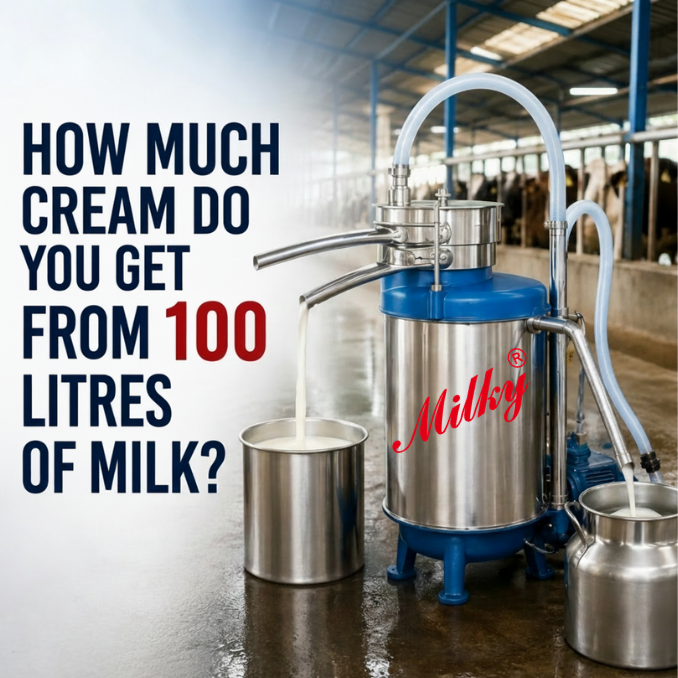
From 100 litres of cow milk (4% fat), you typically get 3.5 to 5 litres of cream using a centrifugal separator. Buffalo milk at 7% fat can yield 6 to 7 litres from the same volume. Actual cream yield from milk depends on fat content, animal breed, season, and your separation method.
If you work in dairy whether you run a small farm, a commercial plant, or you’re just starting out knowing your exact cream yield from milk is essential for planning batches, setting prices, and reducing waste. This guide gives you the formula, worked examples, a reference table, and answers to the questions dairy operators actually ask.
The simple formula for cream yield from milk
You don’t need a food science degree. Here’s the formula dairy professionals use:
cream yield formula:

Cream Yield = Milk Volume × Milk Fat % ÷ Cream Fat %
Where Cream Fat % is your target typically 35% for whipping cream, 48% for double cream.
Example 1 — 100 litres of cow milk at 4% fat
Most Holstein/Friesian cows produce milk at around 3.5–4% fat. Let’s use 4%:
100 × 4% ÷ 35% = 11.4 litres raw cream
Accounting for separator efficiency (roughly 85–90%), practical yield is 9.5 to 10.2 litres. For commercial double cream (48% fat), expect approximately 3.5 to 5 litres.
Example 2 — 50 litres of milk at 3.5% fat
50 × 3.5% ÷ 35% = 5 litres raw cream
After separator losses: approximately 4 to 4.5 litres of usable cream.
Factors that affect cream yield from milk
The formula gives you a baseline. In real dairy operations, several variables shift your result sometimes by more than you’d expect.
Breed of animal
Buffalo milk averages 6–8% fat, making it significantly richer than cow milk. Cream yield is nearly double expect 6 to 7+ litres per 100 litres.
Jersey cows average 4.5–5.5% fat, making them excellent for small-scale cream production. Holstein/Friesian the most common commercial breed averages 3.5–4% fat. High volume, moderate cream yield.
Feed quality
Cows on high-quality pasture or energy-dense feed (corn silage, oilseeds) consistently produce higher-fat milk. Switching to structured TMR (Total Mixed Ration) feeding can increase fat percentage by 0.3 to 0.5% which adds up significantly at scale.
Season
Milk fat is naturally higher in winter and lower in summer. In India and South Asia, the typical seasonal variation is 0.5 to 1% fat between peak and lean months. Build this into your weekly yield estimates.
Separation method
Manual skimming: Chilling milk and skimming the top layer. Simple, but you leave 20–30% of the cream behind. Efficiency: approximately 70%.
Centrifugal cream separator:
The industry standard. Spins milk at high speed, forcing cream outward by density difference. Efficiency: 90 to 97% depending on model and milk temperature. Many small dairies switching from manual skimming report a 25–30% improvement in recoverable cream within the first week of using a cream separator machine.
Types of cream and how they affect yield volume
The fat percentage of your target product directly determines how much volume you’ll get. Higher-fat cream means lower volume but higher value per litre.
- Single cream
18–25% fat
~10–14 litres per 100L milk - Whipping cream
30–35% fat
~8–10 litres per 100L milk - Double cream
40–48% fat
~5.5–7 litres per 100L milk
Double cream fetches the highest price per litre but yields the least volume. Single cream produces the most volume but competes on price in retail markets. Most commercial operations target whipping cream (35% fat) as the sweet spot between yield and margin.
Butter yield from cream — the next step
Once you have your cream, the logical question is: how much butter does that produce?
butter yield formula
1 litre of cream (30–35% fat) → 400–500 grams of butter
Plus buttermilk as a valuable by-product.
From 100 litres of cow milk at 4% fat, your production chain looks like this:
100L milk → approximately 4–5L cream (35% fat) → approximately 1.6 to 2.5 kg butter
Buffalo milk gives a significantly better return: 100L buffalo milk → 6–7L cream → approximately 2.5 to 3.5 kg of butter.
Cream yield table — quick reference for dairy operators
All figures assume centrifugal separation at 90% efficiency, targeting cream at 35% fat. Buffalo milk column uses 7% fat.
| Milk Volume | Fat % | Expected Cream Yield | Approx. Butter Yield |
|---|---|---|---|
| 1 Litre | 4% | 35–50 ml | 14–20 g |
| 10 Litres | 4% | 0.35–0.5 L | 140–200 g |
| 50 Litres | 4% | 1.75–2.5 L | 700 g – 1 kg |
| 100 Litres | 4% | 3.5–5 L | 1.4–2 kg |
| 100 Litres | 7% (Buffalo) | 6–7 L | 2.3–2.8 kg |
| 500 Litres | 4% | 17.5–25 L | 7–10 kg |
Manual skimming reduces these figures by approximately 20–30%.
Note: Values are approximate and may vary based on milk quality, fat content, processing conditions, and equipment efficiency.
How to calculate cream yield for your dairy
Three steps, no special tools required:
Step 1. Find your milk’s fat % use a Gerber or Babcock fat test, or check your supplier’s quality report.
Step 2. Decide your cream grade: single (20%), whipping (35%), or double cream (48%). This becomes your denominator.
Step 3. Apply the formula: Milk Volume × Milk Fat % ÷ Cream Fat % × Separator Efficiency (0.90).
For consistent results, many dairies use a cream separator machine with a built-in flow meter this removes the guesswork and lets you hit target fat percentages reliably every batch.
Track your cream yield weekly. If it drops below your expected range, check fat content first, then separator calibration. A 1% drop in fat at 1,000L per day can mean 10+ litres of cream lost daily that adds up fast.
Frequently asked questions
How much cream from 1 litre of milk?
From 1 litre of cow milk at 4% fat, you get approximately 35 to 50 ml of cream using a centrifugal separator. Buffalo milk at 7% fat yields around 60 to 80 ml per litre. Manual skimming will produce 20–30% less than these figures.
Which milk gives more cream — cow or buffalo?
Buffalo milk gives significantly more cream. Its fat content of 6–8% vs 3.5–4% in cow milk means you can get nearly double the cream yield from the same volume. For cream or butter-focused dairies, buffalo milk is considerably more efficient.
Does boiling milk affect cream yield?
Yes boiling disrupts the fat globule membrane and makes separation harder, reducing effective yield by 10 to 15%. For best results, always separate cream from fresh, chilled milk (4–10°C) before any heat treatment.
What machine is best for cream separation?
A centrifugal cream separator is the industry standard. For small operations under 500L per day, manual centrifuge models work well. For commercial scale, electric separators rated at 300–1,000L per hour give the best efficiency and consistency.
Can I increase my cream yield?
Yes. Improve feed quality, switch to a higher-fat breed (Jersey or buffalo), optimize separation temperature (35–40°C), service your separator regularly, and reduce time from milking to separation. Each factor can add 0.3–0.5% fat to your milk over time.
What is the milk to cream ratio?
For cow milk at 4% fat, the milk to cream ratio is approximately 20:1 for double cream (48% fat) or 10:1 for single cream (18% fat). Buffalo milk ratios are roughly half these numbers due to the higher fat content.
How much cream from 100 litres of buffalo milk?
Using the formula: 100 × 7% ÷ 35% × 0.90 = approximately 18 litres raw cream, or around 6 to 7 litres of commercial double cream. Buffalo milk is the preferred choice for high-yield cream and butter production.
Conclusion
Knowing your cream yield from milk is essential for running a profitable dairy operation. Your three key variables are milk fat percentage, your target cream grade, and your separation method. Use the formula and table in this guide to plan your batches accurately, price your product right, and cut down on waste.
If you’re serious about improving cream recovery and reducing daily losses, the separation method you use matters more than anything else. Mahesh Eng. Works offers high-efficiency centrifugal cream separators designed for Indian dairy conditions—helping you recover more cream from every litre of milk. Get expert guidance on choosing the right capacity for your dairy and start improving yield from day one.

Mahesh Eng. Works
Written by Mahesh Engineering Works, specializing in precision dairy machinery and hygienic stainless-steel dairy solutions for small and medium dairy plants in India.