

Introduction
India is the world’s largest milk producer, generating over 230 million tones annually. Yet quality inconsistency, adulteration, and manual testing errors cost the dairy industry crores every year. Today, dairy farms, milk collection centers (BMCs), and processing plants are rapidly adopting digital milk analyzer machines and for good reason.
Traditional fat testing methods like Gerber or lactometer tests are slow, error-prone, and often manipulated. A modern milk analyzer machine delivers accurate results for fat, SNF, protein, density, and water content in under 60 seconds enabling fair farmer payments, quality assurance, and operational efficiency.
Whether you run a small cooperative or a large dairy processing unit, choosing the right milk analyzer machine is one of the most impactful investments you can make. This guide covers everything: how these machines work, the types available, realistic price ranges in 2026, and a practical buying checklist.
1. What Is a Milk Analyzer Machine and How Does It Work?
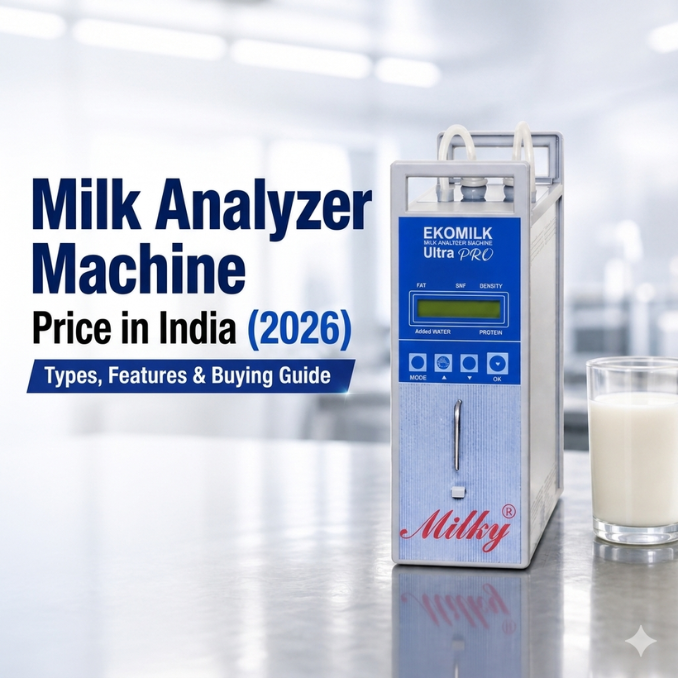
A milk analyzer machine is an electronic instrument that measures the physical and chemical composition of milk quickly and accurately, replacing slow and error-prone manual methods.
Parameters Measured
• Fat % — the most critical parameter for pricing
• SNF (Solid Not Fat) — determines nutritional value
• Protein % — important for processed dairy products
• Density / Specific Gravity — detects added water
• Water Content % — adulteration detection
• Lactose, Temperature, Freezing Point (advanced models)
Working Technology
• Ultrasonic Technology: Sound waves measure compositional properties at a molecular level highly accurate and maintenance-friendly.
• Infrared (IR) Technology: Uses light absorption at specific wavelengths to determine fat, protein, and lactose. Common in high-throughput lab machines.
• Capacitance-based sensors: Used in budget models for basic fat/SNF analysis.
Key Use Cases in the Dairy Industry
• Village milk collection centers and BMCs
• Cooperative society daily procurement (AMUL, KMF, etc.)
• Private dairy farms and bulk chilling centers
• Milk processing plants for incoming quality checks
• Adulteration detection by food safety authorities
2. Types of Milk Analyzer Machines in India
Milk analyzers are not one-size-fits-all. They vary by technology, automation level, and suitability for different operations.
| Type | Best For | Parameters | Speed | Price Range |
| Basic Milk Analyzer | Small farms, individual farmers | Fat, SNF, Water | ~60 sec/sample | ₹15,000–₹30,000 |
| Automatic Milk Analyzer | BMCs, collection centers | Fat, SNF, Protein, Density | ~30 sec/sample | ₹30,000–₹80,000 |
| Advanced Milk Analyzer | Dairy plants, quality labs | 8–12 parameters | ~20 sec/sample | ₹80,000–₹2,50,000+ |
| Ultrasonic Milk Analyzer | High-accuracy environments | All key parameters | <20 sec/sample | ₹60,000–₹2,00,000 |
| Portable Milk Tester | Field use, on-farm testing | Fat, SNF | ~90 sec/sample | ₹10,000–₹25,000 |
3. Best Milk Analyzer Machines in India (By Use Case)
Rather than recommending specific brands, here is a feature-first comparison to help you identify the right category of machine for your operation:
For Small Dairy Farms
• Look for: Fat + SNF + Water detection, simple interface, Hindi/regional language display
• Capacity needed: 50–200 samples/day
• Recommended type: Basic or Entry-level Automatic Analyzer
• Budget: ₹15,000–₹40,000
For Milk Collection Centers / BMCs
• Look for: Fast throughput (30 sec/sample), data logging, PC/printer connectivity
• Capacity needed: 200–500 samples/day
• Recommended type: Automatic Milk Analyzer with memory and software
• Budget: ₹40,000–₹1,00,000
For Dairy Processing Plants / Quality Labs
• Look for: 8+ parameter analysis, ISO calibration, software integration, high precision (±0.05% fat accuracy)
• Capacity needed: 500+ samples/day with batch processing
• Recommended type: Advanced / Infrared Milk Analyzer
• Budget: ₹1,00,000–₹2,50,000+
4. Milk Analyzer Machine Price in India (2026)
| Category | Price Range (INR) | Typical Use | Sample Speed | No. of Parameters |
| Basic Milk Analyzer | ₹15,000 – ₹30,000 | Small farms, individual use | 60–90 sec | 3–4 |
| Automatic Milk Analyzer | ₹30,000 – ₹80,000 | BMCs, cooperatives | 25–45 sec | 5–7 |
| Advanced / Infrared | ₹60,000 – ₹5,00,000+ | Dairy plants, labs | <20 sec | 8–12 |
| Ultrasonic Analyzer | ₹60,000 – ₹2,00,000 | Quality-focused operations | <20 sec | 6–10 |
| Portable Field Tester | ₹10,000 – ₹25,000 | On-farm, field inspections | 60–90 sec | 2–3 |
Prices may vary based on calibration standards (cow/buffalo milk), software integration, and after-sales support in India.
Factors That Affect Milk Analyzer Price
• Accuracy & Calibration Standard: Higher precision (±0.03%) commands a premium over ±0.1% models.
• Number of Parameters: Each additional parameter (lactose, freezing point) adds cost.
• Automation Level: Auto-cleaning, auto-calibration, and memory storage increase price.
• Brand & Build Quality: Branded machines with Indian service networks cost more but offer better after-sales support.
• Software Integration: Ethernet/USB/cloud connectivity and dairy management software compatibility add value.
5. Complete Buying Guide: How to Choose the Right Milk Analyzer
| Factor | What to Check | Why It Matters |
| Accuracy | Fat accuracy ±0.05% or better for commercial use | Directly affects farmer payment fairness |
| Parameters Required | Minimum: Fat, SNF, Water. Advanced: Protein, Density, Lactose | Match to your quality control needs |
| Sample Speed | 30 sec/sample for BMCs, 60 sec acceptable for small farms | Determines daily throughput capacity |
| Ease of Use | LCD display, local language, minimal training needed | Reduces operator error |
| Data & Connectivity | USB/PC export, auto-print, cloud/ERP integration | Essential for record keeping and compliance |
| Service Network | Authorized service center within 50 km or remote support | Downtime = revenue loss |
| Calibration | Pre-calibrated with dairy-specific standards (cow/buffalo/mixed) | Miscalibration means wrong readings |
| Warranty | Minimum 1 year on machine, 6 months on sensors/consumables | Protects investment |
6. Benefits of Using a Milk Analyzer Machine
- Improved Accuracy: Eliminates human error from manual fat testing; ±0.05% precision vs ±0.3% in manual Gerber method.
- Fair Farmer Payments: Automated fat/SNF-based pricing builds trust in collection centers, reducing disputes.
- Adulteration Detection: Instant water addition alerts protect product quality and brand reputation.
- Time Savings: 60 seconds per sample vs 10–15 minutes for traditional testing.
- Data-Driven Operations: Digital records enable trend analysis, quality audits, and regulatory compliance.
- Reduced Labor Costs: One operator can run 300+ tests/day with minimal training.
7. Common Mistakes to Avoid When Buying a Milk Analyzer
• Buying on price alone: A ₹15,000 machine may cost more in calibration, downtime, and inaccuracy than a ₹45,000 model.
• Ignoring after-sales service: Ask for the nearest service center location and average response time before buying.
• Wrong capacity selection: A machine rated for 100 samples/day will fail quickly at a 300-sample center.
• Skipping calibration verification: Always request a calibration certificate and test with a known milk sample on delivery.
• Not checking software compatibility: If you use dairy management software, confirm integration before purchase.
8. Maintenance Tips and Best Practices
Daily Maintenance
• Rinse the sample chamber with distilled water before and after each testing session.
• Clean sensor surfaces with a soft, lint-free cloth avoid abrasive cleaners.
• Record all test results digitally for audit trail integrity.
Weekly / Monthly Maintenance
- Run auto-clean cycle (if available) or manual deep-clean with manufacturer-approved solution.
- Verify calibration using a certified milk standard sample monthly.
- Check all tubing and connectors for milk residue buildup or cracks.
Annual Service
• Book annual preventive maintenance with authorized service partner.
• Replace consumable parts (tubing, O-rings, sensors) as per manufacturer schedule.
• Update firmware/software if applicable.
9. Frequently Asked Questions (FAQs)
Q1: What is the price of a milk analyzer machine in India in 2026?
Milk analyzer prices in India range from ₹15,000 for basic models to ₹2,50,000+ for advanced automatic analyzers. Most milk collection centers use machines in the ₹30,000–₹80,000 range.
Q2: Which is the best milk analyzer for a small dairy farm?
For small farms testing up to 100 samples/day, a basic or entry-level automatic milk analyzer with fat, SNF, and water detection in the ₹15,000–₹40,000 range is ideal. Prioritize ease of use and local language support.
Q3: How accurate are milk analyzer machines?
Good-quality milk analyzers offer fat accuracy of ±0.05% and SNF accuracy of ±0.1%. Basic models may have ±0.1% fat accuracy. Advanced infrared/ultrasonic machines achieve ±0.03% accuracy.
Q4: What are the advantages of an ultrasonic milk analyzer?
Ultrasonic milk analyzers are maintenance-friendly (no moving parts), highly accurate, and work well with both cow and buffalo milk. They measure multiple parameters simultaneously without reagents, making them cost-effective over time.
Q5: What is SNF in milk testing?
SNF (Solids Not Fat) includes lactose, proteins, minerals, and vitamins in milk, excluding fat. It is a critical quality parameter and directly impacts the price paid to farmers in many Indian dairy cooperatives.
Q6: Can a milk analyzer detect water adulteration?
Yes. All standard milk analyzers measure density or specific gravity, which drops significantly when water is added. Advanced models also measure freezing point depression, which is a highly sensitive indicator of water addition.
Q7: Is a milk analyzer suitable for both cow and buffalo milk?
Yes. Most milk analyzers sold in India come pre-calibrated for both cow and buffalo milk. Always verify this with the supplier and test with a certified sample of each milk type before deploying commercially.
Conclusion
A milk analyzer machine is not just a testing device it is the foundation of trust, transparency, and profitability in your dairy operation. Whether you are a village milk collector, a cooperative, or a large dairy plant, the right analyzer pays for itself within months through reduced disputes, better quality control, and saved labor costs.
In 2026, India’s dairy sector is more competitive than ever. Operations that invest in accurate milk testing equipment gain a measurable edge both in farmer confidence and consumer trust. Before you buy, use the buying checklist in Section 5, compare machine types in the table, and always test calibration accuracy with a certified sample. Don’t let price alone drive your decision the cost of inaccuracy is always higher.
Ready to find the right milk analyzer for your dairy? Explore Mahesh Eng.Works product range or contact our dairy equipment experts for a free consultation.

Mahesh Eng. Works
Written by Mahesh Engineering Works, specializing in precision dairy machinery and hygienic stainless-steel dairy solutions for small and medium dairy plants in India.