

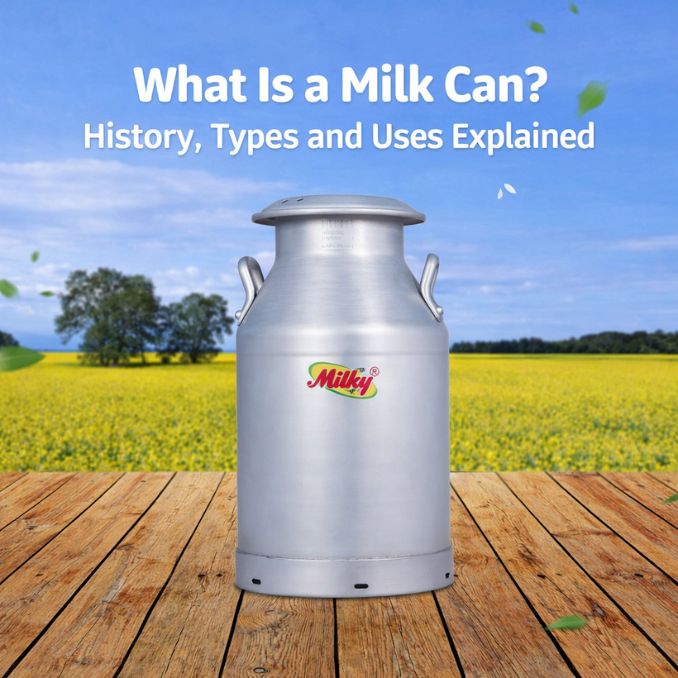
If you have ever watched milk being collected at a village dairy or seen old photographs of farms, you have seen a milk can. That tall, cylindrical metal container with a fitted lid and side handles. Simple-looking. Quietly essential.
But what exactly is a milk can, why does it look the way it does, and what role does it play in modern dairy operations? This guide covers all of it history, types, materials, sizes, uses, and what to look for when buying.
What Is a Milk Can?
A milk can also called a milk churn is a tall, cylindrical or conical container used to store and transport milk from one place to another. It is one of the oldest pieces of dairy equipment still in active daily use. The basic design has barely changed in over a century: a wide-mouth container with a secure lid, side handles for carrying, and enough capacity to hold anywhere from 5 to 50 liters of milk. What has changed is the material from early tin and steel to the aluminum alloy cans that dominate Indian dairy operations today.
A Brief History of the Milk Can
Milk cans were widely used from the late 19th century through the mid-20th century, when small-scale dairy farming and local dairies were prevalent. Farmers used them to transport fresh milk from their farms to nearby dairy processing facilities. Steel milk churns were later replaced with aluminum alloy churns. In Britain, Ireland, and other European countries, milk churns would be left by dairy farmers by the roadside on purpose-built platforms at the right height to be loaded onto the dairy’s cart or lorry.
In India, the milk can became deeply embedded in dairy infrastructure during Operation Flood the landmark dairy development programmer launched by NDDB in the 1970s. KK Cans started manufacturing aluminum alloy milk cans of 40 liters for the milk producers of cooperative milk unions during the Operation Flood Programmer, which helped India achieve self-sufficiency in milk collection.
Today India produces over 239 million metric tones of milk annually the largest in the world. Milk cans remain the primary vessel moving raw milk from farms to collection centers across millions of villages every single morning.
Types of Milk Cans
Not all milk cans are the same. Material, capacity, and lid type all vary depending on where the can is used and what conditions it faces.
Aluminum Milk Cans
The most widely used type across India. Aluminum milk cans are renowned for their sturdiness, rust-resistant properties, and ability to effectively maintain the quality and freshness of milk during transportation.
Aluminum milk cans are non-toxic, lightweight, leakage-proof, and easy to maintain. Aluminum has good thermal conductivity, which means it dissipates heat quickly an important property since milk is highly responsive to temperature. Aluminum milk cans manufactured by reputed aluminum milk cans manufacturers follow BIS standard IS 1825:1983, which specifies food-grade aluminum alloy, corrosion resistance, leak-proof design, and ease of cleaning. They are available from 5 liters to 50 liters capacity and used across dairy farms, collection centers, milk cooperatives, and processing plants throughout India.
Stainless Steel Milk Cans
Made from food-grade SS 304 or SS 316. Stainless steel milk cans are durable, hygienic containers designed for safe storage and transportation of milk rust-resistant, long-lasting, and easy to clean, making them the preferred choice for processing plants and premium dairy operations. Stainless steel cans cost more than aluminum but last longer in high-frequency commercial use and are easier to sanities on automated can scrubber lines. They are the standard choice at larger dairy processing facilities.
Plastic Milk Cans
Lightweight and affordable. Used mainly for short-distance home delivery or small farm use. Not suitable for commercial dairy operations due to lower durability, difficulty maintaining hygiene over time, and lack of food-grade certification in many lower-cost models.
Delivery-Type vs Collection-Type Cans
Within aluminum and stainless steel categories, there are two functional designs. Delivery-type cans are smaller typically 5 to 10 liters used by milkmen for doorstep delivery. Collection-type cans are larger 20, 30, 40, and 50 liters designed for bulk collection from farms to centers. The handles, lid fitting, and construction differ between the two for their respective handling conditions.
Standard Milk Can Sizes in India
Milk can capacity follows fairly standard increments across most milk can manufacturers in India:
5 liters — Home use, doorstep milk delivery, small farm
10 liters — Small farm delivery routes, retail milk vendors
20 liters — Small to medium dairy farms, cooperative collection
30 liters — Medium farms, collection routes with moderate volume
40 liters — The most common commercial size across India
50 liters — High-volume farms and bulk collection operations
The 40-litre aluminum milk can became the standard in India largely because of its adoption during Operation Flood designed to fit standard collection vehicles and can scrubber systems at cooperative dairies.
What Are Milk Cans Used For?
Farm to Collection Centre Transport
The primary use. Every morning across India, dairy farmers fill milk cans with fresh milk, load them onto bicycles, motorcycles, or small vehicles, and transport them to the nearest collection center. The can keeps the milk contained, protected from dust and insects, and relatively stable in temperature during the journey.
Storage at Collection Centers
At village-level milk collection centers, milk from multiple farmers is held in cans while it awaits testing and transfer to bulk coolers. The can’s airtight lid prevents contamination during this holding period.
Processing Plant Intake
Some smaller and mid-size dairy processing operations still receive raw milk in cans rather than tankers. Cans are weighed, sampled, and emptied at the intake point, then cleaned and returned to collection canters for the next cycle.
Cultural and Ceremonial Use
Milk cans also play a crucial role in various festivities and cultural programmer. Hosts of events store milk in large quantities in these cans, which is later used for sweets-making or served to the deity. Arena International In India, milk has deep cultural significance milk cans appear at temple offerings, wedding preparations, and community events involving large quantities of milk.
Why Aluminum Is the Preferred Material in India
Several properties make aluminum the dominant choice among milk can manufacturers for dairy use in Indian conditions:
Lightweight — A 40-litre aluminum can weighs significantly less than the equivalent stainless steel version. For farmers who lift and carry cans daily, this matters physically and practically.
Non-toxic — The oxidized layer on aluminum prevents leaching of chemicals into milk, ensuring non-toxicity. Food-grade aluminum alloy certified to BIS IS 1825:1983 is safe for direct milk contact.
Rust-proof — Unlike mild steel, aluminum does not rust. In humid conditions or monsoon seasons, this is a significant practical advantage.
Thermal properties — Low thermal conductivity helps maintain milk temperature during transit. Milk does not heat up as quickly inside an aluminum can as it would in a container with high heat absorption.
Durable over decades — If handles are maintained and fixed, a well-made aluminum milk can serves storage and transportation for decades. For farmers operating on tight margins, the long service life justifies the upfront cost.
Easy to clean — Smooth interior surfaces with no joints or crevices (particularly in monoblock design cans) allow thorough cleaning without residue buildup.
What to Look for When Buying Milk Cans
BIS certification — For aluminum milk cans, look for IS 1825:1983 compliance. This confirms food-grade material, structural standards, and safety for milk contact.
Monoblock vs welded construction — Monoblock (single-piece) aluminum cans have no handle joints that can break under repeated stress. Superior durability, especially in rough handling conditions on rural collection routes.
Lid type — Push-fit, lockable, or mushroom-type lids are available. Lockable lids with silicon washers provide the best airtight seal, important for preventing contamination during transport.
Handle design — Chamfered-end handles give better grip and reduce hand fatigue during heavy lifting. Smoothly brazed handles that are part of the can structure are more reliable than bolt-on attachments.
Interior finish — A smooth, polished interior makes cleaning faster and reduces bacterial buildup between uses.
Manufacturer reputation Buy from established milk can manufacturers who supply to dairy cooperatives and processing plants. These manufacturers maintain quality standards that small or unbranded suppliers typically do not.
Frequently Asked Questions
What is a milk can used for?
A milk can is a sealed container used to store, transport, and temporarily hold raw milk primarily from dairy farms to collection centers and processing facilities. It keeps milk protected from contamination, dust, insects, and temperature fluctuation during transit.
What is the standard size of a milk can in India?
The most common commercial size in India is 40 liters, which became standard during the Operation Flood programme. Milk cans are also available in 5, 10, 20, 30, and 50-litre capacities for different farm sizes and use cases.
Which material is better for milk cans aluminum or stainless steel?
Both are suitable for dairy use. Aluminum is lighter, more affordable, and the dominant choice for farm-to-collection-center transport across India. Stainless steel is more durable and easier to sanities in high-frequency commercial environments like processing plant intake points and automated can scrubber lines.
What does BIS IS 1825:1983 mean for aluminum milk cans?
It is the Bureau of Indian Standards specification for aluminum alloy milk cans. Compliance confirms the can is made from food-grade aluminum, meets structural strength requirements, has a leak-proof design, and is safe for milk contact. Always check for this certification when buying from aluminum milk cans manufacturers.
How long does an aluminum milk can last?
A well-made aluminum milk can from a reputable manufacturer, properly maintained and cleaned regularly, can last 15 to 20 years or more. The handles are the most common failure point monoblock cans with integrated handles outlast those with welded or bolted handles significantly.
Can milk cans be used for other liquids?
Yes. Stainless steel milk cans are used for water, edible oils, curd, and other food liquids. Aluminum milk cans are primarily intended for milk and dairy use. Always check whether a can is certified for contact with the specific liquid you intend to store.

Mahesh Eng. Works
Written by Mahesh Engineering Works, specializing in precision dairy machinery and hygienic stainless-steel dairy solutions for small and medium dairy plants in India.