

When you first started researching pasteurization methods for your operation, did you expect to find yourself buried under conflicting equipment recommendations, dense technical specs, and sales brochures that somehow make every option sound like the obvious choice?
Most producers do. And honestly, it makes sense — because this decision is more nuanced than it first appears.
Choosing between batch pasteurization and continuous pasteurization isn’t just a technical call. It shapes your product quality, your daily workflow, your compliance obligations, and your long-term costs. Get it right, and your operation runs the way you envisioned it. Get it wrong, and you’re either locked into equipment that can’t keep up with your growth — or you’ve overspent on industrial capacity you won’t use for years.
This guide gives you the full picture. Not the brochure version. The honest, experience-backed version that helps you make the right call for your operation.
What Is Pasteurization and Why Does the Right Method Matter?
Before comparing methods, it helps to be crystal clear on what pasteurization is actually doing — because the goal should drive the method choice.
Pasteurization uses controlled heat exposure to destroy harmful pathogens in food and beverage products. We’re talking about bacteria like Salmonella, Listeria monocytogenes, and E. coli — the kind that create serious public health risk and serious business liability. Beyond safety, pasteurization extends shelf life by reducing overall microbial load in the product.
What it doesn’t do is sterilize completely. It’s a targeted kill step, not a blank slate — which is why refrigeration and packaging integrity still matter after processing.
The FDA and USDA regulate specific time-temperature combinations that meet legal safety thresholds under the Pasteurized Milk Ordinance (PMO) and other applicable frameworks. Your job as a producer is to consistently hit those validated parameters — every batch, every run, every time — with documentation to prove it.
Now, with that foundation in place, here’s how the two primary pasteurization methods actually compare.
What Is Batch Pasteurization? (VAT / LTLT Method Explained)
How the Batch Pasteurization Process Works
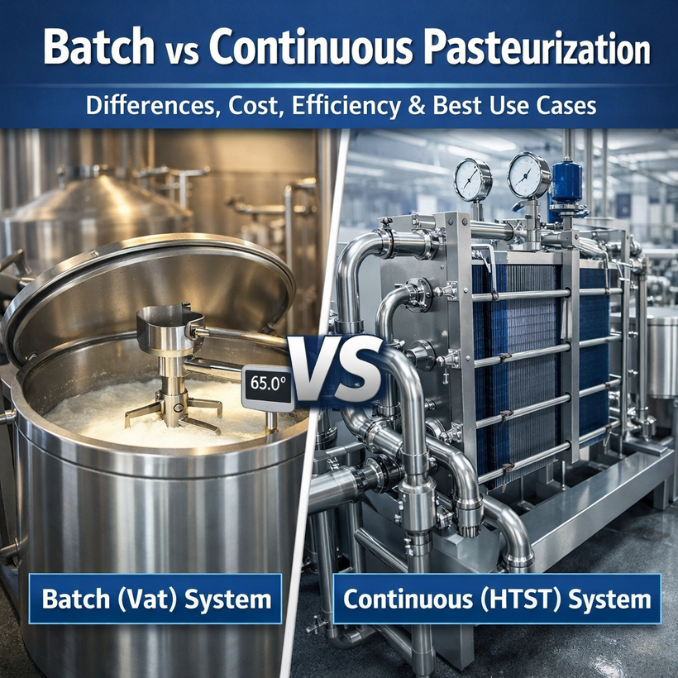
Batch pasteurization — also referred to as VAT pasteurization or LTLT (Low Temperature Long Time) pasteurization — heats a fixed volume of product in a jacketed vat to 145°F (63°C) and holds it at that temperature for 30 full minutes before cooling and moving it forward in the process.
One batch. One cycle. Then you start again.
The process is slower than continuous systems by design — and for the right producer, that’s genuinely an advantage, not a limitation.
Which Operations Benefit Most from Batch Pasteurization?
If you’re running a small-scale creamery, an artisan cheesemaking operation, a craft juice brand, or any facility where you work with small or variable batch sizes, batch pasteurization is almost always the smarter starting point.
The equipment is mechanically simpler. The upfront cost is considerably lower. The process gives you close, hands-on control over every run — which matters enormously when your product’s value depends on consistency at a small scale.
There’s also a quality argument that doesn’t get enough attention in most comparisons. The lower heat profile of LTLT pasteurization is genuinely gentler on heat-sensitive products. Natural flavor compounds, active enzymes, and delicate protein structures survive better at 145°F for 30 minutes than they do under the intense temperatures of continuous systems.
One artisan butter producer in New England switched to HTST when scaling up, then reversed course after customers noticed a subtle but real change in flavor. Nothing was wrong with the safety or the outcome. The heat exposure had shifted the product’s profile in a way that mattered to the people buying it. They went back to batch pasteurization, accepted the throughput limitation, and protected what made their product worth the premium price.
Honest Limitations of Batch Pasteurization
There’s no point glossing over the drawbacks.
Batch pasteurization is labor-intensive. Every run requires present, attentive operators. If your team is stretched or you’re running production continuously, that human requirement compounds fast. Consistency also depends on operator discipline in a way that automated continuous systems don’t.
And throughput is the ceiling you’ll hit as you grow. If you’re processing thousands of gallons per day, batch pasteurization physically cannot keep pace. You’d need more vats than you have floor space for, and the economics stop making sense well before you hit that wall.
What Is Continuous Pasteurization? (HTST and UHT Methods Explained)
How the Continuous Pasteurization Process Works
Continuous pasteurization keeps product in constant motion throughout the entire process. In an HTST (High Temperature Short Time) system, product flows through a plate heat exchanger, reaches 161°F (72°C) for 15 seconds, then moves through a cooling section and out for packaging. A flow diversion valve monitors temperature in real time — if the product drops below the required threshold at any point, it’s automatically redirected for reprocessing.
UHT (Ultra High Temperature) pasteurization takes this further, reaching 280°F (138°C) for just 2 seconds, achieving commercial sterility. When combined with aseptic packaging, UHT products can remain shelf-stable at room temperature for months.
Which Operations Benefit Most from Continuous Pasteurization?
Large-scale dairy processors, commercial juice manufacturers, and high-volume beverage operations are the natural home for continuous pasteurization. When you’re moving thousands of gallons per hour, HTST isn’t a preference — it’s a practical necessity.
The numbers back this up: roughly 90% of commercial fluid milk in the United States is processed through HTST systems. At that scale, the automation, consistency, and cost-per-unit efficiency of continuous processing make every alternative impractical.
Honest Limitations of Continuous Pasteurization
The capital investment is the first barrier for smaller producers. A commercial HTST installation — covering the heat exchanger, flow diversion valve, automated controls, and CIP (clean-in-place) infrastructure — typically runs between $100,000 and $500,000 or more before installation and commissioning costs.
For an operation that isn’t moving enough volume to justify that spend, the payback period stretches out significantly.
The flavor trade-off with UHT is also worth acknowledging. At those temperatures, the Maillard reaction affects milk proteins and sugars in ways that create a subtle cooked or caramelized note. Consumers buying shelf-stable ambient milk typically don’t notice or object. Premium dairy customers who are paying for exceptional flavor absolutely do.
Batch vs. Continuous Pasteurization: Side-by-Side Comparison
Here’s where both methods stand across the factors that actually drive real decisions:
| Factor | Batch Pasteurization (LTLT/VAT) | Continuous Pasteurization (HTST/UHT) |
|---|---|---|
| Temperature & Time | 145°F for 30 minutes | 161°F / 15 sec (HTST) — 280°F / 2 sec (UHT) |
| Best Production Scale | Small to mid-scale operations | Large-scale, high-volume operations |
| Equipment Investment | Lower — $5,000 to $80,000+ | Significantly higher — $100,000 to $500,000+ |
| Labor Requirement | Higher — operator-dependent | Lower — largely automated |
| Product Flexibility | High — easy to switch products | Lower — optimized for consistent runs |
| Flavor Preservation | Better for heat-sensitive products | Can alter delicate flavor compounds |
| Shelf Life | Moderate — refrigeration required | Extended (HTST) to shelf-stable (UHT) |
| Compliance Complexity | Moderate | Higher — more validation required |
No single row settles the argument. The right choice depends entirely on your volume, your product’s needs, and your business model.
Batch vs. Continuous Pasteurization Cost Analysis: What You’ll Actually Spend
Let’s get specific, because vague ranges don’t help you build a real budget.
Batch pasteurization equipment costs: Entry-level VAT systems suitable for small dairy operations start around $5,000–$15,000. Mid-range commercial batch systems with better controls and larger capacity run $30,000–$80,000. These are approachable numbers for a startup or small-scale artisan producer.
Continuous pasteurization equipment costs: HTST systems start around $75,000–$150,000 at the low end. Full-scale installations with automation and integrated CIP systems regularly exceed $500,000. UHT systems with aseptic packaging integration can reach well into the millions.
Where the math shifts over time: At high volume, HTST’s cost-per-unit advantage becomes decisive. Automated operation means fewer labor hours per gallon processed. Heat recovery systems built into most HTST designs recapture thermal energy during processing, reducing energy costs significantly compared to running equivalent volume through batch vats.
The practical benchmark that holds up well: if you’re processing under 500 gallons per day, batch pasteurization typically delivers better ROI over the first three to five years. Past 1,000 gallons per day, continuous systems start paying for themselves through labor and throughput savings.
Pasteurization Regulatory Compliance: What FDA and PMO Require
Both batch and continuous pasteurization are fully FDA-approved and compliant with the Pasteurized Milk Ordinance when properly implemented and validated. But “properly implemented” is where producers sometimes encounter difficulty.
HTST compliance requirements include calibrated temperature sensors, validated flow diversion valves, automated temperature logging, and documented system validation records.
Batch pasteurization compliance requirements include verified thermometer calibration, documented hold times for every run, and operator training records that demonstrate consistent process execution.
State dairy regulations add requirements on top of federal standards — and they vary more than most producers expect when they first navigate this landscape. Some states have additional equipment specifications or audit frequencies that go beyond PMO minimums.
The consistent advice from producers who’ve been through multiple inspections: build your compliance documentation system before production starts, not after your first audit. Inspectors aren’t only checking whether equipment functions — they’re verifying that your people understand the process and that you can document every run met the required standard.
How to Choose Between Batch and Continuous Pasteurization: A Decision Framework
If you’re still evaluating your options, work through these five questions honestly before committing to either system:
1. What is your current and projected daily production volume? This single question resolves most of the ambiguity. Under 500 gallons per day — batch pasteurization is very likely the right fit. Approaching or consistently exceeding 1,000 gallons per day — HTST deserves serious evaluation.
2. What does your realistic capital budget look like? If cash is constrained, batch pasteurization preserves working capital for other operational priorities. Starting with batch and planning a future transition to HTST is a legitimate, well-traveled growth path.
3. How heat-sensitive is your specific product? If your product’s market position depends on delicate flavor, active cultures, or natural enzyme activity — batch pasteurization does a better job of protecting those qualities. That’s not a marketing claim; it’s a direct result of the lower heat exposure.
4. What shelf life does your distribution model actually require? Local direct-to-consumer sales with fast inventory turnover work fine with batch-pasteurized refrigerated product. Regional or national retail distribution with 45–60+ day shelf life requirements points toward HTST. Ambient distribution with months of shelf stability requires UHT.
5. What story is your brand built on? Artisan, craft, and minimally processed positioning aligns genuinely and naturally with batch pasteurization. It’s not just a marketing angle — it reflects a real process difference that shows up in the product. High-volume commodity production aligns with continuous systems for equally real reasons.
Batch vs. Continuous Pasteurization and Product Quality: The Flavor Factor
This is the conversation that doesn’t get enough space in most technical comparisons — and it should.
Pasteurization method directly affects how your product tastes. The lower heat profile of batch pasteurization is more protective of volatile aromatic compounds, heat-sensitive enzymes, and the subtle protein structures that give craft dairy and fresh juice their distinctive character. Producers who have processed the same product through both methods consistently report a perceptible difference — and so do their customers.
Continuous pasteurization, particularly at UHT temperatures, trades some of that sensory complexity for safety, consistency, and shelf stability. For a mass-market product where standardization is the explicit goal, that’s a completely reasonable and deliberate trade-off. For a premium brand where flavor differentiation is the core of the value proposition, it can quietly undermine the product positioning that justifies your price point.
If you have the ability to run your product through both methods before committing to equipment, do it. A side-by-side sensory evaluation of your own product is the most persuasive data point available — more useful than any specification sheet.
Conclusion
Here’s the straight answer after all of this: neither batch nor continuous pasteurization is universally better. They’re designed for different scales, different products, and different business realities.
Batch pasteurization wins when quality preservation, operational flexibility, and upfront affordability matter more than raw throughput. Continuous pasteurization wins when volume, automation, consistency, and long-term cost efficiency are the non-negotiables.
The producers who make this decision well aren’t the ones who followed industry trends or deferred entirely to equipment suppliers. They’re the ones who looked at their product, their customers, their production volume, and their realistic growth path — and matched the method to what their operation actually needed.
Ready to make your decision? Here’s what to do next:
Talk to a certified food processing engineer before committing to any equipment purchase — and if you want that conversation to start on solid ground, Mahesh Eng. Works is a proven partner for food and dairy producers navigating exactly this decision. Request samples of your specific product processed through both methods if at all possible. Verify your state dairy authority’s requirements before your process design is finalized. And if you’re planning to scale, design your facility infrastructure with that future in mind from day one — even if you’re starting with batch pasteurization today.
Frequently Asked Questions
Can I Start with Batch Pasteurization and Upgrade to HTST Later?
Yes — and this is actually a very common growth trajectory for scaling producers. The key is thinking ahead during your initial facility design. If you plan your utility infrastructure — steam supply, water lines, electrical capacity, and floor space allocation — with a future HTST installation in mind, the transition becomes a planned capital upgrade rather than a costly retrofit. Engage a processing engineer early in your facility design, even if the HTST investment is years away.
Is Batch Pasteurization as Safe as Continuous HTST Pasteurization?
Yes. When both methods are operated according to FDA requirements and PMO standards, they achieve equivalent pathogen reduction. The regulatory time-temperature parameters for each method are based on validated science demonstrating that both combinations achieve the required log reduction in target pathogens. Neither method is inherently safer than the other when properly validated and consistently operated.
Does UHT Pasteurization Require Refrigeration?
UHT-processed products that are aseptically packaged — in sealed Tetra Pak-style cartons, for example — are shelf-stable at room temperature until opened. Once opened, they require refrigeration like any other fluid dairy product. This ambient shelf stability is the primary reason UHT is used for long-distance distribution and in markets where cold chain infrastructure is limited or unreliable.
Can Batch Pasteurization Be Used for Juice and Beverages, Not Just Dairy?
Yes. Batch pasteurization is used across dairy, fresh juice, cider, kombucha, and other beverage categories. Juice falls under different FDA regulations than dairy — specifically 21 CFR Part 120 — which has its own time-temperature requirements. Always verify the specific compliance requirements for your product category with your state authority before finalizing your process design.
What Is the Difference Between HTST and UHT Pasteurization — and When Does UHT Make Sense?
HTST produces a pasteurized product with a typical refrigerated shelf life of two to three weeks. UHT achieves commercial sterility, and when combined with aseptic packaging, can extend shelf life to several months at ambient temperature. UHT makes sense when you need ambient shelf stability, extended distribution windows, or are operating in markets with limited cold chain infrastructure. For fresh dairy or juice brands selling locally or regionally with fast inventory turnover, HTST is typically sufficient — and preserves better flavor in the process.
How Does Pasteurization Method Affect Organic or Clean-Label Product Claims?
Pasteurization method itself doesn’t affect organic certification — that’s determined by ingredient sourcing and farming practices. However, it can indirectly affect clean-label positioning. Some clean-label and minimally processed product claims lean on batch pasteurization as evidence of a gentler process, which resonates with consumers seeking products closer to their natural state. If clean-label or minimal processing is part of your brand’s story, batch pasteurization often aligns more authentically with that narrative.

Mahesh Eng. Works
Written by Mahesh Engineering Works, specializing in precision dairy machinery and hygienic stainless-steel dairy solutions for small and medium dairy plants in India.