

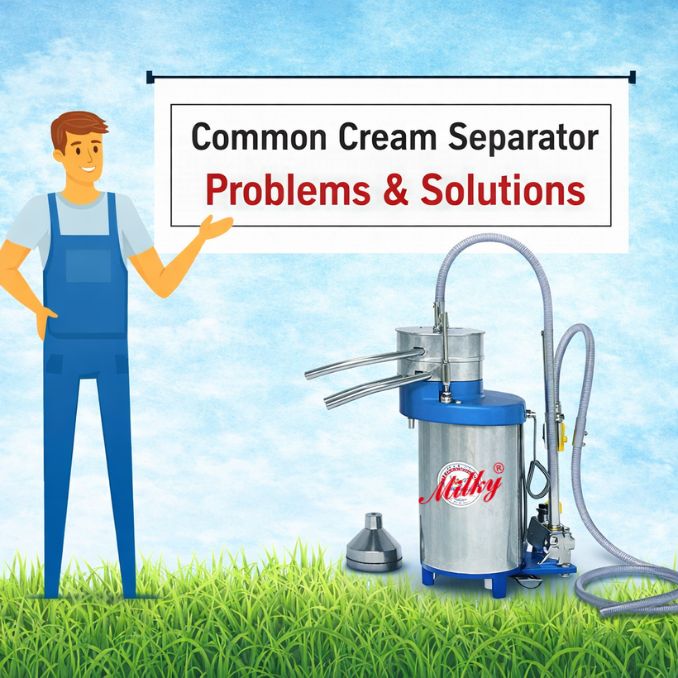
Quick Summery: The most common cream separator problems are thin or watery cream, excessive vibration, milk leaking from the bowl, the machine failing to reach full speed, and milk passing through too fast without separating. Most of these issues come down to milk temperature, disc assembly, worn seals, or lubrication — and the majority can be fixed at home without professional help or expensive parts.
If you’ve landed here because your cream separator is producing watery cream, shaking like it’s about to fall apart, or leaking all over your workbench — you’re in exactly the right place. Maybe you’re also wondering why your cream separator isn’t separating properly, or how to fix a cream separator that vibrates. These are the exact questions this guide answers, drawn from real experience working with dairy equipment and the hard-won lessons of farmers and homesteaders who’ve troubleshot these same machines.
I’ll be honest — the first time my separator started spitting out thin, barely-there cream, I assumed I’d broken something expensive. Turns out I just hadn’t warmed the milk properly. That’s the thing about cream separator machine problems: they look alarming, but they’re usually fixable once you know where to look.
Let’s get into it.
Why Your Cream Separator’s Performance Matters More Than You Think
When a cream separator is dialed in correctly, it’s a genuinely impressive machine. A well-maintained unit pulls cream with 35–45% butterfat content out of fresh milk cleanly and consistently, leaving skim milk ready for other uses. When something goes wrong, you’re not just dealing with frustration — you’re losing real product with every batch you run.
Whether you’re processing milk from a couple of backyard cows, running a small homestead dairy, or managing a larger farm operation, the core mechanics are the same. Milk enters a spinning bowl, centrifugal force pushes heavier skim milk outward, lighter cream rises toward the center, and both exit through separate spouts. Disrupt any part of that chain and the results show up immediately in your output.
Problem 1: Thin, Watery Cream — or Fat in Your Skim Milk
This is far and away the most common complaint, and it’s also the most fixable. If your cream won’t whip, pours like whole milk, or your skim milk has a noticeable fat sheen on top, here’s where to start.
Your milk temperature is probably off. This catches more people than almost anything else. Cream separation depends on fat globules being fluid enough to respond to centrifugal force. Cold milk is too viscous — those fat globules don’t move the way they need to. Warm your milk to 95–104°F (35–40°C) before processing. Yes, it adds a step. Yes, the difference in cream yield is absolutely worth it.
You’re losing speed mid-batch. On hand-crank separators especially, people start with great pace and slow down as their arm tires — completely natural, but it quietly tanks your separation quality. Centrifugal force depends entirely on consistent RPM. If you’re flagging halfway through, process smaller batches so you can maintain speed the whole way through.
The discs need attention. The conical discs stacked inside the bowl are where the actual separation happens. Fat residue, dried milk, or even one disc placed out of order during reassembly will drop your separation efficiency fast. Disassemble everything, clean each disc individually, and put it back together following your manual’s diagram exactly. Tedious? Yes. Effective? Every single time.
Adjust the cream screw. Most separators have a regulating screw or valve controlling the ratio of cream to skim milk output. If it’s set too loose, fat bleeds into your skim milk spout. Tighten it gradually and run small test batches until your cream reaches the thickness you want.
Problem 2: Excessive Vibration or Strange Noises
A cream separator running properly has a smooth, consistent hum. When it starts rattling, grinding, or shaking aggressively, that’s your machine communicating a problem you shouldn’t ignore.
Check your assembly first. After cleaning, it’s genuinely easy to put the bowl back together in the wrong sequence — especially if you were interrupted mid-task. Even one disc seated incorrectly creates enough imbalance to shake the whole unit. Disassemble completely and rebuild from scratch, being deliberate about each component.
Is your work surface level? A separator spinning at high RPM amplifies any instability beneath it. Even a slight tilt on your workbench creates real vibration. Put a spirit level on the surface, check it, and adjust. Sometimes that’s genuinely the whole fix.
Consider the bearings if it’s an older machine. If vibration has gradually crept up over months rather than appearing suddenly, worn spindle bearings are the most likely culprit. This is one repair where I’d say don’t guess around it — contact your manufacturer or a dairy equipment service professional. Replacement bearings exist for most popular models, but the job takes mechanical confidence to do correctly.
Problem 3: Leaking Milk or Cream
Leaks feel urgent because they are. You’re losing product, making a mess, and whatever’s causing the leak will almost certainly get worse before it gets better.
Start with your seals and O-rings. These rubber components wear down from repeated use, heat cycling, and cleaning chemicals. A seal that looks almost fine might not hold under the pressure of a spinning bowl. During every cleaning session, inspect each seal carefully. If anything looks cracked, compressed, or brittle, replace it. Seal kits are inexpensive and available for virtually every separator model on the market.
Did you tighten everything properly? After reassembly, the bowl lock ring and top nut need to be firmly — not just finger-tight — secured. A quick or careless reassembly is one of the most common sources of leaks, and it’s also the easiest to fix.
Look for cracks in plastic parts. Temperature shock — like pouring boiling water over a cold bowl — and general wear can leave hairline cracks that are easy to miss in dim lighting. Inspect your bowl and spout components in good light before every use. A cracked part needs replacing, not a workaround.
Problem 4: The Machine Won’t Reach Operating Speed
An electric separator that struggles to spin up, or a hand-crank model that feels unusually heavy and stiff, is dealing with a friction or power delivery problem.
When did you last lubricate it? Most separators have lubrication points — spindle, gears, drive shaft — that need regular attention. If you’ve been running the machine without keeping up with this, friction accumulates and performance suffers. Check your manual for the correct lubrication schedule and always use food-grade lubricant on any point that could contact milk.
Check the drive belt on electric models. A stretched, glazed, or cracked belt slips under load, meaning the motor runs but the bowl never gets to full speed. Inspect it visually and replace it if it looks worn. Belt replacement is usually a simple, inexpensive job.
If it’s the motor, get professional help. Tripped breakers, loose wiring, and overheating motors all point toward electrical issues. This is one area where DIY troubleshooting can create bigger problems than it solves. Call your manufacturer’s support team or a qualified electrician.
Problem 5: Milk Flowing Through Too Fast Without Separating
If your milk races through the machine and comes out the other side barely changed, the problem is almost always one of two things.
You’re feeding it too fast. Every separator has a rated flow capacity. Exceed it and the centrifugal process simply can’t keep up — milk exits before the fat has time to separate. Slow your feed rate down and use the inlet valve if your machine has one.
You started milk flow too early. Milk should never enter the bowl until the machine has fully reached operating speed. Starting your feed while the bowl is still spinning up means centrifugal force isn’t yet strong enough to do its job. Full speed first, then open the flow.
The Maintenance Habit That Prevents Most Problems
Here’s the honest truth: the majority of cream separator problems I’ve seen could have been avoided with consistent cleaning and maintenance. After every use, fully disassemble the bowl, rinse with warm water, wash with food-safe dairy detergent, rinse thoroughly, and let everything dry before storing. Don’t leave milk residue sitting on the discs — it hardens, harbors bacteria, and quietly degrades your separation quality over time.
Once a month, do a deeper inspection. Check your seals, lubrication points, drive components, and disc condition. If something looks worn, replace it before it fails mid-batch. Keep a simple log of any sounds, performance changes, or parts you’ve replaced — it makes future troubleshooting dramatically faster.
When You Actually Need a Professional
Most cream separator repairs are well within reach for anyone comfortable with basic mechanical work. But some situations genuinely call for outside help: persistent motor issues, commercial-grade bearing replacement, or anything involving electrical systems. Trying to push through these without the right knowledge can turn a manageable repair into a much more expensive one.
If you’re unsure, contact your separator’s manufacturer directly. Most brands offer solid technical support, and genuine replacement parts are usually available at reasonable cost.
Conclusion
Cream separator problems look worse than they are. Poor separation, vibration, leaks, speed issues, excessive flow — nearly every one of these has a straightforward cause and a fix you can handle yourself with a little patience and the right information.
Work through the issues methodically, keep up with your maintenance routine, and your machine will serve you reliably for years. If you’ve hit a problem that isn’t covered here, leave it in the comments — I read everything and I’ll do my best to help. And if this guide saved you a wasted batch or an unnecessary service call, share it with someone in your dairy community who might need it.
Sometimes a problem needs more than a blog post — it needs an expert who’s actually worked on the machine in front of them. At Mahesh Eng. Works, we’ve been repairing, servicing, and supplying dairy equipment for years. Whether your separator needs a quick fix, a replacement part, or a full service, we’ve got you covered.

Mahesh Eng. Works
Written by Mahesh Engineering Works, specializing in precision dairy machinery and hygienic stainless-steel dairy solutions for small and medium dairy plants in India.