

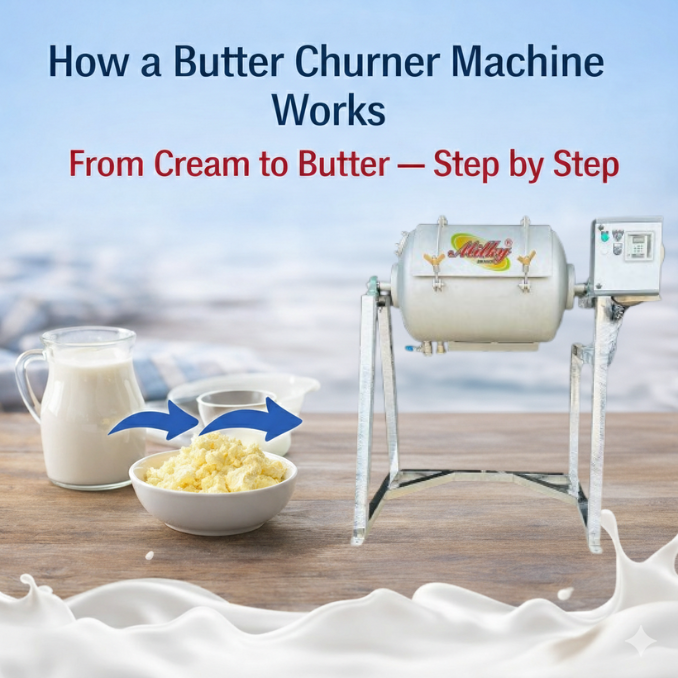
Butter making has evolved from traditional hand churning to efficient mechanical systems that save time, labor, and improve consistency. Today, dairy units—whether small farms, village cooperatives, or commercial plants—rely on the butter churner machine to produce high-quality butter at scale.
In this guide, we’ll explain how a butter churner machine works, step by step, in simple language. We’ll also cover different types of butter churners, including electric butter churners, buttermilk churners, and butter churner machines for home and dairy units, while answering common questions people ask before investing in one.
What Is a Butter Churner Machine?
A butter churner machine is a dairy processing machine designed to convert cream into butter through controlled agitation. During churning, fat globules in cream collide, break their membranes, and bind together to form butter grains, separating from liquid buttermilk.
Modern churners are widely used because they:
- Reduce manual effort
- Ensure uniform butter quality
- Improve butter yield
- Maintain better hygiene
Butter churners can be used at home level, small dairy units, or large dairy plants, depending on capacity and design.
Basic Principle Behind Butter Churning
To understand how a butter churner works, you need to understand one simple principle:
Mechanical agitation breaks fat globules in cream, allowing them to cluster into butter while releasing buttermilk.
When cream is agitated at the right speed and temperature:
- Fat globules lose their protective membranes
- Fat particles stick together
- Solid butter separates from liquid buttermilk
This process is the same whether you use a traditional churn or an electric butter churner—only the method of agitation changes.
Main Components of a Butter Churner Machine
Most butter churner machines share the following core components:
Churning Drum or Bowl
A cylindrical or oval container where cream is added. It rotates or oscillates to create agitation.
Agitator / Paddle System
Helps churn cream evenly and speeds up butter formation.
Drive System
Includes a motor (in electric models), gearbox, and belt or chain mechanism.
Buttermilk Outlet
Allows easy draining of separated buttermilk after churning.
Control Panel (in Electric Butter Churners)
Used to control speed, timing, and direction of rotation.
How Does a Butter Churner Machine Work? (Step-by-Step)
Step 1: Cream Preparation
Fresh cream is first separated from milk using a cream separator. For best results:
Cream fat content is usually 35–40%
Cream temperature is maintained between 10–15°C
This temperature range ensures proper fat aggregation during churning.
Step 2: Loading the Cream
The prepared cream is poured into the butter churner machine.
The drum is typically filled up to 30–40% of its capacity, allowing enough space for agitation.
Overfilling can reduce efficiency and delay butter formation.
Step 3: Churning Begins
Once the machine starts:
- The drum rotates or oscillates
- Cream is continuously agitated
- Fat globules begin to collide
In an electric butter churner, motor-driven rotation ensures uniform churning without manual effort.
Step 4: Butter Formation
As churning continues:
- Fat globules stick together
- Butter grains become visible
- Liquid buttermilk separates
This stage usually takes:
- 10–20 minutes for electric churners
- Longer for manual or traditional methods
Step 5: Buttermilk Separation
Once butter grains form:
The churner is stopped
Buttermilk is drained through the outlet
The remaining butter mass is then ready for washing or further processing.
This is why butter churners are often called buttermilk churners, as they efficiently separate and collect buttermilk as a by-product.
Step 6: Butter Washing (Optional but Recommended)
Cold water is added and churned slowly to:
- Remove residual buttermilk
- Improve butter shelf life
- Enhance flavor and texture
This step is especially important for commercial dairy units.
Types of Butter Churner Machines
1. Manual Butter Churner Machine
- Operated by hand
- Suitable for very small batches
- Low investment, higher labor
Still used in rural and household setups.
2. Electric Butter Churner
An electric butter churner uses a motor for consistent and faster churning.
Best for:
- Small and medium dairy units
- Commercial butter production
- Continuous and hygienic operation
Key advantages:
- Uniform butter quality
- Reduced labor
- Better output control
3. Butter Churner Machine for Home
A butter churner machine for home is compact and easy to use.
Ideal for:
- Home dairy enthusiasts
- Small farm households
- Trial or specialty butter production
These machines usually have smaller capacity but follow the same working principle as industrial models.
Butter Churner vs Traditional Hand Churning
| Feature | Traditional Churning | Butter Churner Machine |
|---|---|---|
| Time Required | High | Low |
| Labor | Manual | Minimal |
| Butter Quality | Inconsistent | Uniform |
| Hygiene | Difficult | Better control |
| Output | Limited | Scalable |
For growing dairy units, switching to a butter churner machine significantly improves productivity.
FAQ’s
How long does a butter churner machine take to make butter?
Most electric butter churners take 10–20 minutes, depending on cream quality, fat content, and temperature.
Can a butter churner machine be used at home?
Yes. A butter churner machine for home is specially designed with small capacity, low power consumption, and easy operation.
What is the difference between a butter churner and a buttermilk churner?
There is no functional difference. A buttermilk churner refers to the same machine, highlighting its ability to separate buttermilk during butter making.
What cream is best for butter making?
Fresh cream with 35–40% fat content gives the best butter yield and texture.
Is an electric butter churner better than manual?
Yes. An electric butter churner offers:
- Faster processing
- Consistent results
- Less physical effort
- Better hygiene
Benefits of Using a Butter Churner Machine in Dairy Units
- Higher butter yield
- Consistent quality batch after batch
- Reduced processing time
- Improved hygiene standards
- Easy handling of buttermilk
- Suitable for scaling production
These advantages make butter churners essential equipment for modern dairy operations.
Maintenance Tips for Long Machine Life
- Clean the drum after every batch
- Avoid overloading
- Maintain proper cream temperature
- Lubricate moving parts as recommended
- Check motor and belts periodically
Proper maintenance ensures smooth operation and long service life.
Final Thoughts
Understanding how a butter churner machine works helps dairy owners make informed decisions about butter production. Whether you operate a small dairy unit, a village cooperative, or even want a butter churner machine for home, the working principle remains the same—controlled agitation to separate butter and buttermilk efficiently.
With rising demand for quality dairy products, investing in the right electric butter churner or buttermilk churner can significantly improve productivity, hygiene, and profitability for your dairy business.
If you’re looking to improve butter quality, reduce manual labour, and achieve consistent output, a butter churner machine from Mahesh Eng. Works is a smart investment. We design our machines for small dairy farms, cooperative societies, and commercial dairy plants, ensuring hygienic processing and reliable performance.