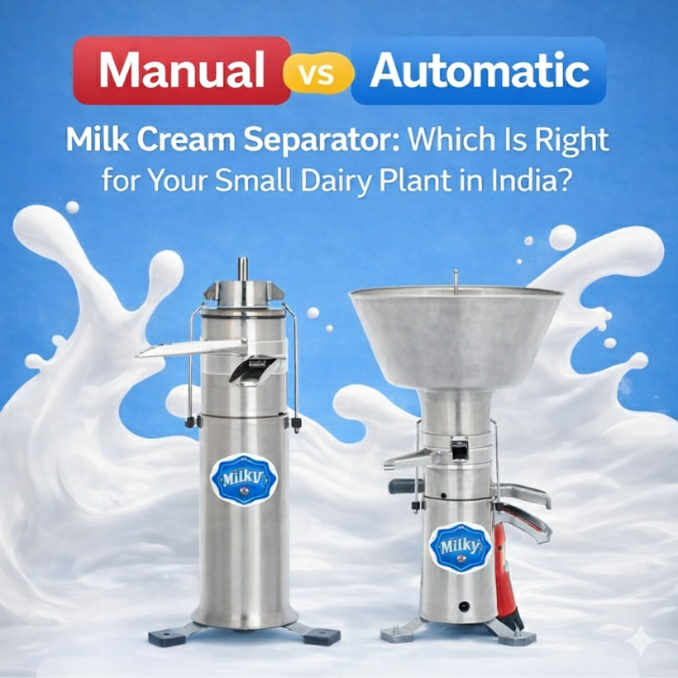
If you run a small dairy plant in India, you already know this—every drop of fat matters. Whether you’re selling cream, making ghee, or supplying butter, the way you separate cream from milk has a direct impact on your daily income.
There’s no one-size-fits-all answer. The right choice depends on your milk volume, manpower, power supply, and where you want your dairy business to go. In this guide, we’ll break it down in simple, practical terms so you can decide what actually works for your setup.
Why Cream Separation Is So Important in Small Dairies
Cream separation is not just a technical step in milk processing—it’s a critical business decision for small dairies. Efficient separation directly impacts profitability by extracting more cream from the same quantity of milk, improving the quality of value-added products like ghee and butter, and minimizing fat losses during processing. It also helps maintain consistent product quality, which is essential for building customer trust.
For small dairy plants handling 500 to 10,000 litres per day, even a slight improvement in fat recovery can translate into significant gains by the end of the month. This is why selecting the right milk cream separator machine is far more important than many dairy owners initially realize.
What Is a Manual Milk Cream Separator?
A manual milk cream separator is the traditional option. It works using hand power—you turn the handle, the bowl spins, and cream separates from the milk.
Where Manual Separators Make Sense
Manual machines are still useful in certain situations:
- Very small village dairies
- Household-level milk processing
- Areas where electricity is unreliable or unavailable
They’re affordable, simple to understand, and easy to move around.
The Downsides You Should Know
As milk volume increases, problems start to show:
- It takes physical effort to operate
- Output depends on how fast and evenly someone turns the handle
- Cream recovery can vary from batch to batch
- Hygiene control becomes difficult with frequent handling
For dairies processing more than a few hundred litres per day, manual separators often become a bottleneck.
What Is an Automatic Milk Cream Separator?
An automatic (electric) milk cream separator does the same job—but with a motor instead of muscle power. The bowl rotates at a constant speed, which leads to stable and consistent separation.
Why Many Small Dairies Are Switching to Automatic
Automatic separators are popular because they:
- Handle larger milk volumes easily
- Give uniform cream quality every time
- Reduce dependence on labour
- Save time during peak collection hours
- Meet hygiene and FSSAI expectations more easily
Capacities usually start from around 100 LPH and go well beyond 1000 LPH, making them suitable for growing dairy plants.
When considering this option, it’s important to keep a few factors in mind. Automatic systems require a reliable power supply, and their initial cost is higher compared to manual machines. However, most dairy owners find that the investment is recovered faster than expected, thanks to higher output, improved efficiency, and significantly lower labour costs over time.
Manual vs Automatic Cream Separator: Simple Comparison
Here’s a straightforward comparison without technical jargon:
| Point | Manual Separator | Automatic Separator |
|---|
| Electricity | Not required | Required |
| Daily Capacity | Low | Medium to high |
| Labour Effort | High | Minimal |
| Cream Consistency | Depends on operator | Consistent |
| Hygiene Control | Limited | Much better |
| Expansion Ready | No | Yes |
Milk Cream Separator Machine Price in India
Price is often the first question—and rightly so.
Manual Cream Separator Price
- Usually starts from ₹5,000
- Goes up to around ₹15,000–18,000
- Best for very small operations
Automatic Cream Separator Price
- Starts from around ₹16,000
- Can go up to ₹1,00,000+, depending on capacity and build
- Better suited for commercial dairy use
Lower price doesn’t always mean lower cost.
Manual machines may seem cheaper, but over time, labour, time, and fat loss can cost you more.
Which One Is Better for Small Dairy Plants in India?
A manual cream separator can be suitable if your dairy processes less than 300 litres of milk per day, electricity supply is unreliable, or you don’t plan to expand your operations beyond the current size.
On the other hand, an automatic cream separator is a better choice if you process 500 litres or more daily, sell cream, ghee, or butter, want consistent product quality, plan to grow your dairy business, or wish to reduce daily manual workload.
A Real-Life Example
Here’s a real-life example to put things in perspective. A village dairy processing around 200 litres of milk per day can easily manage with a manual cream separator. However, a small dairy plant handling 800 to 1,000 litres daily often faces challenges such as long processing hours, exhausted workers, and inconsistent cream yield.
Once such dairies switch to an automatic cream separator, the benefits become clear: processing becomes faster, cream recovery improves, workers have more time for other tasks, and overall profits increase.
Common Mistakes Dairy Owners Make
- Buying the cheapest machine without checking output
- Ignoring future expansion plans
- Choosing capacity based only on price
- Not asking about after-sales service
Conclusion:
Choosing between a manual and an automatic milk cream separator ultimately depends on your daily milk volume, long-term business goals, and budget. Manual separators remain a practical option for very small operations or locations with unreliable electricity.
In contrast, automatic separators are often the wiser investment for small dairy plants looking to improve efficiency, ensure consistent product quality, and support business growth. Whatever machine you choose, make sure it aligns with your operational needs — the right equipment can have a major impact on both productivity and profitability.
If you’re planning to start or upgrade a small dairy plant,
Mahesh Eng. Works is your trusted partner. As a leading dairy machinery manufacturer in India, Our expert team can help you choose the right cream separator and other dairy equipment to maximize efficiency, product quality, and profitability.