

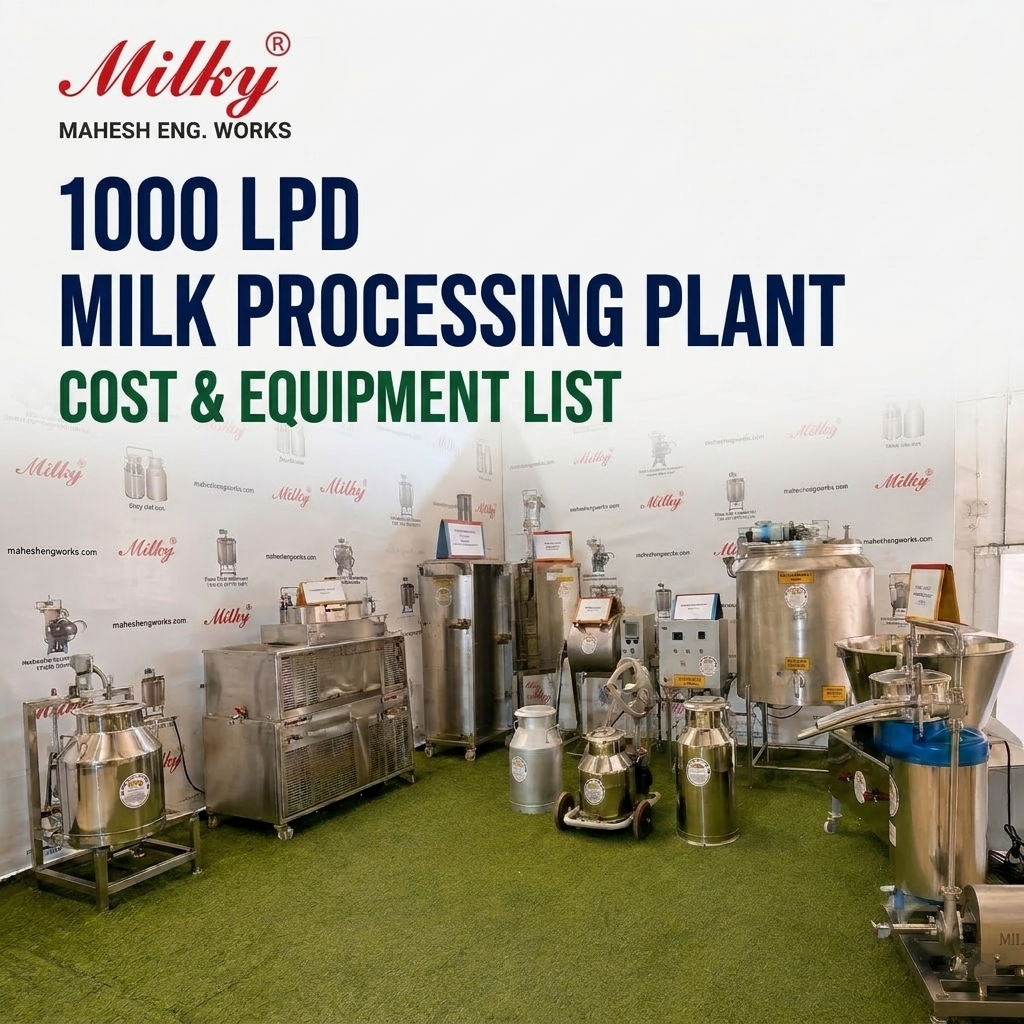
Quick answer: A 1000 ltr (1000 LPD) milk processing plant handles about 125 LPH over an 8-hour shift. Core equipment is a bulk milk cooler, batch pasteurizer, pouch packing machine and milk analyzer, plus a boiler, chilled-water unit and CIP set. Our published ex-works ranges are ₹1,95,000–₹5,50,000 for a 1,000–2,000 L bulk milk cooler and ₹95,000–₹1,80,000 for an optional 100 LPH homogenizer. The total depends on automation, pasteurizer type and utilities, so request an itemised quote. A State FSSAI licence is required.
India is the world’s largest milk producer, contributing about 24% of global milk production, and many new dairy businesses start with a 1,000 litres-per-day (LPD) pasteurised milk unit. The 1000 ltr milk processing plant cost depends on the equipment you choose, how automated it is, and what utilities your site already has. This guide lists the equipment, sizes it for 1,000 litres a day, and shows which costs to budget before you request quotations.
1. What Does “1000 LPD” Mean?
LPD is litres per day; LPH is litres per hour. Over an 8-hour shift, 1,000 LPD is roughly 125 LPH. Over 10 hours it is about 100 LPH. Equipment is sized on LPH and batch size, not on LPD.
2. Process Flow and Layout
Flow: Milk reception and weighing → quality testing (fat, SNF, adulteration) → chilling and raw storage → standardisation (cream separator, if used) → pasteurisation → optional homogenisation → cooling → pouch packing → cold storage.
Layout: Plan a one-way flow: raw milk reception on one side, processing in the middle, packing and cold store on the clean side. Keep raw and pasteurised zones separate to avoid cross-contamination, and place the boiler, chiller and generator outside the processing hall.
3. Equipment List for a 1000 Ltr Milk Processing Plant
| Section | Equipment | Sizing for 1000 LPD |
|---|---|---|
| Reception | Weigh bowl, receiving tank, strainer | 500–1,000 L |
| Testing | Milk analyzer, lab basics | 1 unit |
| Chilling and raw storage | Bulk milk cooler (chills and stores raw milk) | 1,000–2,000 L |
| Standardisation | Cream separator (optional) | Around 125 LPH class |
| Heat treatment | Batch pasteurizer | 500–1,000 L per batch |
| Homogenisation | Homogenizer (optional) | Around 100–150 LPH |
| Pasteurised holding | Milk storage tank as balance or holding tank (optional) | 500–1,000 L |
| Packing | Pouch packing machine | Matched to pasteurizer output |
| Utilities | Boiler, chilled-water or ice-bank unit, CIP set, stabiliser, backup power | Sized to the line |
A bulk milk cooler already stores raw milk, so a separate raw-milk tank is needed only if your site design requires one.
4. Cost of a 1000 Ltr Milk Processing Plant
Disclosure: Mahesh Eng. Works publishes this guide and manufactures several of the machines listed. Prices below are indicative ex-works ranges from our published price guides, exclude GST at 18%, and vary by specification and region. Request a written itemised quote before you buy.
| Equipment | Sizing for 1000 LPD | Indicative price (ex-works) |
|---|---|---|
| Bulk milk cooler | 1,000 L | ₹1,95,000 – ₹3,80,000 |
| Bulk milk cooler | 2,000 L | ₹2,95,000 – ₹5,50,000 |
| Homogenizer (optional) | 100 LPH | ₹95,000 – ₹1,80,000 |
| Batch pasteurizer | 500–1,000 L per batch | Quote on request |
| Cream separator | ~125 LPH class | Quote on request |
| Pouch packing machine | Matched to line | Quote on request |
| Milk analyzer | 1 unit | Quote on request |
| Boiler, chilled water, CIP, backup power | Per site | Quote on request |
Sizing note: A good rule is BMC capacity = 1.2–1.5 × peak daily collection. For 1,000 L/day that is 1,200–1,500 L, so a 1,000 L unit is tight and a 2,000 L unit leaves room to grow.
What moves the price of each item
| Item | Main price drivers |
|---|---|
| Batch pasteurizer | Batch size, SS 304 vs SS 316, heating method (steam, hot water or electric), insulation, agitator, controls |
| Cream separator | LPH capacity, bowl material, electric vs hand operation, automation |
| Pouch packing machine | Pouch size, pouches per hour, filling accuracy, date coding |
| Milk analyzer | Parameters measured, sensor type, accuracy, printer and software |
| Boiler and utilities | Steam capacity, fuel type, chilled-water or ice-bank capacity, CIP design |
Detailed price guides: bulk milk cooler and homogenizer.
5. What Decides the Final Plant Cost
- Automation level: Manual or semi-automatic lines cost less than PLC-controlled lines.
- Steel grade: SS 304 is the standard for milk-contact parts. SS 316 suits acidic products.
- Pasteurizer type: Batch units suit small volumes. Continuous HTST systems cost more.
- Product plan: Toned milk, flavoured milk or curd each add equipment.
- Site readiness: Existing power, water and building cut project cost.
6. Costs Buyers Often Miss
- Steam boiler and fuel arrangement
- Chilled water or ice-bank system for cooling after pasteurisation
- Three-phase electrical work, stabiliser and generator
- SS piping, valves and CIP connections
- Civil work, drainage, flooring and effluent handling
- Installation, commissioning and staff training
- Licences, lab testing and working capital for milk purchase
7. Licence Needed for 1000 LPD
A dairy unit that handles or processes 501 to 50,000 litres of milk per day needs a State FSSAI licence, not a basic registration. See the FSSAI licensing system to apply.
8. Mistakes to Avoid
- Sizing on LPD, not LPH: The pasteurizer then bottlenecks the line.
- Undersized chilling: Milk spoils before processing.
- Ignoring utilities: The boiler and chilled-water costs surprise you.
- Skipping service checks: Confirm a technician within 100 km and spare-parts availability.
- Comparing only the lowest price: Compare specification, warranty and service support.
FAQs
What is the cost of a 1000 ltr milk processing plant in India?
The cost depends on pasteurizer type, automation level, packing machine and utilities such as the boiler and chilled-water system. Individual units such as bulk milk coolers and homogenizers range from ₹95,000 to ₹5,50,000 depending on capacity. For a full itemised figure, request a project quotation based on your milk volume and products.
How many litres per hour is a 1000 LPD plant?
About 125 LPH on an 8-hour shift, or 100 LPH on a 10-hour shift.
Which licence is required for a 1000 LPD dairy plant?
A State FSSAI licence. Dairy units handling 501 to 50,000 litres per day fall in this category. Units up to 500 litres per day need only a registration, and units above 50,000 litres per day need a Central licence.
What temperature is milk pasteurised at?
Under the FSS regulations, pasteurisation means heating every particle of milk to at least 63°C for at least 30 minutes, or to at least 71.5°C for at least 15 seconds, and then cooling it to 10°C or below. See the pasteurisation guidelines.
Is a homogenizer compulsory?
Not for every plant. Whether you need one depends on your product and shelf-life target. It helps reduce fat separation in packed milk.
Batch or HTST pasteurizer at 1000 LPD?
A batch pasteurizer heats milk in a jacketed vat and suits small, intermittent volumes. An HTST pasteurizer gives a continuous flow and suits higher, steady throughput.
What does a 1000 ltr milk processing plant project report include?
A project report typically covers plant capacity, machinery list, utilities, building area, cost estimate, operating cost, manpower and licences. Contact us for the machinery list and sizing for your capacity.
Is any subsidy available?
Support varies by state and project. The NABARD DEDS scheme was discontinued in 2020. See our guide to dairy subsidies and schemes.
Conclusion
A 1000 ltr plant is a manageable first project when you size equipment on LPH, budget for utilities and licences, and compare itemised quotes. Start with the bulk milk cooler and pasteurizer, then add optional equipment as your product range grows.
Ready to plan your plant? Contact Mahesh Eng. Works for an itemised 1000 ltr project quote, or explore our turnkey dairy plant manufacturer in India solutions.

MILKY BRAND
Mahesh Panchal
CEO | Dairy Equipment Manufacturer & Exporter at Mahesh Eng. Works
Mahesh Panchal brings over 30 years of experience in the dairy machinery industry. At Mahesh Eng. Works, he is associated with dairy machinery manufacturing, milk processing equipment and dairy equipment exports. The company’s blog shares practical insights to help dairy farmers, milk processors and businesses understand dairy equipment and milk processing solutions.